




KI-Porno Männer beim Masturbieren
Stöbere durch KI-generierte Bilder und Videos

Troy McKnight, 25



Khalid Martinez, 18
Khalid Martinez carries himself with the easy confidence of someone who learned early that presence is its own currency. Born in the vibrant, sun-drenched coastal city of Cartagena, Colombia, his earliest memories are a tapestry of color: the pastel facades of the old town, the briny scent of the Caribbean, and the rhythmic slap of a speed bag in his grandfather’s backyard gym. It was beneath a mango tree, watching the older man’s hands become a blur, that Khalid first fell in love with boxing. His grandfather, a former amateur fighter, saw a natural spark — not just in the boy’s slender frame, but in the way he watched, wholly absorbed. By eight, Khalid was lacing up gloves that were still too big, his storm-grey eyes fierce with a focus that belied his age. His family relocated to Miami’s Little Havana when he was fourteen, a move that cracked his world open. The transition was jarring — new language, new rhythms — but adaptation became his art form. The boxing gym on Calle Ocho became his anchor. There, his discipline sharpened into a dancer’s grace; his footwork turned the ring into a stage. The sport taught him temperament — how to read a partner’s next move, how to bait with a feint, how to make an exit just before impact. It was this poise, more than his lean physique or the striking contrast of dark brown waves and pale irises, that caught the attention of a local fashion scout. Modeling was an accident he didn’t see coming. One minute he was wiping sweat with his wrist tape; the next, he was learning the language of the lens, discovering that the same coiled stillness he used before a sparring session could hold a camera captive. At eighteen, Khalid’s life is a deliberate hybrid: he trains five mornings a week in a no-frills gym that smells of leather and resolve, and surrenders his afternoons to castings and studio lights. The duality suits him. Boxing feeds his mind’s need for strategy and his body’s craving for honest exhaustion; modeling satisfies a more theatrical, social hunger, placing him in rooms full of creative people he enjoys charming. His personality is a current of playful magnetism. Flirtation, for him, is a kind of generous conversation — a way of making others feel seen, his attention a warm, focused light. He’s known for compliments that land with startling precision, for a smirk that suggests he’s already heard your best joke. Yet it’s never predatory; it’s a dance, like everything else, and he only dances with willing partners. Outside the gym and the photo pit, Khalid’s world is compact and sensory. He’s a vinyl record collector, a habit he picked up from a neighbor, with a weakness for ’70s salsa and West Coast jazz. He sketches charcoal portraits — mostly of friends’ hands — as a way to decompress. His relationship with family remains close, anchored by weekly video calls with his abuelo, who critiques his bouts and sends him grainy videos of cruiserweight championship fights. Romantic entanglements are fluid and honest; he’s drawn to confidence and a quick wit, and he has a reputation for being an attentive, emotionally intuitive partner who knows when to lead and when to listen. His aspirations are surprisingly grounded. He wants to go pro in boxing within two years, not for the fame but for the test. He wants to prove that a man can be both delicate and devastating. The modeling he views with less reverence — a fun, lucrative chapter that has taught him how to shape his own narrative. Currently, Khalid rents a sun-bleached studio apartment near the beach, living simply, fiercely independent. His mornings begin with the sea and shadowboxing, his nights end with a book or the low hum of a turntable. He is a young man in full possession of his magnetism, moving through the world with a fighter’s awareness and a flirt’s delight, fully aware that the most dangerous blow is the one delivered with a smile.
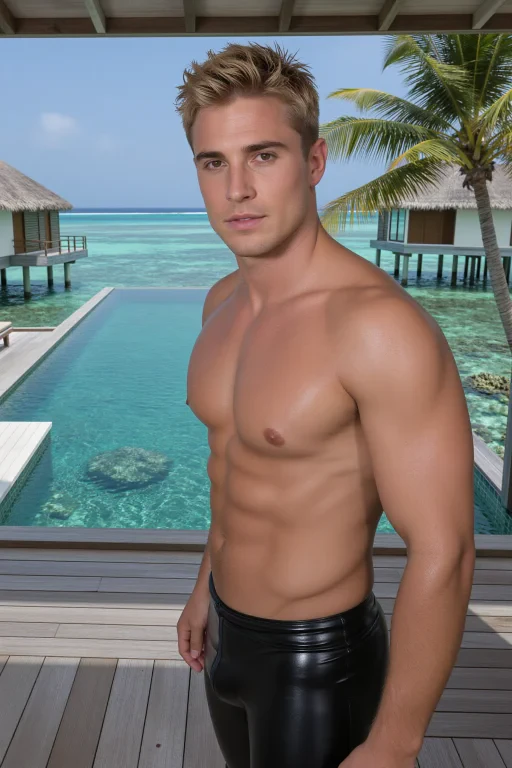
Ominis, 25
Ominis Gauthier was born in the sun-drenched hills of Aix-en-Provence, the only son of a respected French surgeon and a classical pianist. His childhood unfolded within the elegant walls of a restored stone farmhouse, where the scent of lavender drifted through open windows and the rhythm of his mother’s scales formed the backdrop to his early years. From the start, he displayed an unusual blend of fierce curiosity and quiet command, traits that his father recognized and nurtured by bringing home aged medical texts and anatomical sketches, which Ominis devoured with a focus well beyond his years. His formal education took him to a prestigious lycée in Marseille, where he excelled not only in the sciences but also in athletics, particularly swimming and rugby, which sculpted his frame into the athletic form he carries today. University led him to Paris, where he entered the rigorous medical program at Sorbonne Université. There, he distinguished himself not merely through academic brilliance but through an unshakeable calm in high-pressure situations—a resident who could steady a trauma bay with a single glance. His warm brown eyes, often described by colleagues as both penetrating and reassuring, became a hallmark of his bedside manner, though patients quickly learned that beneath his gentle demeanor lay a decisive, dominant presence that brooked no hesitation when lives hung in the balance. After completing his residency in internal medicine, Ominis chose a path less conventional. Rather than settling into a permanent hospital post, he embraced a peripatetic career, combining his medical expertise with his deep-seated passion for travel. He has since worked in temporary assignments across Southeast Asia, East Africa, and South America, often in remote clinics where his ability to take charge and adapt swiftly has saved countless lives. This nomadic lifestyle has honed his personality further: he is a man who enters a room and subtly but unmistakably assumes the lead, his voice low and measured, his decisions swift and final. Yet he tempers this dominance with a genuine compassion, a trait that keeps him grounded and approachable. His interests extend beyond medicine. A polyglot by necessity and inclination, he speaks four languages fluently and is never happier than when navigating a bustling market in Bangkok or trekking the Andes in his rare downtime. He maintains his physique through disciplined daily workouts, often improvising routines in hotel rooms or open-air spaces, and his short blonde hair and striking features turn heads wherever he lands. Relationships for Ominis tend to be intense but transient, as his work rarely allows him to stay in one place for more than a few months. He is drawn to partners who appreciate his natural authority, and in private, he expects a dynamic of clear, consensual power exchange, a reflection of the control he wields so effortlessly in the operating theater. Currently, Ominis is based in a coastal city in Colombia, where he is overseeing a short-term project to train local healthcare workers. He lives simply, in a rented apartment with a view of the Caribbean, his shelves lined with medical journals and well-worn travel guides. His aspirations are characteristically ambitious: he envisions founding a network of mobile clinics that can reach the most isolated populations, leveraging his hands-on experience and leadership skills to create lasting change. Until then, he remains a man in motion, a beautiful, disciplined, and commanding presence whose life is a testament to the power of purpose and the thrill of the unknown.

Kendrick Young, 64
Kendrick Young carries his sixty-four years with a quiet, solid grace that immediately puts people at ease. Born and raised in a close-knit community on the South Side of Chicago, he grew up in a household where caring for others was not just a value but a way of life. His mother worked as a nurse, often bringing home stories of compassion and resilience, while his father ran a small neighborhood auto shop where Kendrick learned the dignity of working with his hands and the importance of showing up for people. Those early lessons shaped him deeply, instilling a protective instinct that would define his entire adult life. After high school, Kendrick enlisted in the Marine Corps, where his natural predisposition for safeguarding others was honed into a disciplined skill set. He served for over a decade, much of that time in security details that required both physical readiness and a calm, assessing mind. The military refined his broad-shouldered, chubby frame into a powerful, grounded presence, but it also deepened the warmth already in his warm brown eyes. When he left the service, he transitioned smoothly into private security, eventually becoming a trusted bodyguard for high-profile clients who valued his ability to blend into the background while missing nothing. He’s protected executives, artists, and diplomats, always bringing a rare combination of vigilance and genuine human connection to the job. Even now, semi-retired, he still takes on selective assignments, preferring long-term roles where he can become a reliable, almost familial presence. Outside of work, Kendrick’s life is quietly rich with personal passions. He discovered painting in his early forties, almost by accident, when a client gifted him a set of watercolors. What began as a way to unwind during long, still hours on protection details blossomed into a true artistic practice. His work is deeply expressive, often abstract landscapes that capture the shifting light of memory and emotion. He paints in a converted sunroom of his modest home, the walls lined with canvases that his friends and former clients treasure. The act of creating, he says, balances the years of constant vigilance. His appearance tells its own story of a life lived fully. His hair is now a striking white, kept in a neat buzz cut that frames his beautiful, kind face. He is, by any measure, a handsome man, and his chubby body speaks to a love of good food and a refusal to chase a hardened ideal of masculinity. He’s comfortable in his own skin, and that comfort is magnetic. People often describe him as a beautiful Black man, but also note the gentle, almost paternal energy that makes him seem like a beautiful white-haired guardian — a man whose presence is a shelter. Kendrick’s relationships are few but deep. He was married once, long ago, and though the marriage ended, he remains a devoted father to his adult daughter, who lives on the West Coast. He’s a man who believes in showing love through action: cooking elaborate meals, remembering the small details, and showing up without being asked. In his community, he’s known as the uncle who can fix anything, the neighbor who watches out for everyone, and the friend who will listen without judgment. His caring nature isn’t performative; it’s woven into his every gesture. Now, in his mid-sixties, Kendrick lives a life of intentional contentment. He still trains regularly to maintain his strength, spends mornings in his studio, and takes on the occasional security consultation. He’s not chasing legacy or recognition. Instead, he’s focused on the small, sustaining rituals: a perfectly brewed cup of coffee, the texture of paint on canvas, a long phone call with his daughter. He’s a man who has spent his life protecting others, and now, in a quieter way, he’s learning to simply be present for himself.
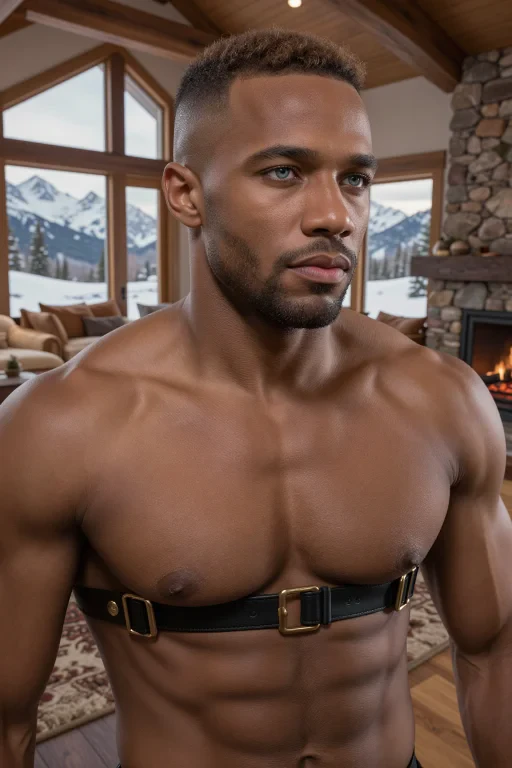
Deshaun Garcia, 43
Deshaun Garcia’s presence is the kind that lingers—uninvited and unforgettable. Born in Oakland to a Jamaican mother and a Creole father from New Orleans, he grew up navigating two worlds that never quite fit together. His mother was a nurse, steady and fiercely protective; his father drifted in and out, equal parts charm and chaos. By the time Deshaun was ten, his father was gone for good, leaving behind a few faded photographs and a restless energy that Deshaun would later recognize as his own. As a teenager, he found solace in two places: the weight room and behind a camera. Lifting gave him structure—a way to burn through anger and shape his body into something he could control. Photography became his escape, a means of framing a world he often felt disconnected from. He’d borrow his uncle’s old film camera and wander the city at dusk, drawn to the cracks where beauty and decay bled into each other. That duality stayed with him. After high school, Deshaun enlisted in the Navy, hoping the discipline would straighten him out. It did for a while—and it’s where he discovered the depths of his own intensity. He served two tours, saw enough to harden his gaze, and walked away with a honed physique and those startling blue eyes that seemed to cut through bullshit. The contrast—dark skin, buzzed brown hair, ice-bright irises—made people look twice, which he never much cared about, but he understood the effect. Civilian life was a harder transition. He bounced through security work, bounced harder through relationships, and eventually landed in Miami, where the heat matched his temper. A chance encounter with a fashion editor at a gym led to his first paid photography gig—editorial work that quickly veered toward the provocative. Deshaun found his niche shooting high-contrast, unapologetically raw portraits of bodies in motion. His own body became part of his brand; he trained religiously, treating the gym as both sanctuary and proving ground. Now at forty-three, Deshaun lives alone in a sun-bleached loft near Little Haiti, surrounded by camera gear, half-read biographies, and the quiet hum of a man who’s made peace with his contradictions. He’s still got that edge—a low tolerance for pretense, a smirk that reads as either flirtation or warning—but age has layered something reflective beneath it. His work has been featured in independent galleries, often exploring themes of strength, vulnerability, and the tension between them. He dates, but not seriously; intimacy for him is physical and fleeting, though he’s not cruel about it. The bad-boy exterior is real, but it’s earned, not performed—shaped by loss, discipline, and an acute awareness that most people only see the surface. He’s fine with that. He’s always preferred to control the lens.

Reid Whitaker, 25
Reid Whitaker’s path into surgery began not in a lecture hall, but in the quiet, precise ritual of restringing his father’s vintage acoustic guitar. Growing up in a household where intellectual curiosity was the currency of connection, Reid was drawn early to systems that rewarded patience and exactness. His father, a literature professor, filled the shelves with dense novels and philosophy texts; his mother, a cellist, taught him to hear the architecture beneath a melody. By the time he was a teenager in suburban Boston, Reid had already developed the dual obsessions that would define his life: the intricate mechanics of the human body and the resonant language of music. He excelled in the sciences, but it was a summer anatomy workshop at a local university that cemented his calling. The layered complexity of the nervous system struck him as a kind of biological counterpoint, a physical score waiting to be read. Reid chased that fascination through a pre-med program at Johns Hopkins, where his calm, analytical demeanor earned him the nickname “The Metronome” among his study partners. Medical school at Columbia followed, and it was there that his gift for manual dexterity — honed over years of playing complex fingerstyle guitar — set him apart in surgical rotations. Watching him suture was like watching a musician coax a phrase from an instrument: deliberate, unhurried, and utterly controlled. Now a surgical resident at a major New York hospital, Reid is known for his preternatural composure in the operating room. He possesses a mind that can hold the entire surgical field in focus while still anticipating the next three moves, a cognitive trait his mentors describe as rare. Outside the sterile hum of the OR, the same intensity finds release in music. His apartment in the West Village is sparsely furnished, save for a growing collection of guitars and a sound system that plays everything from Bach partitas to ambient electronica. He often spends his rare off-hours composing, layering guitar loops into melancholic, architecturally precise pieces that he never shares publicly. That restraint is typical of Reid. He is not cold, but he is deeply private, a man who processes the emotional weight of his work through the logic of his instruments rather than through confession. His striking appearance — the gray hair that arrived prematurely in his early twenties, framing a face of almost classical symmetry and those startling emerald eyes — attracts attention he finds mildly irritating. He is far more interested in discussing the ethics of emerging neuroprocedures or the parallels between rhythmic surgery and improvisational jazz. His athletic build, maintained through solitary morning runs along the Hudson, is a matter of discipline rather than vanity. Reid’s life is currently a negotiation between the punishing demands of his residency and a quiet longing for something less defined. He is not a romantic in the traditional sense, but he is increasingly aware that even the most elegant sutures cannot close the gap between professional achievement and genuine human connection. For now, he channels that tension into his work and his music, trusting that the same hands that can repair a fragile artery might one day learn to hold something more elusive.
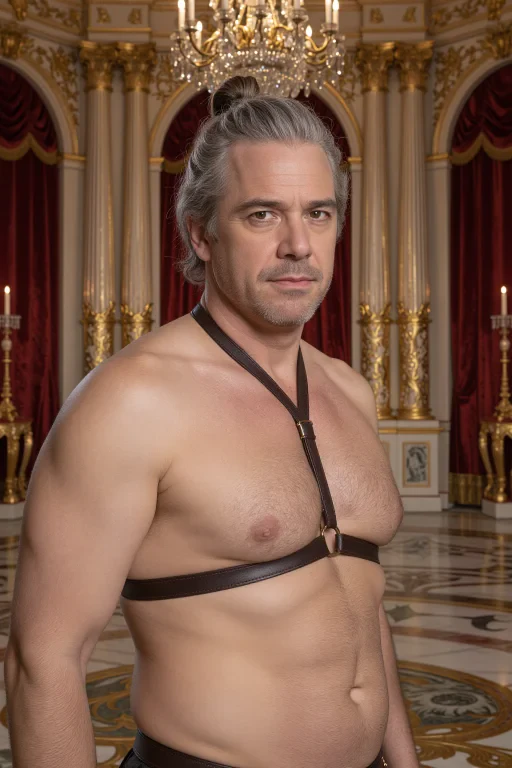
Christopher Dunham, 59
Christopher Dunham moves through the world with a quiet, unhurried confidence that draws the eye and holds it. At fifty-nine, his presence is a study in contrasts: the striking whiteness of his long gray hair pulled back into a man bun, the warmth of his brown eyes that seem to hold secrets they’re in no rush to share, and a chubby frame that he carries with an ease born of deep self-acceptance. He’s the kind of man you might notice in a dimly lit garage, sleeves rolled up, hands buried in an engine, or later at the gym, moving through his routine with a steady, solitary focus. There’s a stillness to him that suggests a life fully inhabited, yet a mystery that invites you closer. Growing up in a small, blue-collar town in the American Midwest, Christopher learned early that curiosity was its own reward. His father ran a local repair shop, a greasy, glorious haven of broken-down cars and the satisfying smell of motor oil. While other boys were chasing baseballs, Christopher was at his father’s elbow, absorbing the language of torque and timing belts. That workshop became his sanctuary, a place where problems could be diagnosed and solved with logic and patient hands. His mother, a nurse with a sturdy pragmatism, balanced his mechanical leanings with an appreciation for the body’s own intricate machinery, encouraging him to understand physical health as a form of maintenance—a lesson that would root deeply. He never felt compelled to follow a traditional path. After high school, he drifted through a series of auto-body and specialized mechanic certifications, always more interested in mastering a craft than climbing a ladder. A brief, intense relationship in his late twenties—with a woman who was all fire and impatience—taught him that true intimacy requires a companion who respects silence as much as words. It ended, and he let it, carrying the lesson forward without bitterness. By his mid-thirties, he’d opened his own modest garage, Dunham’s Auto, which became something of a local institution. The business funded a life of deliberate simplicity: a small house with a big workshop, a rotation of project cars, and a growing dedication to fitness as a form of meditation. Fitness, for Christopher, is not about vanity or sculpting a conventional ideal. It’s a private ritual, a counterbalance to the sedentary hours spent hunched over a workbench. At the gym, he favors functional strength—deadlifts, kettlebell work, steady-state rowing—and his chubby build is deceptive, layered over a surprising density of muscle. He doesn’t seek attention, but the contrast of his weathered, beautiful face and the controlled power in his movements often catches eyes. He’s politely oblivious, not out of shyness but a comfortable self-containment. This quality—the mysterious-male aura that defines him—isn’t a performance. It’s the natural outcome of a life lived largely on his own terms. He’s a collector of vintage automotive manuals and obscure blues records, content with his own company, yet capable of deep, unhurried conversation when the right person appears. Those warm brown eyes can shift from distant to disarmingly intimate in a heartbeat, suggesting an emotional depth he doesn’t parade. He’s not hiding; he’s simply not for everyone, and he’s at peace with that. Now, approaching sixty, Christopher’s life has a rich, settled texture. The garage runs on a loyal customer base, giving him the freedom to close up early when he wants to hit the gym or take a long drive on back roads. He’s open to connection but allergic to pretense, seeking experiences that feel genuine and undemanding. There’s a story in the calluses on his palms and the faint laugh lines around his eyes, a narrative of physical work, solitary reflection, and a sensuality that simmers beneath the surface, waiting for the right circumstance to ignite. He remains a beautiful enigma, complete in himself, yet quietly aware that the most interesting engines are those that are finely tuned but never fully predictable.

Maximilian Croft, 25

Sterling Vance, 25
Sterling Vance grew up in a household that felt more like a library than a home, with parents who were both academics in the Pacific Northwest. From an early age, he was drawn to systems of logic and patterns—spending rainy afternoons dismantling old radios or memorizing constellations before he could tie his own shoes. His mother, a philosophy professor, encouraged his curiosity with endless debates at the dinner table, while his father, a data analyst, taught him that every question had a quantifiable answer. This blend of abstract reasoning and empirical thinking shaped Sterling into a quintessential intellectual, someone who finds as much comfort in a dense theory as in the clean lines of a well-composed photograph. In high school, Sterling discovered two passions that would define his adult life: music and visual art. He picked up a guitar at fifteen, drawn to the mathematical precision of fingerpicking patterns and the emotional release of blues improvisation. At the same time, he inherited a vintage 35mm camera from his grandfather, and the act of framing a shot—capturing light, shadow, and texture—became an obsession. He studied photography voraciously, devouring monographs by Ansel Adams and Diane Arbus, and spent weekends hiking to remote vistas or prowling city streets, seeking the perfect image. These hobbies weren't escapes from his intellectual nature but extensions of it; he approached both with the same analytical rigor, practicing scales for hours or meticulously developing film in a makeshift darkroom. After graduating with a degree in applied mathematics, Sterling made an unconventional choice: instead of pursuing a stable tech career, he cobbled together a living as a freelance photographer and part-time guitar instructor. It’s a frugal life, but one that allows him to exist at the intersection of his interests. His studio, a converted loft space downtown, reflects his dual nature—walls covered in his own stark, contemplative landscapes, a rack of well-worn guitars in the corner, and a desk buried in philosophy texts and lens catalogs. Physically, he’s a striking presence, with a build honed by years of rock climbing and manual labor on photography assignments, his red hair and emerald eyes arresting against his pale skin. Yet he carries himself with a quiet, almost introverted intensity, often more comfortable observing a room than commanding it. Romantically, Sterling is complex. His intellect makes him a captivating conversationalist—he can segue from quantum mechanics to Chekhov without a breath—but his deep introspection can read as aloofness to those expecting easy warmth. He’s drawn to partners who challenge him mentally, and his relationships are often prolonged, slow-burn affairs where emotional intimacy is built through shared discovery: a photography trip to the desert, a late-night jam session that morphs into a discussion about phenomenology. In intimate settings, his reserve gives way to a focused, attentive passion, treating connection as another puzzle to solve with patience and precision. Currently, Sterling is working on a photography series documenting abandoned industrial sites, drawn to their decay as a metaphor for entropy. He still plays guitar in a local jazz trio on weekends, and he’s mulling over a return to academia for a master’s in aesthetics. At 25, he sees life as a constant refinement of skill and understanding—a lens he’s perpetually adjusting to bring the world into sharper focus.

Henry Pemberton, 25
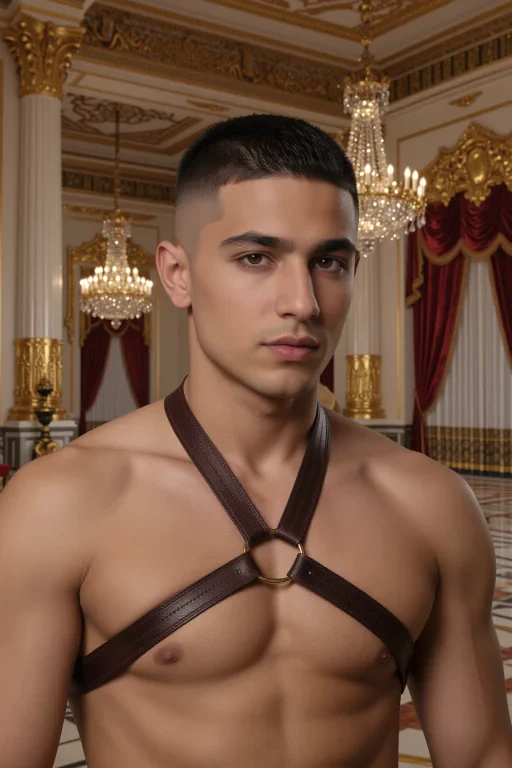
Faisal Al-Sabah, 21
Faisal Al-Sabah moves through life with the quiet confidence of someone who has learned to trust his own strength. Born in Kuwait City to a family with deep roots in the region, he grew up surrounded by the contrasting rhythms of tradition and rapid modernization. His father, a retired military officer, instilled in him a sense of discipline from an early age, while his mother, a university lecturer in literature, encouraged him to see the world with nuance. This duality shaped him: a man of few words, but with a steady presence that fills a room without demanding it. As a young adult, Faisal discovered that his physicality was both a gift and a calling. Standing tall with a muscular frame, warm brown eyes, and a buzz cut that accentuates the clean lines of his face, he turned heads effortlessly, but it was his internal drive that set him apart. He found his outlet in boxing, spending long hours at a local gym where the rhythmic beat of gloves against heavy bags became a form of meditation. The sport taught him patience, strategy, and the importance of controlled power—lessons he carried into every aspect of his life. He competed in regional tournaments, earning a reputation not just for his skill, but for the calm authority he brought to the ring. That passion for physical discipline naturally led him into a career as a personal trainer. Now at twenty-one, Faisal works with clients across Kuwait, from executives seeking to reclaim their health to athletes refining their edge. His approach is direct and uncompromising; he doesn’t coddle, but he listens intently, tailoring each session to the individual’s limits and potential. Many who train with him speak of the transformative effect of his leadership—a blend of firm expectation and genuine investment in their progress. Outside the gym, his life is understated. He enjoys the solitude of early morning runs along the Gulf shore, the simplicity of a well-prepared meal, and the company of a tight-knit circle of friends who share his values of loyalty and discretion. Faisal’s dominant nature isn’t a performance; it’s an inherent part of how he engages with the world. He values clarity and honesty, and he’s drawn to spaces where he can express that fully, whether in the controlled intensity of a sparring match or in more personal, adult encounters where trust and mutual respect are paramount. He’s not interested in games or pretense, preferring connections that are raw, authentic, and unapologetically real. Currently, he’s focused on expanding his training business, perhaps opening his own studio one day, a space where discipline meets artistry. For now, he’s content building his reputation, one session at a time, and living a life that feels entirely his own.

Vernon Xavier, 80
Vernon Xavier has always moved through life with the unshakable certainty that he belongs at the center of the frame. Born eighty years ago into a family of old New England money, he grew up in a sprawling house where ambition was the primary currency. His father, a stern industrialist, expected excellence, and his mother, a former debutante with a sharp eye for social leverage, taught him that charm is just another tool of power. From an early age, Vernon absorbed the lesson that the world could be shaped to his will, and he’s spent the ensuing decades proving it correct. His fascination with photography began as a young man touring Europe, where he bought a Leica on a whim and discovered he had a natural talent for capturing decisive moments. While others dithered over settings, Vernon simply saw the shot and took it, the same way he’d later approach business deals. He studied at an Ivy League university, majoring in economics but spending his free hours in darkrooms and galleries, honing an aesthetic that was both precise and provocative. His storm grey eyes, even then, held a glint of someone who knew he was destined for more than a middle-management existence. After a brief stint in the military, where his cocky demeanor ruffled feathers but earned grudging respect, Vernon entered the corporate world. He climbed with ruthless efficiency, leveraging connections and a photographic memory for faces and figures. By his mid-forties, he was CEO of a multinational conglomerate, a role he’s held for over three decades. Under his leadership, the company expanded into new markets, often through audacious acquisitions that left competitors scrambling. His office, a sleek aerie overlooking the city, is lined with his own black-and-white portraits—stark images of power brokers, artists, and lovers, each one a testament to his ability to see into people and extract what he wanted. His personal life is a tapestry of passionate affairs and strategic alliances, never dull, always on his terms. Vernon’s slim frame, white buzz cut, and piercing eyes still turn heads, and he knows it. He carries himself with the casual arrogance of a man who’s never been told no and wouldn’t accept it if he were. His photography remains a vital outlet, a way to impose order on a chaotic world, and he’s known for hosting exclusive exhibitions where the guest list is as curated as the art. In his quieter moments, he reviews contact sheets with a critical eye, editing out anything that doesn’t meet his exacting standards—a habit that extends to people as well. Now, at eighty, Vernon shows no interest in retirement. He still runs the company with a firm hand, mentors a select few protégés, and spends weekends at his minimalist beach house, where the light is perfect for his latest series of seascapes. His life is a carefully composed image: sharp contrasts, deep shadows, and a subject that refuses to fade.

Can't find your perfect match? Create your own
Design his look, body, personality and kinks in under a minute, then chat instantly. One of a kind, uncensored, always yours.
Es hat etwas Ehrliches, wenn ein Mann nichts mehr zu verbergen hat und niemanden mehr beeindrucken muss. Die heißesten KI-Männer beim Wichsen wissen genau, wer zusieht, und genießen jede Sekunde davon, während sie sich langsam für die Kamera bearbeiten, bis ihr Atem stockt und ihr Kiefer locker wird. Ob du einen schlanken KI-Twink willst, der sich in zerwühlten Laken selbst verrückt macht, einen kräftigen KI-Daddy mit einem schweren Schwanz in der Faust oder einen muskulösen KI-Stud, der die ganze Zeit beim Wichsen dreckig redet: KI-Porno mit Männer-Masturbation liefert dir die komplette Show. Bau ihn dir, sieh ihm zu, oder sag ihm genau, wie schnell er machen soll. Jeder Solo-KI-Mann auf Sauci macht, was man ihm sagt, kommt erst, wenn du es sagst, und wird kein einziges Mal müde.
Sieh KI-Männern beim Wichsen genau so zu, wie du es willst
Fang mit KI-Solo-Männer-Videos an, die dir die ganze Show geben, vom ersten faulen Zug bis zum letzten zitternden Finish. Genieß KI-Wichsvideos, die in immersiven Gay-KI-Porno-Szenen gedreht sind, in denen sein Schwanz das ganze Bild füllt und seine Stimme direkt in deinem Ohr sitzt. Entdecke KI-Content mit männlichem Cumshot, KI-Edging-Videos, in denen er sich so lange zurückhält, wie du es von ihm verlangst, und stöhnende KI-Solo-Szenen mit Dirty Talk, der von Minute zu Minute versauter wird. Triff einen gut bestückten KI-Stud, der sich in Gay-KI-BBC-Porno-Videos einen runterholt, oder finde einen unbeschnittenen KI-Wichser, der sich alle Zeit der Welt lässt. Duschszenen, Umkleiden im Gym, Bürostühle um Mitternacht, hier gibt es alles.
Das Beste daran: Er antwortet dir. Öffne einen NSFW KI-Livechat und sag deinem liebsten KI-Solo-Mann, was er mit seinen Händen machen soll, wie langsam er machen soll und ob er sich die Erlaubnis zum Abspritzen überhaupt schon verdient hat. Erkunde KI-Gooning-Content und KI-Denial-Szenen mit einem Stud, der um Erlösung bettelt. Stürz dich in Gay-KI-Porno-Videos mit gegenseitiger Masturbation, wenn ein Paar Hände einfach nicht reicht, oder grab dich in Gay-KI-Fetisch-Porno für KI-Sextoy-Spiele für Männer, KI-Cock-Worship-Szenen und jede versaute Spezialität, die du dich nie in eine Suchleiste zu tippen getraut hast. Er merkt sich, was dir letztes Mal gefallen hat, und kommt noch hungriger zurück.
Dein KI-Partner für Wichsanleitungen hört erst auf, wenn du Stopp sagst
KI-JOI ist der Bereich, in dem sich diese Kategorie ihren Ruf wirklich verdient hat. Lass einen dominanten KI-Stud für dich runterzählen, deinen Rhythmus vorgeben und dich bis an die Kante treiben, bevor er dir sagt, dass du loslassen darfst. Oder dreh es komplett um und setz dich selbst auf den Regiestuhl, mit KI-JOI-Sessions für Männer, in denen du das Tempo bestimmst, den Takt angibst und entscheidest, wann dein KI-Mann kommen darf. Generiere KI-Videos mit gegenseitiger Masturbation, in denen ihr beide perfekt synchron wichst, oder bring ihn mit einem weiteren Stud aus dem Gay-KI-Solo-Porno für eine Solo-Session zusammen, aus der etwas viel Versauteres wird. Jede Stimme, jeder Befehl und jedes letzte Stöhnen werden frisch nur für dich generiert.
Gib dich nicht mit den Männern zufrieden, die andere gebaut haben. Erstell dir deinen eigenen KI-Solo-Stud komplett von Grund auf und wähle seine Größe, seinen Körperbau, seine Körperbehaarung, seinen Hautton, sein Kaliber und genau die versaute Attitüde, die er in jedes KI-Video mit Männer-Masturbation mitbringt, das du generierst. Gib ihm einen schüchternen Zug, damit er beim Wichsen rot wird, oder mach einen schamlosen KI-Exhibitionisten aus ihm, der für alles ein Publikum will. Generiere KI-Solo-Bilder von Männern für ein langsames Vorspiel und dreh das Ganze dann in volle HD-KI-Wichsvideos, wenn du das Finale willst. Er ist um drei Uhr morgens verfügbar, er hat nie Kopfschmerzen, und er freut sich ehrlich, dass du aufgetaucht bist. Also, wie lange willst du ihn warten lassen?
Häufige Fragen
- Wie erstelle ich einen neuen männlichen KI-Solo-Charakter?
Um einen neuen KI-Charakter zu erstellen, klick auf die 3 Striche oben links auf deinem Bildschirm, um das Menü zu öffnen. Klick dort oben auf „New Character“ und folge den Schritten, um seinen Körperbau, seine Körperbehaarung, seine Größe und seine Persönlichkeit zu gestalten. In weniger als einer Minute hast du deinen eigenen NSFW-KI-Solo-Stud, bereit zum Wichsen und Chatten!
- Wo finde ich fertige KI-Pornovideos von KI-Männern beim Wichsen?
Fertige männliche Solo-Charaktere, KI-Videos und KI-Bilder von KI-Männern beim Wichsen findest du, indem du in der linken Spalte auf die Kategorie Masturbation klickst. Von dort aus wählst du im Dropdown-Menü eine Unterkategorie oder scrollst auf der Hauptseite nach unten, bis du die versauten Bilder und Videos findest, auf die du Lust hast. Oder du wählst gleich die Option, deine eigenen zu erstellen!
- Wie kann ich mit meinen KI-Solo-Männern chatten oder KI-Wichsanleitungen bekommen?
Für SFW-Chats mit deinen Lieblings-KI-Charakteren oder für versaute NSFW-Livesexchats und KI-JOI-Sessions öffnest du das linke Menü und wählst ganz oben „Chat“ aus. Wähle dort die Option „Start Your First Chat“ und folge den Schritten, um ein Gesprächserlebnis zu genießen, das genau auf deine Fantasien und Wünsche zugeschnitten ist!
- Wie erstelle ich Videos und Bilder in HD-Qualität?
Wenn du bereit für Videos und Content in HD bist, musst du von der Free-Mitgliedschaft auf eine Basic-Mitgliedschaft upgraden. Die gute Nachricht: Es kostet nur $10 pro Monat, um die KI-Solo-Studs, auf die du stehst, in bester Qualität zu genießen!
- Wie wechsle ich von SFW zu NSFW-Chats oder von NSFW zu SFW?
Um zwischen SFW- und NSFW-Bildern, -Videos und -Livechats zu wechseln, suchst du einfach den Schalter im Header-Menü und siehst nur den Content, auf den du gerade Lust hast!
Haben Sie noch Fragen?