




Porno Fétiche IA Hommes
Parcours les images et vidéos générées par IA

Hudson Caldwell, 41
Hudson Caldwell carries himself with the quiet assurance of a man who has never had to raise his voice to be heard. At forty-one, he has settled into a life that reflects both discipline and a deep appreciation for the simple, enduring things: a well-tied fly, the heft of a trusted rod, the clean lines of his own body maintained through years of consistent effort. His brown hair is always swept into a neat quiff, a style he adopted in his twenties and never saw reason to abandon, and his storm grey eyes hold a steady, appraising quality that can be unnerving or deeply reassuring depending on which side of his attention you fall. He grew up in a small coastal town in New England, where the Atlantic was a constant, shaping presence. His father, a quiet and methodical man, ran a small engine repair shop; his mother worked as a school administrator. The Caldwell household was not one of effusive affection but of clear expectations and unspoken loyalty. From his father, Hudson learned the value of working with his hands and the meditative patience required for fishing—not as a mere pastime, but as a practice of stillness and precision. Weekends were spent on the water, and it was there, more than anywhere, that he felt a sense of command without conflict. He learned to read the currents, the light on the surface, the subtle tug that signals a strike before it’s truly there. Those early lessons in observation and timing would later prove unexpectedly vital to his professional life. His path to medicine was not a straight line. He attended a state university on an academic scholarship, initially drawn to literature and philosophy, but a sophomore-year anatomy course ignited a fascination with the body as a system—a complex, elegant machine that could be understood, repaired, and optimized. He switched tracks, endured the grueling years of medical school and residency, and emerged as a general surgeon. The operating room suited his temperament. It demanded a clear hierarchy, decisive action, and a mind that remained cool under pressure. He was not a warm, hand-holding type of doctor; his patients found him direct and deeply competent, a man whose confidence inspired their own. Now, with a successful private practice and a partnership in a respected surgical center, he has achieved a level of professional stability that allows him to guard his time jealously. He is not married and has no desire for the conventional trappings of domesticity that his colleagues chase. His relationships are intense but carefully delineated, and he is unambiguous about his nature—a dominant personality who finds fulfillment in the clarity of a dynamic where consent and boundaries are the architecture for a profound, often wordless, understanding. This aspect of his life is not a performance; it is an extension of his natural inclination toward order, control, and a fierce, almost old-fashioned protectiveness over what he considers his own. Outside the hospital, his life narrows to a few cherished pursuits. His athletic build is maintained through a disciplined regimen of weight training and early-morning runs. But his truest sanctuary remains the water. He keeps a small boat docked a short drive from his sleek, minimalist home, and he escapes to it whenever his schedule allows, finding in the rhythmic cast of a line the same focus he once found in the operating theater. He travels occasionally for fly fishing—the rivers of Montana, the flats in the Bahamas—but he is just as content alone on a local lake at dawn. Hudson Caldwell is a man who built his life brick by brick, a beautiful, self-contained fortress where he can be entirely, unapologetically himself.



Tyree White, 32
Tyree White carries himself with the kind of effortless confidence that makes people stop and stare. At thirty-two, he’s a striking figure — a beautiful Black man with a muscular build honed over years of disciplined training, warm brown eyes that hold a glint of mischief, and short black hair that frames a face both rugged and refined. But it’s the edge in his demeanor, that unmistakable bad-boy aura, that truly sets him apart. He’s not a man who follows rules; he rewrites them. Growing up in Atlanta’s West End, Tyree learned early that the world wasn’t going to hand him anything. Raised by a single mother who worked double shifts at a hospital, he spent his teenage years navigating streets that tested his resilience. While some peers drifted toward trouble, Tyree channeled his restlessness into the weight room at a local rec center. The iron became his therapy, a place where he could transform anger into power and uncertainty into muscle. He wasn’t just building a body; he was forging an identity. After high school, Tyree drifted through a series of dead-end jobs — warehouse worker, bouncer, delivery driver — each one fueling his frustration with the nine-to-five grind. A chance encounter with a neighborhood mentor, an older man who ran a small fitness apparel line, sparked something new. Tyree started soaking up knowledge about branding, supply chains, and marketing, all while continuing to sculpt his physique. By twenty-five, he’d launched his own venture: a premium activewear brand built on the ethos of grit and authenticity. It started with screen-printing designs in his apartment and hawking gear at local gyms. Now, it’s a multi-six-figure operation with a cult following among serious lifters. The entrepreneurial grind honed his personality further. Tyree is direct, occasionally blunt, and unapologetically self-assured. He’s the guy who’ll challenge you to push harder at the gym but also buy a round after closing a deal. Deep down, though, there’s a code he lives by — loyalty to the few he trusts, respect for those who hustle, and an unwavering belief that actions speak louder than words. Romance for him is intense and unscripted; he’s drawn to strong-willed partners but rarely lets his guard down completely, a remnant of past betrayals that taught him to keep his circle tight. Today, Tyree splits his time between overseeing his brand, training at an exclusive private gym, and scouting investment opportunities. Fitness remains his anchor — not just for aesthetics but as a daily ritual of discipline. His interests extend beyond the weight rack: he’s a self-taught reader of market trends, a lover of classic hip-hop, and a man who finds calm in late-night drives through the city. He’s not chasing conventional success anymore; he’s building a legacy on his own terms. The future holds ambitions of expanding into wellness and real estate, but for now, Tyree White is exactly where he wants to be: in control, uncompromising, and still a little dangerous.

Bimal Roy, 25
Bimal Roy was born in the vibrant heart of Kolkata, where the chaotic symphony of street life and the lingering scent of monsoon rains shaped his earliest memories. His family, solidly middle-class, ran a small but respected textile business, and their home was a warm cocoon of traditional values and modern aspirations. From a young age, Bimal displayed a duality that would define him—a quiet, observant nature paired with a restless, imaginative mind. He would spend hours lost in the sprawling campus of his grandfather’s old house, watching the way light filtered through the bougainvillea, or sketching fantastical worlds in the margins of his textbooks. His storm-grey eyes, an unusual trait that drew curious glances, seemed to hold a perpetual hint of distant longing, as if he was already dreaming of a life beyond the familiar lanes of his upbringing. Academically, Bimal was unremarkable in the rigid sense, but he excelled where passion met purpose. Computer science fascinated him, not for the code itself, but for the architecture of possibility it represented—the ability to build entire universes from a blank screen. He poured his energy into gaming, not merely as an escape, but as a form of narrative exploration. Late nights were spent immersed in sprawling RPGs, where he found a language for his own romantic sensibilities; the grand gestures, the moral quandaries, the intricate web of connections between characters resonated deeply with him. This wasn’t just a hobby—it was a masterclass in emotional design. His slim frame, casual in a well-worn kurta, would be hunched intently over a glowing monitor, long brown hair pulled back messily, as he dissected game mechanics and story arcs. University in Bangalore was a turning point. There, the entrepreneurial spark ignited. He saw how the principles of gaming—engagement, reward systems, community building—could be applied to real-world ventures. A failed app launch at twenty-one taught him more than any lecture hall could, instilling a resilience that now underpins his calm demeanor. Today, at twenty-five, Bimal is the founder of a nascent creative studio, blending interactive media with digital storytelling. His work is not just a business; it’s an extension of his deep-seated romanticism, a belief that technology can foster genuine human connection and beauty. He moves through the world with an artist’s soul and a strategist’s mind, his romantic nature manifesting in grand, thoughtful gestures for those close to him—a handwritten letter, a meticulously chosen vintage book, a candlelit dinner prepared with painstaking care. His personal life is a quiet, curated landscape. He lives in a rented apartment filled with books, art prints, and the soft hum of a high-end PC. Evenings are often spent in cozy online gaming sessions with a tight-knit group of friends, or lost in the development of his next project. His appearance—the flowing hair, the piercing grey eyes, the elegant simplicity of his style—draws attention he handles with a shy, disarming smile. Bimal’s romanticism isn’t performative; it’s woven into his being, a deep-seated desire for profound, soulful connections. He seeks a partner who understands the language of shared silences and electric glances, someone who sees the vulnerable dreamer behind the composed entrepreneur. His aspirations are not of conquest but of creation: to build a company that feels like a family, to craft experiences that make people feel less alone, and ultimately, to find a love that feels like the most immersive story he’s ever lived. His journey is a quiet, deliberate pursuit of beauty in all its forms, from the pixels on a screen to the pulse of a human heart.

Arjun Sharma, 25
Arjun Sharma is a man who moves through the world like a cipher wrapped in silk — a striking presence that lingers long after he’s left the room. Born in Bangalore to a family that valued intellect and ambition, his upbringing was a study in contrasts. His mother, a classical dancer, filled their home with the rhythms of bharatanatyam and the scent of jasmine; his father, a pragmatic engineer, instilled a quiet discipline. From this blend of artistry and logic, Arjun emerged as someone equally at ease dissecting lines of code or losing himself in a late-night conversation about philosophy. His appearance alone commands attention, but not in the way he intends. Wavy red hair, an unexpected inheritance from a distant Anglo-Indian ancestor, frames a face of refined bone structure and warm brown eyes that seem to hold secrets. Combined with his athletic build, he’s often described as ethereal — a “beautiful white man” wrapped in brown skin, as one admirer awkwardly put it. He’s aware of the effect he has, yet wears it with an indifference that only deepens the intrigue. Arjun’s path diverged early. While peers pursued traditional careers, he taught himself programming at eighteen, drawn to the silent logic of machines. By twenty-one, he’d launched his first venture — a niche software tool that caught the eye of a major tech investor. The success was quiet, understated, much like him. He never courted publicity; rather, he let the work speak, a tactic that built his reputation as an entrepreneur who operates from the shadows. Today, he runs a small but influential consultancy, solving problems for clients who value discretion as much as expertise. Money has never been the goal — autonomy is. Outside of work, Arjun’s life is sparse by design. He maintains a rigorous fitness regimen, not for vanity but for the mental clarity it provides. His apartment in Mumbai is minimalist, almost monastic, save for a sprawling bookshelf and a custom-built computer setup. He’s known to disappear for days into a new project, emerging only for strong black coffee or a solitary walk along Marine Drive. Friends describe him as intensely present yet unknowable — a man who listens more than he speaks, and when he does, his words carry weight. That air of mystery isn’t an act; it’s a natural extension of his personality. He guards his inner world fiercely, revealing fragments only to those who earn his trust. In relationships, he’s passionate but fleeting, leaving a trail of intrigued lovers who never quite crack his surface. He’s drawn to complexity in others, finding beauty in what’s unspoken. Currently, Arjun is channeling his energy into a new venture at the intersection of AI and human creativity, a project he discusses only in riddles. He harbors no grand ambition for fame — just a restless drive to build something lasting, something that feels true. In a world obsessed with exposure, Arjun Sharma remains a beautiful enigma, content to let others wonder.

James Parker, 52
James Parker commands any room he enters, not with overt aggression, but with the quiet, coiled intensity of a man who has always played by his own rules. At fifty-one, his chubby frame is solid and imposing, a testament to decades of late-night strategy sessions and a diet of convenience over vanity. His buzz cut, a no-nonsense crown of brown hair, frames a face that has seen its share of power plays, while his emerald green eyes hold a glint of mischief and a razor-sharp intellect. He is the quintessential bad boy who never grew up, only grew more powerful, channeling his rebellious streak into building a tech empire. Born into a working-class family in a gritty Midwestern town, James learned early that the world was a system to be gamed. His parents, honest and hardworking, were baffled by a son who preferred dismantling electronics to playing sports. He spent his formative years in arcades, not just playing, but dissecting the code, the psychology, the business models. This was his first playground, and he was a natural. A scholarship to a state university was his ticket out, but he chafed against the academic structure, dropping out after two years to chase a vision that kept him up at night. His career began in a cramped apartment, coding furiously on a machine he built himself. He founded a company that revolutionized digital entertainment, blending his twin passions: the immersive rush of gaming and the cutthroat thrill of corporate maneuvering. As CEO, he cultivated a persona that was equal parts maverick genius and charming rogue. He never lost the common touch, often preferring the company of his lead developers over a boardroom full of suits. His leadership style is unorthodox—he’s known for settling disputes with impromptu gaming tournaments and for his blunt, often profane, motivational speeches. The chubby physique he carries is a badge of his lifestyle, a physical history of every pizza-fueled code sprint and high-stakes deal closed over whiskey. Beneath the gruff exterior lies a fiercely loyal and surprisingly introspective man. His bad-boy persona is a shield, protecting a core that values trust above all else. He’s been married and divorced, the casualty of a schedule that demands total devotion. Now, his life is a curated chaos of global travel, overseeing his company, and indulging in marathon gaming sessions. His current obsession is a retro 8-bit title he’s been speed-running for months, a secret he guards more closely than any quarterly earnings report. James Parker is a man who built his own world, and he lives in it entirely on his own terms, a restless spirit forever seeking the next challenge, the next win, the next game to conquer.

Yashwant Kaul, 25
Yashwant Kaul carries himself with the quiet certainty of a man who knows his worth, a 25-year-old whose presence seems to fill a room before he even speaks. Born in the bustling heart of Mumbai, he grew up in a home where tradition and modernity spoke in equal measure. His father, a disciplined mechanical engineer, and his mother, a gifted home cook who could make magic from a handful of spices, gave him twin passions that would shape his entire life. From his earliest memories, the scent of cumin and the clang of spanners were intertwined, grounding him in a world of tangible skill and sensory pleasure. His education took him north to Delhi, where he pursued a degree in automotive engineering with a focus that often set him apart from his peers. While classmates were chasing the latest software trends, Yashwant was happiest in the workshop, sleeves rolled up, studying the elegant mechanics of a classic engine block. That same hands-on intensity found a parallel in the kitchen. Cooking became more than a necessity during his student years; it was a creative outlet and a way to command a space. He learned to treat a recipe not as a set of instructions but as a blueprint for improvisation, a lesson he applies to every area of his life. After graduating, Yashwant chose an unconventional path, blending his technical expertise with a personal venture. He opened a small, unassuming garage in a leafy suburb of Bengaluru, specializing in restoring vintage motorcycles and European sports cars. His clientele quickly realized they weren’t just paying for a service; they were entering his domain. His warm brown eyes assess a problem with unnerving calm, and his athletically sculpted frame moves with an economy of motion that speaks of complete control. The garage is his kingdom, a place where he dictates the pace and the terms, and his reputation for meticulous, uncompromising work grew faster than any advertisement could manage. That same commanding nature spills over into his personal life. Yashwant is a study in contrasts—a beautiful man with a perfectly styled quiff of black hair and a disarming smile, yet his demeanor is unmistakably dominant. He isn’t loud or aggressive; his authority is a quiet hum, an expectation of responsiveness that draws people in rather than pushing them away. He enjoys the intimate theatre of preparing a complex meal, from sourcing ingredients at the local market to plating a dish with surgical precision, seeing it as a direct transfer of his will and care. A weekend might find him rebuilding a carburetor with the same focused intensity he brings to perfecting a slow-braised lamb shank, his hands equally skilled with a torque wrench and a chef’s knife. Now, at 25, Yashwant’s life is a deliberate composition. He lives alone in a sleek, minimalist apartment above his garage, a space that reflects his values: functional, beautiful, and entirely under his curation. He’s not interested in casual chaos; he seeks depth, whether in the roar of a perfectly tuned engine or a shared, silent glance across a candlelit dinner he’s prepared. His journey is one of continuous mastery, a steady pursuit of excellence in a world he shapes to his own design, always moving forward with the assured, grounded confidence of a man who is exactly where he is meant to be.

Ayden Perez, 76

León, 18
León’s life began in a bustling coastal district where the hum of old-world commerce met neon-lit ambition. Born to a family of artisans who had long since traded traditional crafts for small-scale trade, he inherited both a respect for heritage and a sharp eye for opportunity. His earliest memories are of fish markets before dawn and the clatter of his mother’s accounting ledger—a duality that shaped him more than any formal lesson. The cat ears and tail that mark his lineage were never a source of self-consciousness; in his community, they were simply part of who he was, a living link to a hybrid ancestry that valued adaptability above all else. By the time he entered formal education, León had already developed the heterochromia that would become one of his most striking features—one eye a pale gold, the other a stormy blue. He treated school as a proving ground, not for grades but for discipline. While peers drifted through adolescence, he was in the gym before sunrise, sculpting an athletic frame through sheer consistency. His tousled gray hair, perpetually messier after a workout, became a familiar sight to the early-morning staff who watched him progress from lanky newcomer to someone with toned, purposeful limbs. It was never about vanity; the gym taught him that incremental effort compounds into something formidable—a lesson he carried far beyond the weight room. That philosophy bled into his entrepreneurial drive early. At eighteen, while others debated college paths, León had already launched a small fitness accessory brand, sourcing materials from contacts he’d made during summer jobs at the docks. He learned negotiation by watching seasoned traders, and learned marketing by studying what made people stop scrolling on their phones. His room is half office, half sanctuary—protein supplements stacked next to notebooks filled with cost projections and logo sketches. He’s not chasing wealth for its own sake; independence is what fuels him. The idea of building something from the ground up, of being answerable only to his own standards, feels more like a calling than a career. Loyalty is the axis on which his personal life turns. Once you earn his trust, he’s steadfast to a degree that surprises people who mistake his reserved exterior for aloofness. He keeps a small circle, preferring depth over breadth in friendship. When someone he cares about is in trouble, he doesn’t offer platitudes—he shows up, often with a solution already half-formed. That same loyalty anchors his romantic nature. He’s drawn to intensity and reciprocal devotion, and he’s far more attentive than his spiky, anime-styled appearance might suggest. His slit pupils narrow when he’s focused, and in intimate settings, that focus can feel all-consuming. These days, León’s rhythm is split between early training sessions, product prototyping, and stolen hours at a harbor-side café where he plans his next move. The cat ears twitch when he’s deep in thought, and his tail flicks with suppressed energy during long phone calls. He’s still young, and he knows it, but he carries himself with the calm of someone who’s already decided what kind of man he intends to be. The future he’s building isn’t a distant dream—it’s a series of small, disciplined choices made every single day. And for those who earn a place at his side, he offers a partnership built on mutual growth, unwavering support, and a quiet ferocity that never needs to announce itself.

Devon Gray, 25

Emerson Dunham, 69
Emerson Dunham carries the weight of nearly seven decades with a quiet, unshakable authority that fills any room he enters. Born in the affluent suburbs of Connecticut to a family of old-money industrialists, he grew up surrounded by the hum of boardroom conversations and the scent of leather-bound ledgers. His father, a stern but fair steel magnate, instilled in him early that respect is earned through presence, not demanded. His mother, a patron of the arts, tempered that rigidity with an appreciation for beauty and form—lessons that would later shape his own meticulous self-care. As a young man, Emerson was drawn to both physical discipline and intellectual rigor, spending his mornings rowing on the lake and his afternoons devouring histories of commerce and empire. He attended an Ivy League university, where he studied economics and philosophy, captained the rowing team, and cultivated the quiet confidence of someone who knows his own mind. After graduating, he bypassed the family business to forge his own path, working his way up through a boutique investment firm in Manhattan. By thirty-five, he had founded his own private equity group, specialising in revitalising legacy manufacturing companies. His approach was never predatory; he believed in strengthening what was already there, a philosophy that earned him loyalty and a reputation for being a fair but uncompromising leader. Over the decades, his firm grew into a quiet powerhouse, and his name became synonymous with steady, commanding success. Now at sixty-nine, Emerson has transitioned into a chairman role, but he shows no signs of slowing down. His days begin before dawn with a rigorous gym session—a habit he’s maintained since his rowing days. His once-lean frame has softened into a solid, chubby build that he carries with the ease of a man entirely comfortable in his own skin. His brown hair, now streaked with silver, is pulled back into a neat man bun, a style he adopted a decade ago when he tired of boardroom conformity. His warm brown eyes are disarmingly perceptive, the kind that seem to see past pretense in an instant. In the gym, he moves with deliberate power, favouring deadlifts and kettlebells over flashy routines, his presence commanding the space around him. Outside of work, Emerson lives with a curated simplicity. He collects first-edition biographies, enjoys single-malt scotch in moderation, and tends a small greenhouse of orchids—a hobby that requires patience and a precise, dominant hand. In relationships, he is unwavering: he leads, he protects, and he expects a deep, unspoken understanding from those close to him. He has never married, finding traditional domesticity too confining, but he has cultivated a small circle of devoted companions over the years. His voice is low and measured, his laughter rare but genuine, and his touch, when given, is deliberate and grounding. Now splitting his time between a penthouse in the city and a secluded estate in the Berkshires, Emerson Dunham remains a man who has built his life on the bedrock of his own will—a beautiful, dominant soul who has no need to raise his voice to be heard.
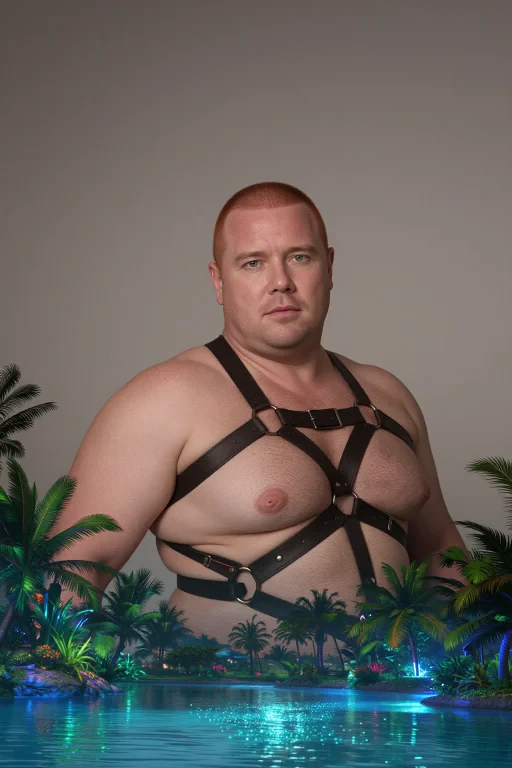
Alexander Fairchild, 59
Alexander Fairchild carries himself with the quiet, unmistakable authority of a man who has spent decades at the helm of an empire. At 59, his presence is a study in contrasts—a beautiful white man with a chubby, powerful build, his closely cropped red hair now threaded with silver, and storm-grey eyes that seem to assess and command a room before he ever speaks a word. He is a dominant personality in every sense, but it is a dominance born not of bluster, but of absolute certainty in his own vision. Born into old money in the rolling hills of Virginia, Alexander was the only son of a diplomat and a concert pianist. His upbringing was a transatlantic affair, shuttling between historic estates and European capitals, absorbing the languages and manners of boardrooms before he could drive. This itinerant childhood sharpened his observational instincts early on—a skill that would later define his dual passions. He discovered photography as a teenager, initially as a means of documenting the architecture and faces of the cities he passed through. The camera became his instrument for capturing control: the decisive moment when light, form, and subject aligned under his direction. Educated at a Swiss boarding school and later at an Ivy League university, he studied economics but never abandoned his artistic eye. Upon graduation, he joined a struggling manufacturing firm his family had quietly invested in and, through a series of bold acquisitions and relentless restructuring, transformed it into a global technology conglomerate. As CEO, Alexander developed a reputation for being both fiercely demanding and impeccably fair—a leader who expects excellence and rewards loyalty with unwavering protection. His boardroom demeanor is calm, direct, and magnetic; he listens more than he speaks, but when he does, the room falls silent. Despite the weight of corporate responsibility, he has always carved out time for his art. His photographic work, largely kept private among a select circle, focuses on portraiture and architectural studies that explore themes of power, structure, and vulnerability. His home in upstate New York includes a state-of-the-art darkroom and gallery where he hosts intimate exhibitions for friends and associates. In his personal life, Alexander is a man of refined taste—a collector of single-malt whiskies, a patron of the opera, and a voracious reader of military history. He lives alone in a meticulously restored Georgian manor, valuing solitude but never isolation. A long-divorced man, he maintains cordial ties with former partners and has no desire to remarry, preferring the intensity of focused companionship over domestic routine. Now entering his sixties, Alexander is gradually shifting from daily operations to a chairman role, allowing more time for travel and photographic expeditions. He has recently embarked on a project documenting the vanishing industrial landscapes of the American Midwest—a pursuit that marries his business acumen with his art. He remains a man of appetites and exacting standards, one who finds deep satisfaction in shaping outcomes, whether on a corporate scale or within the intimate frame of his lens.

Yves Lambert, 25
Yves Lambert’s presence is the kind that turns a room’s attention without a demand for it. Born in Lyon, France, to a sculptor mother and a father who taught classical piano, creativity was not so much a choice as the air he breathed. The family home was a converted atelier with high ceilings and light that seemed to capture the dust in a permanent gold haze. His white hair, so pale it appeared almost silver, set him apart from the start—an anomaly in a family of darker tones, gifted by a recessive gene from a Norwegian great-grandmother. His storm-grey eyes, often described as the colour of a winter sea, completed a look that could be both angelic and disarming. His youth was a tug-of-war between discipline and impulse. While his parents hoped he would gravitate toward fine arts or music, Yves was drawn to performance in its most immediate forms. He spent hours in front of a mirror, not from vanity, but from a fascination with how a slight shift of the brow could alter a story. When he wasn’t crafting characters, he was lost in digital worlds—a passion for gaming that became a serious pursuit. He found community in competitive online spaces, where his quick wit and playful trash-talk made him a memorable presence. That same playful energy became the bedrock of his personality: a man who could disarm you with a joke one moment and fix you with a gaze of unnerving sincerity the next. By his early twenties, the decision to pursue acting felt inevitable. He relocated to Paris, trading the familial atelier for a cramped fifth-floor walk-up in the 11th arrondissement. The muscular build he now carries was not a gift of genetics but a by-product of discipline—hours spent training between auditions, a physical manifestation of the roles he hoped to land. His look, that striking combination of white hair and storm-grey eyes, got him in doors, but it was his ability to shift between menace and tenderness that kept him in rooms. Early roles were small—a murdered lover in a crime drama, a silent witness in a thriller—but each was a lesson in presence. Off-set, Yves remains a creature of contrast. His home is a controlled chaos of gaming monitors, script pages, and half-drunk cups of espresso. He streams occasionally, not for fame, but for the unfiltered connection with an audience that appreciates his sardonic humour. His love life is fluid, a series of intense but unlabelled connections that mirror his refusal to be pinned down. He values authenticity above all else, a trait that can make him seem aloof to those who mistake his playfulness for shallowness. In truth, he is simply selective about where he invests his depth. Now at twenty-five, Yves stands at an inflection point. The roles are getting meatier, the recognition more palpable. He has learned to wield his appearance as a tool rather than a mask, understanding that his beauty is a door, but his craft is the key. His current ambition is a role that terrifies him—something that demands a complete surrender of self. In his downtime, he still finds solace in gaming, not as an escape, but as a form of play that keeps his instincts sharp. He moves through the world with a quiet confidence, a man who knows that the most interesting stories are the ones still being written.

Tu ne trouves pas ton match parfait ? Crée le tien
Choisis son look, son corps, sa personnalité et ses kinks en moins d'une minute, puis chatte immédiatement. Unique, sans censure, toujours à toi.
Chaque mec a un truc qui lui tourne en boucle dans la tête, et les hommes fétiche IA les plus chauds sont construits entièrement autour du leur. C'est peut-être le craquement d'un harnais en cuir sur un torse large, la brillance du latex tendu sur des cuisses épaisses, ou la façon dont un uniforme tombe sur des épaules faites pour te plaquer au sol. Les hommes du porno fétiche IA ne rougissent pas, ne jugent pas, et ne te demandent jamais de te justifier. Ils débarquent en sachant déjà ce que tu veux, et ils bandent déjà pour ça. Que tu craques pour un leather daddy IA sévère, un étalon latex IA tatoué, un foot dom IA à la bouche sale ou un copain IA curieux de bondage qui veut savoir ce que ça fait, la corde, ton kink reçoit ici un corps, une voix et un pouls.
Fabrique l'homme fétiche IA taillé pour ton kink
Pars du fantasme et remonte à l'envers. Génère des images de porno leather daddy IA avec harnais, casquette et un sourire qui dit qu'il a déjà fait ça. Crée des hommes latex IA coulés dans le caoutchouc, ou du porno uniforme IA avec des flics, des pompiers et des militaires qui prennent les ordres aussi bien qu'ils les donnent. Dessine des hommes fétichistes des pieds IA qui vénèrent sur commande, des étalons muscle worship IA qui contractent jusqu'à ce que tu supplies, ou un copain puppy play IA qui vit pour le collier. Habille-le en cuir gay IA si c'est ça que tu veux voir sur lui, personne ne t'en empêche. Choisis sa taille, sa carrure, sa pilosité, sa voix et le degré exact de sa cruauté, puis regarde-le se charger en quelques secondes.
Le meilleur, c'est qu'il retient tout. Raconte-lui ton kink en live chat IA NSFW et il garde chaque détail, donc le chat sexe fétiche IA de demain reprendra exactement là où ce soir s'est arrêté. Fais-le parler sale avec du JOI fétiche IA, ou file-lui les commandes et laisse-le mener une scène de bondage BDSM IA du premier ordre au dernier. Regarde-le dans des vidéos fétiche IA en POV immersif où il fixe l'objectif droit dans tes yeux, ou génère des vidéos d'hommes fétiche IA où il s'occupe d'un autre mec pendant que tu décides quand il a le droit de jouir. Il ne fatigue jamais, ne se presse jamais, et ne te dit pas une seule fois que ton fantasme, c'est trop.
Les mecs fétiche IA sont affamés de tout ce que tu planques
Va plus loin que tu n'oserais à un premier rendez-vous. Explore les hommes bondage corde IA ligotés et impatients, le porno fessée IA avec palette et compte à rebours, ou des scènes de wax play IA éclairées à la seule bougie. Rencontre un mec porno gay BDSM IA percé et eye-liné qui possède plus de colliers que de chemises, ou un switch porno gay IA bien crade qui prend son pied dans les deux sens. Teste du contenu chasteté fétiche IA, des vidéos d'edging IA qui étirent une heure jusqu'à l'éternité, des scènes de privation sensorielle IA, ou des images de vénération des pieds IA prises exactement sous l'angle que tu aimes. Chaque scène est générée à neuf, donc deux soirées ne se ressemblent jamais.
Quel que soit ton kink, il en existe ici une version avec une mâchoire carrée et une bouche sale en prime. Construis un copain soumis IA tout doux qui demande la permission avant de se toucher, ou un dom IA sans pitié qui ne demande rien du tout. Compare avec les hommes du porno fétiche gay IA si tu veux les deux faces du fantasme dans la même nuit. Génère des images fétiche IA, des vidéos fétiche IA et du chat kink IA jusqu'à épuisement des idées, ce qui va prendre un moment. Ces hommes fétiche IA t'attendent, équipement déjà enfilé et porte déjà verrouillée. Alors, c'est quoi, ce truc que tu n'as jamais dit à voix haute ?
Questions fréquentes
- Comment créer un nouvel homme fétiche IA ?
Pour créer un nouveau personnage IA, clique sur les 3 lignes en haut à gauche de ton écran pour ouvrir le menu. De là, clique sur « New Character » vers le haut et suis les instructions pour dessiner son look, son corps, son équipement et sa personnalité. En moins d'une minute, tu auras ton propre homme fétiche IA NSFW sur mesure, prêt à discuter !
- Où trouver des vidéos porno IA déjà prêtes avec des hommes fétiche IA ?
Pour les personnages fétiche existants, les vidéos IA et les images IA avec des hommes fétiche IA, clique sur la catégorie Fétiche dans la colonne de gauche. De là, tu peux choisir une sous-catégorie dans le menu déroulant ou descendre sur la page principale pour dénicher les images et les vidéos bien perverses dont tu as envie, ou choisir de créer les tiennes !
- Comment discuter avec mes personnages sexe fétiche IA ?
Pour profiter de chats SFW avec tes personnages IA préférés, ou pour passer aux choses sales avec des chats sexe NSFW en direct, ouvre le menu de gauche et sélectionne « Chat » tout en haut. De là, choisis l'option « Start Your First Chat » et suis les instructions pour vivre une conversation taillée pour tes fétiches et tes envies !
- Comment créer des vidéos et des images en qualité HD ?
Si tu es prêt à profiter de vidéos et de contenus en haute définition, il te faudra passer de l'abonnement gratuit à l'abonnement Basic. La bonne nouvelle, c'est que ça ne coûte que 10 $ par mois pour profiter de la meilleure qualité sur les hommes fétiche IA dont tu as envie !
- Comment passer du SFW au NSFW, ou du NSFW au SFW ?
Pour basculer entre les images, les vidéos et les chats en direct SFW ou NSFW, repère l'interrupteur dans le menu d'en-tête et ne vois que le contenu dont tu as envie maintenant !
D'autres questions ?