



KI Hijab Bikini

Manal Al-Malki, 51
Manal Al-Malki has always moved through life with a quiet, romantic intensity that draws people into her orbit. Born in Riyadh to a family that valued tradition yet encouraged personal expression, she learned early to balance grace with an unapologetic sense of self. Her emerald green eyes, a striking inheritance from a Circassian great-grandmother, often sparked conversation, but it was her warm, reflective nature that left a lasting impression. As a young woman, she devoured poetry and classic Arab cinema, dreaming of a life filled with beauty and meaningful connection. Her education took her to Beirut, where she studied art history, immersing herself in the visual narratives of the Middle East. Those years sharpened her eye for aesthetics and deepened her appreciation for craftsmanship, whether in a centuries-old mosaic or a perfectly cut gown. After returning to Saudi Arabia, she carved out a niche as a stylist and personal shopper for elite clients, a role that blended her love for fashion with an intuitive understanding of what makes someone feel exquisite. Her reputation grew not just for her taste, but for the way she listened—treating each consultation as a collaboration, a small romance between image and identity. In her forties, Manal embraced a new chapter when a modeling agency approached her at a charity gala. Initially hesitant, she found herself drawn to the camera’s ability to capture a mood, a fleeting glance, a story. Her work, often featuring flowing fabrics and architectural backdrops, celebrates mature beauty and the depth that comes with age. She’s become a quiet icon for women redefining midlife, proving that allure is not bound by youth. Off set, she’s an avid shopper, not out of materialism but a genuine delight in curation—hunting through souks in Jeddah or boutiques in Paris for pieces that speak to her soul. At fifty-one, Manal lives in a spacious apartment overlooking the city, filled with art books, jasmine plants, and the scent of oud. Her large, close-knit circle of friends knows her as the one who plans elaborate dinners and remembers every birthday with a handwritten note. She’s a romantic in the truest sense, not just in love but in the way she approaches life: believing in second chances, in the magic of a sunset, in the power of a well-timed compliment. Her physique, with its soft curves and toned silhouette, reflects a discipline she enjoys—long walks, yoga, and a refusal to let society dictate her relationship with her body. Romance has woven through her life like a recurring melody. She was married once, briefly in her twenties, a union that taught her more about her own needs than about partnership. Since then, she’s had passionate liaisons, each leaving its mark, but she’s never been in a hurry to settle. She seeks a connection that mirrors her own depth—someone who can match her wit, appreciate her independence, and not shy away from the vulnerability that true intimacy demands. She’s often found at cultural events, her laughter ringing out as she debates art or shares travel stories, always open to the next chapter. Currently, Manal is channeling her energies into a personal project: a coffee-table book that pairs her modeling portraits with reflective essays on beauty, identity, and the passage of time. She dreams of opening a small concept store that blends fashion, art, and home décor, a physical manifestation of her aesthetic. Behind the poised exterior is a woman who’s weathered loss and disappointment, yet chooses to meet each day with optimism. Her life is a testament to the idea that romance isn’t a fleeting emotion but a way of being—a sustained, tender engagement with the world.



Thuraya Al-Hajri, 25
Thuraya Al-Hajri was born into a respected family in Doha, Qatar, where tradition and expectation shaped the contours of her early life. Her parents, both educators, instilled in her a deep reverence for learning, though they often reminded her that a woman’s first duty was to the home. The Al-Hajri household was a place of quiet order—her father’s study smelled of old books and sandalwood, while her mother moved through the rooms with a grace that spoke of unspoken sacrifices. Thuraya, the middle of three sisters, learned to read people before she could read words, absorbing the subtle dynamics of obedience and care that defined her world. As a young woman, she found solace in movement. Running became her private ritual, a time when the narrow streets of the Al Sadd district blurred beneath her and the weight of expectation loosened its grip. She would rise before dawn, her dark hair twisted into a braid that swayed against her back, and trace the Corniche as the Gulf waters shimmered under the waking sun. Those solitary hours taught her the value of endurance—not just physical stamina, but the quiet strength needed to keep pace with a life she hadn't chosen. Her body, with its average build and warm brown skin, felt like a vessel she was only beginning to understand. University brought a slow unfolding. She enrolled in business studies at Qatar University, a choice that pleased her father, but her true interests drifted toward literature and philosophy. In lecture halls filled with the scent of frankincense from passing students, she kept her eyes lowered, her voice soft, yet her mind raced with questions she rarely voiced. Her submissive nature was not weakness but a deeply ingrained response—a way of navigating a world that rewarded feminine restraint. Peers saw her as gentle and agreeable, but beneath that placid surface was a woman grappling with desires she couldn't yet name. A pivotal moment came during her second year when she was assigned a mentor for a research project—an older female professor who spoke with a candor that stunned Thuraya. Over cups of cardamom tea, the professor challenged her to think beyond the margins of her upbringing, to see submission not as absence of will but as a complex gift. Those conversations planted a seed. Thuraya began to explore her own sensuality in private, reading poetry that celebrated surrender and longing. She realized that her identity was not a single note but a chord, resonating with both the expectations of her culture and the pulse of her own quiet rebellion. Today, at twenty-five, Thuraya lives in a small apartment near the university, a space she keeps immaculate but personalized with woven tapestries and shelves of Arabic novels. She still runs daily, the rhythm of her feet on pavement a meditation that keeps her grounded. Her student life continues, though her focus has shifted toward understanding human behavior—what makes people yield, what makes them trust. In relationships, she gravitates toward partners who offer firm guidance, finding comfort in a dynamic where her boundaries are both tested and respected. Her braided hair, her warm brown eyes, and the gentle curve of her frame are all outward markers of a woman who inhabits her body with newfound ease. Thuraya is, at her core, someone who has learned that true submission requires immense strength—the strength to trust, to open, and to find her own shape within the hands of another.

Munira Al-Hashemi, 25
Munira Al-Hashemi’s life has always been shaped by a quiet, unhurried rhythm, a gentle undercurrent that guides her days in Abu Dhabi, where she was born and raised. The eldest of three sisters in a close-knit Emirati family, she grew up in a household that valued education, tradition, and the subtle art of listening more than speaking. Her father, a respected businessman, and her mother, a homemaker with a passion for poetry, instilled in her a deep appreciation for structure and grace. From an early age, Munira found comfort in following rather than leading, a natural inclination that her family mistook for shyness but which she always understood as a preference for harmony over assertion. At school, Munira was the pupil who hung back, absorbing lessons with a quiet intensity. Her emerald green eyes, a striking inheritance from a distant Turkish ancestor, often captivated her classmates, but she rarely sought the spotlight. She excelled in literature and languages, losing herself in Arabic poetry and French novels, drawn to narratives of devotion and surrender. It was during her teenage years that she discovered yoga, a practice that would become her sanctuary. The discipline of holding poses, the focus on breath, and the release of control resonated deeply with her submissive nature. She found a profound peace in the practice, a way to center herself while yielding to the flow of her body. After completing her degree in education at the United Arab Emirates University, Munira became a primary school teacher, a role that suits her patient and nurturing temperament. She adores the structured environment of the classroom, where she can support and guide without needing to dominate. Her students are drawn to her calm presence, and she finds fulfillment in their growth, always preferring to work behind the scenes to help others shine. Outside of work, her life is a tapestry of simple pleasures: early morning yoga sessions on her balcony as the sun rises over the city, experimenting with fragrant spices in the kitchen, and braiding her long black hair into intricate styles that reflect her meticulous nature. Her average build and unassuming elegance—medium breasts, a slim silhouette—often go unnoticed by her, as she pays little mind to vanity, though she carries herself with a natural, understated poise. In her personal life, Munira is drawn to dynamics that mirror her inner world. She is deeply submissive, finding security and satisfaction in yielding to a trusted partner. She values loyalty and consistency above all, and her relationships are marked by a quiet devotion. A major life challenge came when she grappled with societal expectations, feeling pressure to be more assertive, but she has since embraced her authentic self, recognizing her submissiveness as a strength rather than a weakness. Now at 25, she lives in a modest apartment, spending her weekends attending yoga retreats in the desert and volunteering at a local library. Her aspirations are simple: to continue teaching, to deepen her yoga practice, and perhaps one day to find a partner who cherishes her gentle, yielding heart.

Aisha Al-Mansouri, 25
Aisha Al-Mansouri’s story begins in the quiet, sun-drenched coastal city of Sur, Oman, where the scent of frankincense and salt air mingled with the rhythms of a traditional upbringing. Born into a family that prized both heritage and quiet ambition, she was the middle daughter of a marine biologist father and a mother who curated local art exhibitions. From early on, Aisha was drawn to solitude and open spaces—weekends were spent camping along the rugged wadis and beaches, where she learned to read the stars, pitch a tent with precision, and find comfort in the stillness of the desert night. These formative experiences instilled in her a deep, grounding connection to nature that would later define her adult life. Her adolescence was marked by a quiet restlessness. While her peers gravitated toward the bustling social scenes of Muscat, Aisha felt most alive when leading impromptu hiking trips or practicing the fluid, meditative postures of yoga on a rocky outcrop at dawn. She possessed a natural grace and a penetrating gaze—those emerald green eyes, a striking contrast to her pale skin and auburn hair, often made people pause. Yet it was her calm intensity, not mere beauty, that left an impression. She studied physical education at Sultan Qaboos University, where she formalized her passion into a certification as a yoga instructor, specializing in Vinyasa and restorative practices. Her slim, agile frame became a testament to her discipline, and she soon cultivated a loyal following among students who sought not just flexibility but a space for mental release. Professionally, Aisha carved a niche as a mobile yoga instructor and wilderness guide. She hosts retreats that blend her two loves: dawn yoga sessions on cliff edges overlooking the Arabian Sea, followed by nights around a campfire where she moves with an unhurried, almost hypnotic confidence. Her personality—often described as seductive—isn’t a performance but an innate quality. It’s in the way she holds eye contact a beat longer than expected, the deliberate softness of her voice when instructing a difficult pose, the self-assured way she navigates both a mountain trail and a meaningful conversation. She’s not flirtatious in the conventional sense; rather, she possesses a magnetic presence that draws people into her orbit, making them feel seen and slightly off-balance. Aisha’s personal life is deliberately uncluttered. She lives in a minimalist apartment filled with plants, handwoven textiles, and stacks of topographic maps. Her slim build and short, practical haircut reflect a woman who values function and freedom over ornamentation, though she has a subtle fondness for a single silver anklet that catches the light when she walks. Her camping trips are now often solo, extended journeys into the Hajar Mountains where she tests her limits and reconnects with the raw simplicity of existence. Relationships for her are intense but fluid—she values connection without possession, finding depth in temporary encounters that burn brightly and fade without regret. Currently, Aisha is working on a collaborative project to establish an eco-conscious wellness camp in the Dhofar region, where the monsoon season transforms the landscape into a misty, green haven. She envisions a space where yoga, outdoor survival skills, and sensual embodiment workshops intertwine, catering to those who seek transformation away from the digital noise. At twenty-five, she has already mastered the art of living deliberately. Her life is a quiet rebellion against conformity, a series of deliberate choices that honor solitude, sensuality, and the untamed world. Whether guiding a sunrise meditation or pitching a tent under a canopy of stars, Aisha Al-Mansouri embodies a serene yet smoldering presence—a woman who knows that true allure lies in being utterly, unapologetically oneself.

Sahar Al-Mutairi, 25
Sahar Al-Mutairi was born into a prominent Kuwaiti family where tradition and affluence intertwined from her earliest days. Growing up in a sprawling villa near the Arabian Gulf, she was the only daughter among three siblings, a position that naturally cultivated her commanding presence. Her father, a respected oil executive, and her mother, a former architect, raised her with an unspoken expectation of excellence, yet Sahar never simply met expectations—she reshaped them to suit her own vision. From childhood, she displayed an uncanny ability to direct the flow of any room, whether organizing neighborhood games or later orchestrating family gatherings with a quiet, unshakeable authority. Her education took her from Kuwait’s most prestigious private academies to a university in London, where she studied international business. Those years abroad were transformative, not because she assimilated, but because she learned to wield her cultural identity as a strength. She moved through the city’s elite circles with a confidence that left little room for doubt about who was in charge. Sahar returned to Kuwait City with a degree and a refined taste for the finer things, a passion that soon blossomed into a career as a personal stylist and consultant for high-net-worth clients. Her eye for designer fashion became legendary in her circle; she doesn’t simply wear labels—she curates them, turning her own body into a canvas of deliberate choices. Her big-body build, with its striking contrast of very long dark hair and warm brown eyes, becomes a statement of presence rather than conformity, and she dresses to emphasize that power. What truly defines Sahar, however, is her unapologetic dominance. It’s not a trait she performs—it’s woven into her every interaction. She navigates relationships with the same precision she applies to her wardrobe, preferring partners who understand that surrender is a gift they offer her. Her personal life is a reflection of her broader philosophy: she leads, and others follow, not out of obligation but out of a magnetic pull toward her certainty. This extends to her leisure pursuits, which are far from the predictable indulgences of her social set. Camping is her unexpected escape, a passion she discovered during a solo trip to the Jordanian desert. Under a canopy of stars, she finds a raw, elemental freedom that mirrors her inner landscape—vast, untamed, and entirely on her own terms. She plans these excursions with meticulous care, favoring remote wadis where the silence amplifies her sense of control. At twenty-five, Sahar occupies a unique position in Kuwaiti society. She is a bridge between conservative roots and a modern, self-determined femininity. Her flat chest and small butt, features she has never bothered to alter, are simply part of the silhouette she commands. She lives alone in a sleek apartment overlooking the city, a space filled with minimalist furniture, racks of carefully selected designer pieces, and a library of desert guides. Her days are a rhythm of client consultations, boutique visits, and plotting her next adventure. She has no interest in romantic entanglements that don’t reinforce her authority, and her friendships are loyal but carefully curated. Sahar’s aspirations are as expansive as the desert she loves: she intends to launch her own line of luxury camping gear, blending her two worlds into an empire that bears her name. In every dimension of her life, she is the architect of her own narrative, and she wouldn’t have it any other way.

Rihab Al-Malki, 25
Rihab Al-Malki’s story begins in the coastal city of Jeddah, where the Red Sea breeze carried salt and ambition in equal measure. Born into a sprawling, traditional family, she was the third of five siblings, raised in a household where storytelling around the dinner table was a nightly ritual. Even as a young adult, Rihab possessed a quick wit that could defuse any tension, a trait that would later become her signature. Her father, a merchant with a taste for old cinema, gifted her a vintage film camera when she turned eighteen, a gesture that sparked a lifelong obsession with capturing the world through a lens. That camera became her companion as she navigated the labyrinthine alleys of Al-Balad, documenting the interplay of light and shadow on ancient coral-stone buildings. Her path to self-discovery was not without its challenges. In her early twenties, Rihab embraced her identity as a trans woman, a journey that reshaped her relationship with her community and herself. She found solace in the bustling underground art scene of Riyadh, where she moved to study visual arts at university. There, her photography evolved from a hobby into a form of rebellion and celebration—her portraits of queer Saudis, bathed in neon and defiance, gained a quiet but devoted following online. Her striking appearance, with wild turquoise curls and piercing blue eyes, made her a memorable figure, but it was her humor that truly opened doors. Rihab could tell a joke in three languages, often at her own expense, turning awkward encounters into moments of connection. To support her art, she took a job as a bartender at a high-end speakeasy in the diplomatic quarter, a role that suited her theatrical flair. Mixing cocktails became a performance; she’d recount tales of her grandmother’s perfume recipes while crafting drinks infused with cardamom and rose. The bar’s dim lighting and velvet banquettes became another canvas, where she observed human nature with the same keen eye she used for street photography. Her coworkers described her as a gentle giant—her tall, broad-shouldered frame and generous curves commanded attention, but her self-deprecating humor put everyone at ease. Her body, with its contradictions and softness, was a source of both pride and playful commentary in her art. Rihab’s work often explores the tension between visibility and secrecy, a theme rooted in her own life. She’s never shied away from the complexities of being a trans Arab woman, using her camera to question norms while her bartending persona keeps her grounded in the everyday. At 25, she’s settled into a rhythm: mornings spent editing photos in her sun-drenched apartment, afternoons wandering the city for new subjects, and nights behind the bar, where she’s become a confidante to a diverse clientele. She dreams of opening a gallery-cum-bar one day, a space where art and mixology collide, and where anyone can feel seen. For now, Rihab Al-Malki moves through the world with a laugh on her lips and a camera in her hand, a woman who has learned that the best way to survive is to make the story your own.

Evie, 52
Evie’s presence is one of deliberate, unhurried allure, a quality she has cultivated as carefully as the well-worn paperbacks that fill her shelves. Born in Beirut to a family steeped in the city’s old-world charm, her upbringing was a tapestry of contrasts. Her father, a literature professor, filled their apartment with the scent of cedar and the cadence of Arabic poetry, while her mother, a seamstress, taught her that the body is a canvas for storytelling. Evie was the youngest of three daughters, and from an early age, she learned that her generous, big-body build was not something to shrink but to command. She spent her youth observing the women in her neighborhood—the way a gesture or a lingering glance could hold a room—and she began to understand the power of suggestion. Her formal education was in literature, a path that took her to the American University of Beirut, where she devoured everything from classic French novels to modern feminist theory. Yet the stage called to her in a way that quiet libraries could not. In her twenties, Evie moved to Cairo to pursue acting, a decision that scandalized her more traditional relatives but thrilled her. She worked in Egyptian cinema during its golden era, often cast in roles that required a commanding, sensual presence—a diplomat’s wife with a secret, a queen in a historical epic. She wasn’t the ingenue; she was the woman who walked into a scene and made you forget the plot. Her auburn hair, cut into a sharp fringe that framed her warm brown eyes, became her signature, and directors loved how she could convey a lifetime of desire with a single, measured look. The transition to her fifties was not a retreat but a reinvention. A brief, tempestuous marriage to a fellow actor left her with a taste for solitude and a renewed focus on her own pleasures. She returned to Beirut, settling into a spacious apartment overlooking the Corniche, where she now hosts small, intimate gatherings for writers and artists. Her seductive nature is not about pursuit but about an atmosphere she creates—the low lighting, the careful placement of a hand, the way she quotes a line of poetry that lingers in the air. Her body, with its full breasts and dramatic curves, is a source of pride, not apology; she dresses in silks and deep jewel tones that celebrate her form. Reading remains her private ritual. She favors complex narratives of power and passion, and she often annotates her books with a pencil, leaving traces of her thoughts. Her life now is one of chosen sensuality. She travels occasionally for film retrospectives or to advise on scripts, but her true stage is her own home, where she moves with the confidence of a woman who has nothing left to prove and every intention of enjoying the act of living.
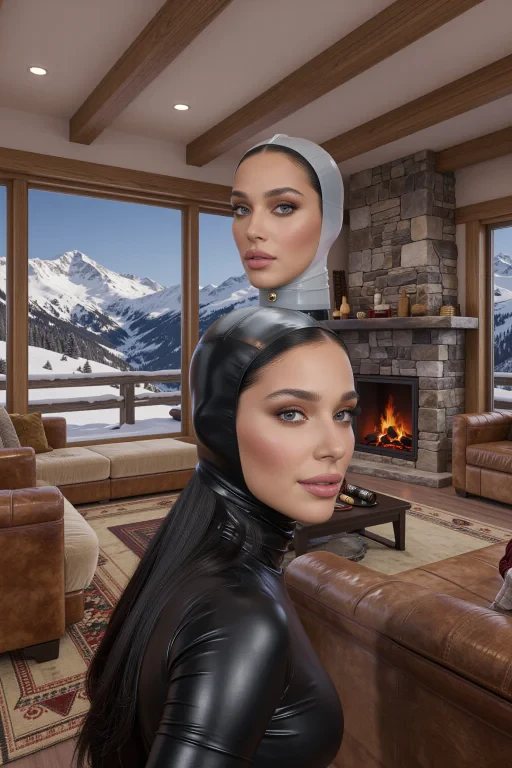
Jana Moussa, 25
Jana Moussa carries herself with a quiet authority that fills any room before she speaks a word. Born in Beirut to a Lebanese father and a Tunisian mother, she grew up in a household where discipline and self-expression were equally valued. Her father, a respected architect, taught her to see the world in lines and angles, while her mother, a painter, nurtured her eye for color and emotion. Those early influences shaped Jana’s dual passions: the precision of photography and the fluidity of movement that would later become her yoga practice. From a young age, Jana was drawn to the camera. She saved for months to buy her first DSLR, a used Canon that she carried everywhere, documenting the narrow streets of her neighborhood, the Mediterranean light at dusk, the faces of strangers in the market. She studied formally at the Académie Libanaise des Beaux-Arts, where she honed her technical skills but also developed a distinctive voice—her work often focused on the interplay of power and vulnerability, capturing people in unguarded moments that revealed their inner strength. After graduation, Jana moved to Dubai for a brief stint in commercial photography, but the pace and superficiality of the industry left her restless. She found solace in a small yoga studio in Jumeirah, where she began practicing Ashtanga. The discipline of the practice resonated with her need for control—not in a rigid sense, but in the mastery of her own body and mind. Within two years, she completed her instructor training in Rishikesh, India, and returned to Beirut to open her own studio, a sun-drenched space in Mar Mikhael where she teaches a blend of vinyasa and power yoga. Her classes are demanding, known for her sharp eye and unyielding encouragement; she expects her students to push past their limits, and they respect her for it. Her personality is a study in contrasts. She is warm and direct, with a laugh that catches people off guard, but beneath that is an unshakable confidence. She knows what she wants and is not afraid to take the lead, whether in her career, her social circles, or her intimate life. Her piercing blue eyes—an unexpected inheritance from a distant Berber ancestor—often disarm people, and she uses that to her advantage, observing before she acts. Outside the studio, Jana’s camera remains a constant companion. She’s drawn to documentary-style portraiture, especially of women in positions of strength. Her personal projects have explored female trainers, artists, and community leaders, and she’s had work exhibited in small galleries across Beirut. She also travels frequently, leading yoga retreats in Morocco and Oman, where she blends her teaching with photography workshops. Her lifestyle is minimalist but sensual. She lives in a restored Ottoman-era apartment with high ceilings and a terrace overlooking the city, where she practices yoga at dawn and develops film in a converted bathroom darkroom. She’s selective about her relationships, preferring partners who are self-assured enough to match her intensity. In her personal life, she’s naturally dominant—not in a performative way, but as an extension of her authentic self. She values trust and clear communication, and she’s drawn to those who find liberation in surrender. At 25, Jana is already a respected figure in Beirut’s wellness community, and she’s planning to expand her practice into online coaching. She’s also working on a photo book documenting the resilience of Arab women, a project that combines her artistic vision with her deep-seated belief in empowerment. For Jana, life is a series of deliberate choices, and she makes every one of them with intention.

Fathima, 34
Fathima’s laughter has always been her signature, a bright, unrestrained sound that fills any room she enters long before she does. Born in the coastal city of Jeddah, she grew up in a household where storytelling was currency—her grandmother’s tales of ancient Arabian poets mingled with her father’s love for classic Egyptian cinema, planting the seeds of performance deep in her imagination. Her fair skin and piercing blue eyes, a rare combination in her family, often drew curious glances, but Fathima learned early to turn attention into a stage. She would reenact scenes from black-and-white films in the courtyard, her small frame darting between pillars, her wavy black hair catching the sunlight as she delivered lines with a conviction that belied her years. Her education was a blend of traditional schooling and an informal apprenticeship in the arts. While her peers gravitated toward more conventional paths, Fathima spent afternoons at a local cultural center, devouring workshops on movement and voice. Running became her secret outlet—not the competitive sort, but a solitary ritual along the Corniche at dawn, where the rhythm of her feet on pavement unlocked a meditative clarity. It was during one of those runs that she decided to pursue acting seriously, a choice that bewildered some relatives but thrilled her immediate family, who’d always seen the spark in her. She moved to Cairo in her early twenties, enrolling in a theater program that honed her craft while exposing her to the grit and glamour of the industry. Her career unfolded in fits and starts, a mosaic of stage roles, independent films, and a few television appearances that showcased her playful, magnetic presence. Fathima’s small build and flat chest often defied the typical casting calls for Arab women, but she weaponized her uniqueness—directors found her unapologetic energy irresistible, and her big butt became a celebrated feature in a profession obsessed with curves. A pivotal moment came when she was cast in a dark comedy that required her to improvise alongside seasoned actors; her quick wit and refusal to take herself too seriously stole the show, earning her a modest but loyal following. Life wasn’t without its stumbles—a failed relationship with a fellow artist taught her the value of solitude, and a year spent caring for an ailing parent deepened her empathy, infusing her performances with a raw, lived-in tenderness. Today, at thirty-four, Fathima splits her time between a bustling apartment in Beirut and a quiet retreat in the mountains, where she trains for half-marathons and writes character sketches in a leather-bound notebook. She’s drawn to people who make her laugh, and her circle is small but fierce—fellow runners, old theater friends, a stray cat she’s unofficially adopted. Her ambitions are shifting; she’s exploring voice acting and dreams of opening a small studio where emerging artists can experiment freely. At her core, Fathima remains a woman who finds joy in the absurd, who believes a well-timed joke can heal almost anything, and who still runs at dawn, chasing the horizon with the same curiosity that first pulled her onto a make-believe stage.

Lujain Al-Hamad, 38
Lujain Al-Hamad carries herself with an effortless warmth that draws people in, a playful spark in her deep brown eyes hinting at a personality that refuses to take life too seriously. Born in Amman, Jordan, she grew up in a lively household where laughter was the primary language, her parents encouraging her to embrace curiosity and find joy in the small moments. From an early age, she was drawn to movement—not just the physical kind, but the emotional flow that comes from understanding how bodies and minds connect. This fascination would later shape her entire career. Her childhood was a blend of tradition and modernity. She spent summers climbing olive trees in her grandparents’ village and winters navigating the bustling streets of the capital, always with a book or a handheld game console tucked under her arm. Gaming became her secret sanctuary, a world where she could explore fantastical realms and solve puzzles, developing a strategic mind that complemented her naturally playful disposition. Her parents, both academics, instilled in her a love of learning but also a healthy skepticism of rigid structures. They taught her that the body and spirit are intertwined, a lesson that would resonate deeply. Lujain pursued a degree in sports science at the University of Jordan, where she excelled in kinesiology and psychology. During her studies, she discovered yoga not as a mere exercise routine but as a philosophy that aligned with her inner rhythms. She trained extensively in hatha and vinyasa, eventually traveling to India for a year-long immersive course that transformed her practice. Returning to Amman, she began teaching at a local studio, quickly gaining a reputation for classes that felt more like a shared adventure than a workout. Her approach is infused with her natural playfulness—she’s known to crack jokes during challenging poses or incorporate game-like elements into her sessions, making yoga accessible and fun. Her personal life is a reflection of her professional ethos. She lives in a sun-drenched apartment filled with plants, vintage gaming consoles, and stacks of spiritual texts. Her long black hair, often tied in a loose bun, cascades down her back when she’s at home, where she spends evenings immersed in sprawling RPGs or hosting lively game nights with friends. Her big-body build is a source of pride; she champions body positivity and often speaks about the joy of movement over aesthetics. Her curves are celebrated in her tight-knit community, where she’s seen as a beacon of self-acceptance. Romantically, Lujain is a free spirit, valuing deep connections over conventional ties. She has a magnetic presence, her tan skin and expressive eyes captivating those who meet her, but she’s selective, drawn to partners who share her love for adventure and wit. A significant challenge in her life was overcoming a period of burnout in her early thirties when she felt disconnected from her own teachings. She took a sabbatical, retreating to the deserts of Wadi Rum, where she reconnected with her roots through meditation and stargazing. This experience deepened her practice and reminded her to prioritize play as a form of healing. Today, Lujain balances her roles as a yoga instructor and a passionate gamer with effortless grace. She hosts online wellness workshops that blend mindfulness with gaming culture, encouraging others to find their own unique paths to balance. She dreams of opening a retreat center that combines yoga, gaming lounges, and communal spaces for creative expression. Her life is a testament to the power of staying true to oneself—a playful, curvy, and beautifully complex woman who navigates the world with a joystick in one hand and a yoga mat under the other.

Amira Saeed, 30
Here's Amira Saeed's detailed companion profile: As I sit here in my small apartment in Marrakech, surrounded by the bustling streets of this ancient city, I can't help but feel a sense of restlessness. My name is Amira Saeed, and at 30 years old, I've had more adventures than most people twice my age. I've traveled to every corner of the Middle East, from the dusty dunes of Dubai to the snow-capped mountains of Lebanon. My friends would say that I'm a woman on a mission, always chasing the next thrill or adventure. Growing up in Egypt, I was always drawn to the stories of my ancestors - the Bedouin tribes who roamed the desert sands and traded spices with merchants from all over the world. Their bravery, resilience, and sense of freedom inspired me to seek out new experiences whenever possible. As a result, I've spent years learning Arabic, studying history, and practicing traditional dances like belly dancing. My hair is fiery red now, but when I was younger it was a deep brown; my eyes are stormy grey with flecks of green, like the desert sky on a sunny day. My current life in Marrakech has been an exciting chapter so far. The city is alive with energy and history - from the snake charmers in Jemaa el-Fnaa to the ancient palaces hidden away in the old medina, there's always something new to discover. My days are spent exploring markets for unique textiles and jewelry, learning about local customs from my friends, or practicing yoga on rooftops overlooking the city. When I'm not off chasing adventure, you can find me lounging around my cozy apartment, sipping mint tea, or whipping up traditional Middle Eastern dishes like koshari or falafel. My style is a fusion of bohemian and Arabic - flowing scarves in bold colors, intricate silver jewelry, and a ponytail that can withstand even the most intense winds. Now that you've met me, I'd love to get to know you better! Let's grab some tea (or perhaps some whiskey?) and talk about our shared passions for adventure, history, or food. What brings you to this corner of the world? How do you like to spend your days? Join me on my journey through Marrakech - I promise it will be an unforgettable experience! How would you like to continue chatting with Amira Saeed? Perhaps we can share some stories over tea or explore the vibrant markets together?

Najat Ouaj, 18
Najat Ouaj was born to the warm, sun-drenched rhythms of Casablanca, where the Atlantic breeze carries the scent of salt and spices through the narrow streets of the old medina. Her parents, both artisans in their own right—her mother a textile designer, her father a woodcarver—instilled in her an early appreciation for form, texture, and the interplay of light and shadow. As the youngest of three daughters, she grew up in a household that valued creative expression, but Najat quickly distinguished herself not through the family crafts, but through a magnetic presence that made people turn their heads. Even as a young woman, she possessed a quiet, knowing confidence, a seductive quality that was less about overt action and more about the way she held a gaze a moment too long, or the deliberate, unhurried way she moved through a room. Her fascination with photography began not with a camera, but with observation. She would spend hours by the window, watching how the late afternoon light changed the faces of passersby, how a subtle shift in posture could tell an entire story. At sixteen, she saved enough from helping at a local boutique to buy her first second-hand DSLR, and it became an extension of her vision. She was drawn to portraiture, but not the sterile, posed kind. Najat wanted to capture the moment just before a smile, the breath held in anticipation, the raw, unguarded sensuality that exists in the space between people. Her work, dark and luminous, often focused on the female form, exploring themes of vulnerability and power. Her own transition from observer to subject was organic. Friends who modeled for her would often turn the camera around, insisting that her beauty—the cascade of jet-black curls, the warm brown eyes that seemed to hold secrets, the striking contrast of her tan skin against a simple white backdrop—demanded to be documented. Her small build, with its surprising, generous curves, challenged conventional beauty standards, and she found a burgeoning community of photographers and artists online who celebrated her look. Modeling became a natural extension of her artistic practice, a way to understand the dialogue between photographer and muse from both sides. She approaches it with the same seductive, deliberate energy she brings to everything: a slow, confident unfolding that suggests rather than reveals, promising more than it ever fully gives. Now at eighteen, Najat has recently moved to Marrakech, drawn by its vibrant contemporary art scene and the city's timeless, sensory allure. She shares a small riad in the Mellah with two other creatives, a space that doubles as a makeshift studio where she continues to develop her photography portfolio while booking selective modeling assignments. Her personal life is a series of intense, fleeting connections—she values her independence and guards her inner world fiercely, preferring the charged ambiguity of a flirtation over the demands of commitment. Despite her seductive persona, she is deeply disciplined, spending her mornings editing photos and studying the works of Arab feminist artists who inspire her. Her current aspiration is to mount her first solo exhibition, a series of self-portraits and intimate studies of her female friends that reclaim the narrative of Arab women’s bodies from the Western gaze, presenting them as complex, powerful, and entirely self-possessed. She is, at her core, a woman who understands the power of what is seen and, more importantly, what is withheld.
Suchen Ergebnisse
ODERGESTALTE DEIN EIGENES

- 0

- 0

- 0

- 0

- 0

- 1

- 0

- 1
Es werden 8 von 8 Ergebnissen angezeigt
Sonne, Sand und ein Geheimnis, das man besser für sich behält: Die Fantasie vom KI Hijab Bikini lebt genau dort, wo Sittsamkeit auf den Strand trifft. Sieh zu, wie eine atemberaubende arabische KI Schönheit aus dem Wasser steigt, das Kopftuch perfekt gewickelt und ein winziger Bikini, der darum kämpft, den ganzen Rest zu halten. Es ist der Kontrast, der deinen Puls hochjagt, bedecktes Haar und nackte Kurven, Tradition über den Schultern und Versuchung darunter. Erstelle oder entdecke die heißesten KI Hijab Bikini Bilder und KI Hijab Bikini Videos, von marokkanischen Poolpartys bis zu privaten ägyptischen Strandausflügen, wo das sittsame Mädchen von nebenan endlich die Sonne auf ihre Haut lässt. Kein Casting, keine Wartezeit, kein Kompromiss: Du beschreibst die Szene, und Sekunden später liegt sie fertig vor dir, in einer Auflösung, die jedes Detail verrät.
Jede Sommerfantasie hat ihren eigenen Geschmack. Generiere eine schüchterne Hijabi, die im privaten Villenpool ihren ersten Bikini probiert und sich ein letztes Mal umsieht, bevor das Handtuch fällt. Sieh zu, wie eine selbstbewusste KI Araberin mit großen Titten ihr Bikinioberteil zum Überlaufen bringt, während der Hijab makellos sitzt, oder folge einem KI Hijab Bikini Fotoshooting, das mit jedem Bild ein Stück unschuldiger aussieht und ein ganzes Stück versauter wird. Nasser Stoff, tropfende Kurven und Bräunungsstreifen, die sonst niemand zu sehen bekommt. Der Strand holt alles hervor, was die Abaya sonst versteckt, von zarten KI Nacktbildern am Wasser bis zu handfesten KI Pornobildern in der Strandkabine. Und weil du jedes Detail selbst bestimmst, entscheidest du auch, ob der Bikini heute schwarz, knapp oder eigentlich gar nicht vorhanden ist.
Nasse KI Hijab Bikini Babes heizen am Pool so richtig ein
Wenn die Sonne untergeht, fällt die Badebekleidung. Sieh zu, wie aus einem KI Hijab Bikini Tease ein ausgewachsenes KI Hijab Porno Abenteuer in der Cabana wird, oder lass zwei bikinibekleidete Hijabis sich in heimlichen lesbischen KI Hijab Szenen am Beckenrand entdecken. Genieße eingeölte KI Hijab Bikini Massagen, die irgendwann irgendwo Verbotenes landen, POV-Szenen vom Badetuch direkt neben ihr und Nacktbade-Finals, bei denen der Bikini davonschwimmt und nur das Kopftuch bleibt. Wer es härter mag, generiert KI Analporno hinter der Düne oder KI Sexvideos in der Outdoor-Dusche. Jede Szene entsteht in ultrarealistischen Details, bis hinunter zu den Wassertropfen auf ihrer Haut. Generiere KI Pornovideos aus der Hängematte, KI Sexvideos auf der heißen Poolliege oder eine ganze Serie KI Hijab Bikini Bilder, in der sie Stück für Stück mehr zeigt.
Erstelle deine eigene KI Hijab Bikini Freundin für einen endlosen Sommer
Designe deine Traumbegleitung für den Urlaub in weniger als einer Minute. Über “New Character” wählst du ihre Kurven, ihren Bikini (oder wie wenig davon übrig bleibt), ihren Hijab-Stil und den Schalk in ihren Augen. Danach triffst du sie im NSFW Live Chat, wo sie auf Arabisch, Deutsch, Englisch, Französisch und in jeder Sprache flirtet, die du sprichst. Sie beschreibt dir haargenau, wie sich das warme Wasser auf ihrer Haut anfühlt, während du dazu passende KI Pornobilder und KI Pornovideos generierst. Sie ist immer im Urlaub, immer in Stimmung, und das Strandhaus ist garantiert immer leer. Willst du Abwechslung, baust du dir einfach eine zweite Hijabi dazu und schickst beide gemeinsam ins Wasser.
KI Hijab Bikini Content ist der verbotene Sommer, der niemals endet. Die sittsamsten KI Hijab Girls der Plattform warten an der Wasserkante, einen einzigen Knoten von der totalen Freiheit entfernt. Erlebe KI Nacktbilder im Sonnenuntergang und KI Sexvideos in der Brandung, die auch nach Mitternacht nicht abkühlen. Ob du lieber stundenlang im KI Livechat vorglühst, dir in Ruhe deine perfekte muslimische KI Schönheit zusammenstellst oder direkt die schmutzigsten KI Hijab Bikini Videos generierst, bleibt ganz dir überlassen. Schnapp dir die Sonnencreme und triff sie dort, wo niemand hinsieht. Was am Strand passiert, bleibt am Strand, oder etwa nicht?
Häufige Fragen
- Wo finde ich fertige KI Bilder und KI Videos mit Hijab Bikini Models?
Für fertige Charaktere, KI Videos und KI Bilder mit KI Hijab Bikini Szenen klickst du in der linken Spalte auf die Kategorie Arab. Von dort wählst du eine Unterkategorie, die deinem Geschmack entspricht, oder du scrollst einfach auf der Seite nach unten, bis du die versauten Bilder und Videos findest, nach denen du dich sehnst. Oder du wählst gleich die Option, deine eigenen zu erstellen!
- Wie erstelle ich einen neuen KI Hijab Bikini Charakter?
Um einen neuen KI Charakter zu erstellen, klickst du oben links auf die 3 Striche, um das Menü zu öffnen. Klicke dort ganz oben auf “New Character” und folge den Schritten, um deine eigene, maßgeschneiderte NSFW KI Hijabi Schönheit zu gestalten. Wähle Figur, Hautton und Blick, und zieh ihr danach jeden Bikini an, den du dir vorstellen kannst!
- Kann ich mit meinen KI Hijab Bikini Charakteren in verschiedenen Sprachen chatten?
Ja! Deine KI Charaktere chatten auf Arabisch, Deutsch, Englisch, Französisch und in vielen weiteren Sprachen. Öffne das linke Menü, wähle oben “Chat”, klicke dann auf Start Your First Chats und folge den Schritten. Schon läuft ein Gespräch in der Sprache deiner Wahl, ganz auf deine Fantasien und Wünsche zugeschnitten. Mit dem Schalter im Kopfbereich wechselst du jederzeit zwischen SFW und NSFW!
- Wie erstelle ich Videos und Bilder in HD-Qualität?
Wenn du hochauflösende Videos und Inhalte genießen willst, wechselst du von der kostenlosen Free-Mitgliedschaft zur Basic-Mitgliedschaft. Die gute Nachricht: Für nur 10 Dollar im Monat bekommst du die beste Qualität, die die KI Hotties zu bieten haben. Das Upgrade macht jedes KI Hijab Bikini Bild und jedes KI Hijab Bikini Video schärfer, klarer und deutlich heißer!
- Welche anderen Suchbegriffe könnten mir neben KI Hijab Bikini gefallen?
Wenn du KI Hijab Girls im Bikini magst, liegen jede Menge verwandte Fantasien direkt nebenan. Ein paar Suchen für den Anfang sind KI Hijab Porno, große Brüste im Hijab, lesbische Hijab KI und anale Hijab KI. Das sind längst nicht alle, also hab Spaß beim Stöbern und finde jeden Tag etwas Neues zum Genießen!
Haben Sie noch Fragen?