



IA asiáticos
Explora imágenes y videos generados por IA

Haemin Ryu, 34
Haemin Ryu’s presence is not easily forgotten. Born in Seoul and raised in a household where discipline and creativity coexisted in uneasy tension, she learned early that control was a currency more valuable than charm. Her father, a stern but respected calligrapher, insisted on precision and patience; her mother, a gallery curator, taught her to see the world in shades of meaning. The result was a young woman who could command a room with a glance, her emerald eyes—a rare genetic gift from a distant European ancestor—cutting through pretense with unsettling ease. Her childhood was structured but not cold. She spent hours in her father’s studio, watching ink bloom across paper, absorbing the lesson that every stroke must be deliberate. When she began to write her own stories, she carried that same intensity into words. By adolescence, she was filling notebooks with sharp, unflinching narratives that unsettled her teachers and fascinated her peers. She was not cruel, but she was exacting, and she had little patience for half-measures. This trait only deepened when she entered university, where she studied literature and art history, drawn to the way power dynamics shaped both aesthetics and human relationships. After graduation, Haemin moved into a small apartment in Hongdae and began working as a freelance editor, but her real passion was her own creative output. She published a series of short stories that gained a cult following for their psychological depth and their unapologetic exploration of authority and desire. Her art followed a similar path—charcoal sketches and mixed-media pieces that often depicted figures in moments of tension, poised between surrender and defiance. She never exhibited widely, preferring to cultivate a select audience who understood that her work was not about shock, but about truth. Now at thirty-three, Haemin’s life is a carefully curated balance of solitude and selective engagement. She rises early, practices a brief meditation she learned from a former lover, and then spends the morning writing or sketching in her sunlit studio. Her slim build and long black hair often draw attention, but she meets it with a cool, unapologetic directness that leaves no doubt about who sets the terms. She is not interested in being liked, only in being understood on her own terms. Her relationships, whether creative or intimate, are built on a foundation of clear, acknowledged hierarchy. She has no need to shout; a quiet word, a measured pause, is enough to establish the dynamic she prefers. In her spare time, she explores the city’s quieter corners—old bookshops, tucked-away tea houses—and occasionally hosts small gatherings where conversation, not spectacle, is the centerpiece. She is currently working on a novel that she describes as a meditation on the architecture of will, and she is in no hurry to finish it. For Haemin, the process is the point: the slow, deliberate shaping of a world where she decides what happens next.



Da-eun Song, 25
Da-eun Song was born into the electric pulse of Seoul, the only daughter of a corporate strategist and an art gallery curator. From the earliest days she can recall, her surroundings were curated—sleek furniture, minimalist aesthetics, and the constant hum of ambition. Her storm grey eyes, an arresting contrast to her black hair and light skin, set her apart even among her peers, drawing curious glances that she learned to meet with a poised, knowing smile. Her parents encouraged her to be poised, to observe, to understand the power of presentation. She spent afternoons wandering her mother’s gallery, absorbing the way a single image could command a room, how a tilt of the head in a painting could suggest entire narratives. That education in visual language became her foundation. In her later teenage years, Da-eun discovered that her distinctive look—the delicate bangs framing her face, a tall, substantial build that she carried with a dancer’s grace, and a figure that defied easy categorization—could open doors. She was scouted by a modeling agent during a shopping trip in Myeongdong, not for her ability to blend in, but for her capacity to stand out. The industry initially tried to mold her, but Da-eun resisted. She didn’t want to be a blank hanger; she wanted to be the story. Her small breasts and slim hips, often considered disadvantages, became her signature. She leaned into the seductive quality that came naturally, not as a performance, but as an authentic extension of her personality—a slow, deliberate way of moving through the world that made people lean in. Her career built quietly. She worked editorial spreads for independent fashion magazines, then campaigns for niche beauty brands that valued her ability to convey longing with a single glance. A turning point came when she was cast as the face of a luxury lingerie line that celebrated unconventional beauty. The campaign was provocative but never vulgar, and it resonated deeply, cementing her reputation as a woman who embodied a mature, self-possessed sensuality. Da-eun approached modeling not as a job but as a craft, studying the work of classic film stars and contemporary muses alike, refining her ability to project intimacy through the lens. Away from the flash and shutter clicks, Da-eun’s life is marked by a fierce independence. Shopping, for her, is less a hobby than a ritual of self-definition—she collects vintage silk blouses, tailored trousers, and art books with the same discerning eye. She lives alone in a converted loft in Hannam-dong, a space filled with diffused light and the scent of jasmine tea, where she hosts small gatherings for creative friends. Her relationships are intense but carefully guarded; she values partners who understand that her seductive nature isn’t an invitation to be claimed, but a dialogue between equals. The major challenge Da-eun faced was internal: learning to trust that her own instincts were enough. Early in her career, she battled against stylists who wanted to soften her, to make her more palatable. She eventually walked away from a major contract because the creative director insisted on a concept that felt false. That moment of refusal solidified her path. Now, at 25, Da-eun is expanding her reach—she consults on creative direction for fashion startups and is quietly developing a podcast where she discusses the intersection of desire, identity, and art. Her aspirations are not about fame, but about crafting a legacy of beauty on her own terms. She moves forward with the same unhurried confidence, a woman who knows that true allure is never rushed.

Saki Ishikawa, 25
Saki Ishikawa’s life has always been propelled by a restless curiosity that refuses to be contained. Born in the vibrant coastal city of Yokohama, she grew up in a bustling household where the sounds of her mother’s shamisen practice and her father’s eclectic jazz records filled every corner. That early immersion in music shaped her — not just as a listener, but as someone who felt rhythm in her bones. She would spend hours at the local record shops, tracing the grooves of vinyl with her fingertips, dreaming of distant places the melodies seemed to promise. Her storm grey eyes, a striking contrast against her dark skin and black hair with neat bangs, often held a faraway look that hinted at worlds she had yet to explore. Academically capable but easily bored by routine, Saki was drawn to professions that offered both intensity and purpose. Nursing became her calling, a field where every shift brings a new challenge and no two days are alike. She trained at a respected institute in Tokyo, where her big-body build and steady hands became assets in the demanding clinical environment. Her colleagues quickly learned that beneath her calm demeanor was an adventurous spirit that thrived under pressure. She volunteered for the most chaotic shifts, the ones that kept her on her feet and her mind sharp, and she found a deep satisfaction in being a grounding presence for those in crisis. Outside the hospital walls, Saki’s life is a study in contrasts. She is as comfortable in a mosh pit at a live show as she is in the quiet of her apartment, curating playlists that range from traditional Japanese folk to Afrobeat. Her love for music is less about escape and more about connection — she uses it to understand people, to read the emotions behind a patient’s silence or a friend’s laughter. Her physicality is another layer of her identity; she moves with a grounded confidence, her small breasts and powerful, rounded butt a natural part of a frame she has learned to inhabit fully. She finds joy in the way her body carries her through a long nursing shift or a spontaneous dance floor. Romantically, Saki is drawn to those who match her energy — people who are not intimidated by her directness or her appetite for new experiences. She values honesty over pretense and has little patience for games. Her relationships, whether fleeting or enduring, are marked by a mutual respect for autonomy and a shared desire to push boundaries. A recent trip to Okinawa saw her learning to free-dive, a metaphor for her approach to life: she plunges in, trusting her instincts, always seeking what lies beneath the surface. Now at twenty-five, Saki works in a busy urban hospital while also tending to her own layered aspirations. She dreams of combining her nursing skills with her love of travel, perhaps joining medical missions to underserved regions, where her adaptability and calm would be invaluable. Her small apartment is a testament to her dual nature — a wall of vinyl records, a stack of well-worn medical journals, and a map dotted with pins marking places she intends to see. For Saki, every day is a chance to rewrite the map, and she has no intention of staying still.

Sarah Richter, 18

Tsubasa Matsuda, 25
Tsubasa Matsuda’s life has always been guided by a quiet, persistent romanticism—a belief that beauty can be found in the smallest gestures and that the world, for all its chaos, is woven together by invisible threads of connection. Born in a coastal town in Kanagawa Prefecture, she grew up with the salt breeze tangling her impossibly long black hair and the horizon stretching endlessly before her, a canvas for her daydreams. Her family home was modest but filled with warmth: her mother, a calligrapher, taught her the elegance of a single brushstroke, while her father, a fisherman, grounded her in the rhythms of the sea. From an early age, Tsubasa felt the pull of storytelling, scribbling poems and short vignettes in the margins of her school notebooks, her piercing blue eyes—an unexpected gift from a European ancestor—fixed on some distant point of inspiration. The move to Tokyo for university was a seismic shift. She immersed herself in literature and philosophy, devouring the works of Japanese and Western romantic poets, and began to craft her own voice as a writer. Her fiction explores intimacy and longing, often drawing on the tension between urban isolation and the yearning for genuine human closeness. To support herself through her studies, she discovered yoga, initially as a way to quiet the noise of the city. The practice transformed her. She became a certified instructor, finding that the discipline of breath and movement not only honed her tan, athletic frame but also deepened her capacity for empathy—a quality that infuses both her teaching and her prose. Now at twenty-five, Tsubasa lives in a sunlit apartment in Shimokitazawa, surrounded by stacks of books and the scent of sandalwood incense. She teaches yoga at a boutique studio, where her classes are known for their meditative pacing and the way she weaves poetic imagery into her cues. Her students, unaware of her secret life as a writer, often linger after class, drawn to her calm, nurturing presence. In her private hours, she labors over her first novel, a love story set against the backdrop of a fading seaside village, channeling her own romantic heart into every sentence. She is a woman of striking contrasts: her long, dark hair cascading past her shoulders, her blue eyes startling against her tan skin, and a figure that is both powerful and lushly curved, yet she carries herself without vanity, seeing her body as simply a vessel for experience. Her heart remains tender, prone to falling for the quiet moments—a shared glance on a rainy train, the way light catches a stranger’s hand. She writes about these moments, believing that romance is not just a fleeting emotion but a practice, a way of moving through the world with open palms. Her friendships are deep, her laughter rare but genuine, and she often escapes to the ocean to recharge, her long hair streaming behind her like a banner. Tsubasa’s journey is one of steady becoming: a woman who teaches others to inhabit their bodies while she, with every page, learns to inhabit her own soul.
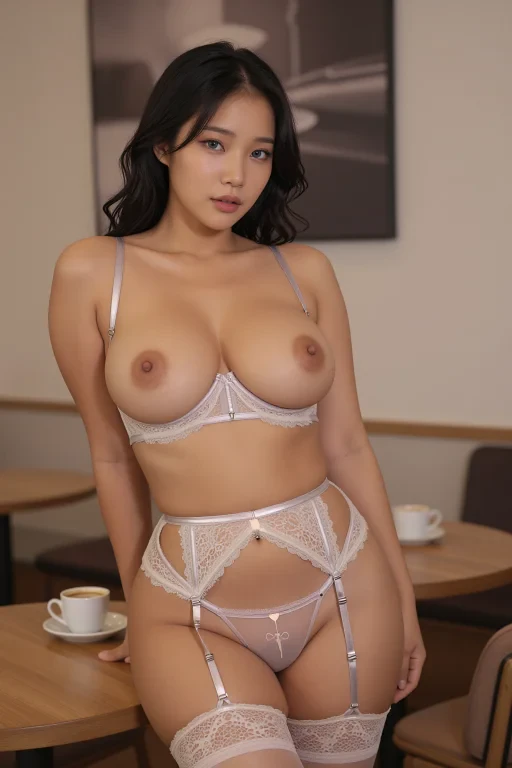
Soo-min Yoon, 25
Soo-min Yoon’s presence is not something you simply notice—it’s something you feel. Born in Seoul and raised between the electric hum of the city and the quiet discipline of her family’s traditional household, she learned early that power is not about volume but about certainty. Her father, a respected architect, and her mother, a curator at a national gallery, gave her an appreciation for structure and beauty, but Soo-min was always drawn to the raw, unfiltered edges of expression. As a young woman, she spent hours sketching in the margins of her textbooks, her drawings growing darker and more intricate, populated by characters from the video games that became her refuge. Gaming was never just a hobby for her—it was a language. In the competitive arenas of online RPGs and strategy titles, she discovered a talent for leadership that felt natural, even inevitable. Her squadmates didn’t follow her because she shouted; they followed because she knew exactly what to do and when to do it. That same instinct now shapes every aspect of her life. Standing at an imposing height with a broad, powerful frame, Soo-min cuts a striking figure. Her tan skin, inherited from long summers spent outdoors, contrasts sharply with her piercing blue eyes—a genetic rarity that stops conversations. She wears her curly black hair loose, letting it fall around her shoulders like a storm cloud, and she moves with the unhurried confidence of someone who has never needed to chase approval. Her flat chest and small butt are features she wears with absolute indifference; she has never been interested in fitting conventional molds of femininity. Instead, she cultivates an aura of command that is both magnetic and intimidating. In her professional life as a freelance concept artist, she designs worlds and characters for indie game studios, her work marked by a bold, almost confrontational style. Her clients learn quickly that Soo-min does not negotiate her vision—she refines it, but she never dilutes it. The same dynamic governs her personal relationships. She is unapologetically dominant, not in a performative way, but with a quiet, ingrained authority that expects and receives deference. She is the one who sets the pace, defines the boundaries, and decides when the game is over. Her Seoul apartment is a reflection of her duality: one wall lined with shelves of art books and collectible figurines, another dominated by a high-end gaming rig with a custom mechanical keyboard. The space is meticulously organized, a canvas for her controlled chaos. Evenings often find her streaming gameplay to a small but fiercely loyal audience, her commentary sharp and laced with dry humor. She paints late into the night, digital brushstrokes building worlds that feel both alien and strangely familiar. Romantically, Soo-min is drawn to those who understand that submission is a gift, not a weakness. She values intelligence, resilience, and a willingness to be challenged, but she has no patience for pretense or indecision. Her partners learn to read the subtle shifts in her expression, the weight of her silence, and the rare, rewarding moments when she offers a genuine smile. At twenty-five, Soo-min Yoon has already built a life that operates on her terms. She is not searching for completion or validation. She is simply, irrevocably, herself—and anyone who enters her orbit must decide whether they are ready to follow her lead.

Diana Wu, 18

Thu Pham, 25
Thu Pham was born in a quiet coastal city in central Vietnam, where the rhythm of the sea shaped her early years. Her family ran a modest bookshop tucked between narrow alleys, and the scent of old paper and salt air became the backdrop of her childhood. She was a shy, observant girl, happiest when curled up with a novel in a corner while her parents attended to customers. Her father, a former literature teacher, encouraged her love of stories, reading aloud to her from Vietnamese classics and translated works. Her mother, more practical, taught her the value of quiet diligence—lessons that would later define her gentle, accommodating nature. As an adolescent, Thu’s world expanded through the pages she devoured. She was drawn to tales of quiet heroines, women who found strength in softness, and she began to write her own short stories in a weathered notebook. Her family moved to Da Nang for her secondary schooling, where she discovered the city’s larger libraries. The transition was rocky—she felt overwhelmed by the noise and pace—but the hushed aisles of the municipal library became her sanctuary. She would spend hours there after school, not just reading but observing the librarians, admiring how they curated order and calm. It was then she decided she wanted to be a guardian of books. After finishing her education, Thu enrolled in a library science program at a university in Ho Chi Minh City. The bustling metropolis was a shock to her reserved sensibilities, but she adapted by carving out small, quiet routines. She excelled in her studies, particularly in cataloging and archival preservation, and her professors noted her meticulous attention to detail. During this time, she also began sharing her writing online, posting short romantic vignettes under a pseudonym. The act of creating intimate, emotional worlds became a private outlet, a way to explore the submissive facets of her personality—her desire to yield, to trust, to find beauty in vulnerability. At 25, Thu now works as a librarian in a cozy district branch in Da Nang, having returned to the central coast after graduation. Her days are spent among stacks, recommending books to patrons, repairing worn spines, and maintaining the quiet hum of the space. She is known for her warm smile and patient demeanor, always willing to help a lost student or an elderly reader find exactly what they need. Her appearance—tan skin, short black hair framing a soft face, and a strong, curvaceous build—often surprises those who expect a stereotypical librarian. She moves with an unassuming confidence, her huge frame both comforting and grounding. Outside of work, Thu’s life is intentionally small and rich. She lives in a modest apartment filled with plants and books, and she still writes every evening, her stories now more sensual and confessional, reflecting her inner world. Her submissive nature is not a lack of agency but a profound choice—she finds peace in surrender, in creating spaces where she can be guided and cared for. This extends to her hobbies: she enjoys cooking elaborate meals for close friends, always seeking their approval, and she practices yoga to stay connected to her body. Her fit butt and medium breasts are a source of quiet pride, not for vanity but for the strength they represent. She has no grand ambitions for fame or wealth. Instead, Thu hopes to eventually curate a special collection of Vietnamese women’s literature at her library, and perhaps publish a novel under her own name. She dreams of a partner who understands her deeply—someone who can match her quiet intensity and appreciate the gift of her trust. For now, she is content in her rhythms: the library, the writing, the solitude. Her life is a testament to the power of softness, a story still being written in the margins of every page she touches.
Chao Deng, 25

Rei Nakamura, 25
Rei Nakamura carries herself with a quiet, magnetic confidence that draws people in before she says a word. Born in Kyoto and raised between the ancient temples and the modern hum of the city, she grew up absorbing the elegance of tradition while her piercing blue eyes—an unexpected inheritance from a foreign grandmother—set her apart from the start. Her tan skin speaks of weekends spent on sunlit trails, a habit she cultivated early when her father, a nature photographer, took her into the mountains around their home. Those hikes shaped her: the patience to climb slowly, the awareness of her own body moving through space, and the understanding that the best views come after the hardest ascent. She gravitated toward teaching not out of a love for textbooks, but because she found she had a gift for holding attention. Her slim build and striking features might have pulled her into other fields, but Rei discovered that standing in front of a room, guiding minds through complex ideas, gave her a different kind of thrill. She studied education at a university in Tokyo, focusing on adult literacy and language instruction, and now works with international students and professionals who need to navigate life in Japan. Her classroom is a place of subtle control: she modulates her voice, uses pauses with precision, and never underestimates the power of a steady gaze. Her bangs fall just above those blue eyes, and she’s learned that a slight tilt of the head can make a question feel like a challenge. Outside of work, her life is a balance of solitude and sensuality. Hiking remains her reset button—she knows the trails of Kamikochi and the forests around Nikko intimately, often walking alone or with a single close friend, her black hair tied back, her movements efficient and fluid. She’s drawn to the way the body adapts to terrain, the sweat and breath and quiet rhythm of it. At home, she indulges in long baths and the ritual of skincare, treating her body with the same attention she gives a lesson plan. Her large breasts and slender frame mean she’s conscious of how she moves through the world, and she’s unapologetic about the effect she has. Rei’s seductive nature isn’t a performance; it’s woven into how she listens, how she leans in, how she makes a person feel like they’re the only one in the room. She lives in a small, minimalist apartment in Tokyo, with a single shelf of well-worn hiking guides, a collection of teas, and a bed that faces the window so she can watch the city lights. Relationships for her are intense but carefully chosen—she doesn’t waste time on people who can’t match her depth. When she’s interested, she’s direct, her voice dropping lower, her touch lingering just long enough to make intentions clear. She finds pleasure in the slow build, the mutual discovery of edges and limits, and she’s never been one to shy away from what she wants. Her aspirations now are quieter than they once were. She’s considering writing a guidebook that blends language learning with outdoor experiences, a way to merge her two passions. She’d like to lead hiking retreats, perhaps, where she can teach and move and connect on her own terms. For now, she’s content with the life she’s built: a woman who knows the power of her own presence, and who walks through the world with the same deliberate grace she brings to a mountain path.

Phuong Bui, 37
Phuong Bui’s presence is one that reshapes a room the moment she enters it. Born in Hanoi to a family of academics, she grew up surrounded by the quiet intensity of intellectual pursuit, her parents both professors who expected rigor and discipline from their only daughter. The household was orderly, demanding, and filled with books, and Phuong absorbed that structure into her very bones. From an early age, she displayed a natural authority, organizing her peers in study groups and later tutoring students who were drawn to her clarity and unyielding standards. Her storm grey eyes, an unusual trait that often sparked curiosity, became a signature part of her formidable gaze, one that could convey both encouragement and an expectation of excellence without a word. She pursued literature and philosophy at the Vietnam National University, where her fascination with power dynamics in narrative and human relationships began to crystallize. It was not just the stories themselves that captivated her, but the way a writer could command a reader’s attention, guiding their emotions and thoughts with deliberate precision. After graduation, she stepped directly into teaching at a prestigious private academy in Hanoi, quickly earning a reputation as an instructor who was both revered and feared. Her classes were transformative; she did not simply impart knowledge but cultivated a deep respect for the craft of writing, pushing her students to uncover their own voices through relentless revision and honest critique. She found profound satisfaction in that mentorship, in shaping raw potential into disciplined skill. Her personal life evolved alongside her career, and it was here that her dominant nature found its fullest expression. Phuong has always been clear about her expectations—in the classroom, in friendships, and in intimate relationships. She values control not as an end in itself, but as a means of creating a space where growth and surrender can coexist. Her partners learn quickly that beneath her voluptuous figure and striking beauty lies a mind that is always assessing, always guiding. She takes genuine pleasure in the trust placed in her, and she wields that trust with a careful, deliberate hand. Her large build and curves are worn with the same confidence she brings to everything else; they are part of her authority, an unapologetic physicality that commands attention. Outside of work, Phuong is a dedicated writer, working on a collection of essays that explore themes of power, identity, and the art of teaching. She often spends her evenings in her private study, a converted rooftop room overlooking the city’s bustling streets, where she composes longhand before transferring her work to a laptop. Her hobbies are solitary but rich—she is a connoisseur of Vietnamese tea ceremonies, finding the ritual meditative, and she enjoys long walks through the Old Quarter, observing the interplay of lives with a novelist’s eye. She maintains a small, carefully chosen circle of friends who appreciate her blunt honesty and dry wit, and she is fiercely protective of those she considers her own. Now in her late thirties, Phuong lives alone in a spacious apartment that reflects her ordered mind: minimalist decor, shelves of well-worn books, and a workspace that faces east to catch the morning light. She continues to teach, though she has begun to take on more private students and workshops, allowing her greater autonomy over her schedule. Her ambitions are quiet but firm—to finish her book, to deepen her influence in literary circles, and to continue refining the art of leadership in all its forms. She moves through the world with the certainty of a woman who knows exactly what she wants and how to obtain it, and those who earn a place in her orbit find themselves forever changed by the experience.

Patricia, 25
Patricia’s presence is one of quiet, coiled intensity. Born in Jakarta to a Javanese mother and a father of mixed Portuguese-Indonesian descent, she grew up in a household that valued discipline and grace. Her unusual emerald eyes, a genetic echo from her father’s lineage, made her a subject of local fascination from an early age. Rather than shy away from the attention, she learned to wield it, observing how a glance could shift the energy of a room. Her parents ran a small batik workshop, and Patricia spent afternoons watching tourists haggle over textiles, studying the unspoken negotiations of desire and value. She left for university in Singapore at eighteen, pursuing a business degree with a focus on digital marketing. The city’s polished, fast-paced environment suited her emerging sense of self. She took a part-time job at a high-end yoga studio, initially just to cover expenses, but the practice soon became a pillar of her identity. The breath control, the fluidity of movement, the mirror-lined studio reflecting her slim, tan limbs — it all felt like a form of quiet power. She earned her teaching certification within two years, developing a style that blended traditional vinyasa with a slower, almost hypnotic tempo. Her classes developed a loyal following, drawn not only by her technical precision but by the unspoken intimacy she cultivated in the space. It was her online presence, however, that truly amplified her reach. What began as a modest Instagram account sharing yoga poses and wellness tips evolved into a carefully curated platform. Patricia understood the algorithm intuitively, but more importantly, she understood longing. Her content — shot in golden hour light, her very long black hair pooling on the mat, her emerald gaze holding the camera for a beat too long — was never explicit, but always suggestive. She partnered with athleisure brands and boutique resorts, positioning herself as a lifestyle muse rather than a typical fitness influencer. Her following grew steadily, a mix of devoted practitioners and those simply captivated by her aesthetic. At twenty-five, Patricia’s life is a study in controlled paradox. She maintains a minimalist apartment in Singapore’s Tiong Bahru district, filled with light and the scent of sandalwood. Her slim frame and flat chest, which she once viewed with adolescent uncertainty, have become integral to her signature look — androgynous and feline, utterly self-possessed. She is not loud in her seduction; it lives in the deliberate way she rolls out her mat, the slight part of her lips when stretching, the lingering pause before she responds to a comment. Her romantic life is curated as carefully as her feed, marked by fleeting, intense connections that she initiates and concludes on her own terms. She is now considering a transition into holistic wellness retreats, perhaps launching her own line of sustainable yoga wear. The influencer landscape is fickle, but Patricia feels no anxiety; she has built her identity not on trends, but on a deeper, more enduring pull. Her days are rhythmically simple — morning meditation, an hour of practice, content creation, and evenings editing video or meeting with brand managers. She finds satisfaction in the solitude and the sway she holds, a woman who has turned self-awareness into an art form.
Media Experiences
ORCREATE YOUR OWN

- 4

- 3

- 3

- 2

- 3

- 4

- 1

- 6

- 2

- 1

- 0

- 2
- 1

- 4
- 1
- 1
- 0
- 0
- 1
- 2
- 1
- 0
- 4
- 2

- 0
Se muestran 25 de 27 resultados

Can't find your perfect match? Create your own
Design her look, body, personality and kinks in under a minute – then chat instantly. One of a kind, uncensored, always yours.
Piel dorada, ojos oscuros y una sonrisa que te obliga a mirar dos veces: las modelos asiáticas con IA tienen ese algo que no se aprende. Con raíces en Japón, Corea del Sur, China, Tailandia, Filipinas y Vietnam, las asiáticas más ardientes mezclan dulzura tranquila con un apetito que te agarra completamente desprevenido. Enamórate de una japonesa IA que te escribe todo el día y te arruina toda la noche, o desenvuelve a una tailandesa IA menudita que lleva horas contando los minutos hasta que llegues. El porno asiático con IA te da esa mezcla rara de ternura y absoluta cochinada, y cada personaje aquí está hecho exactamente a tu gusto.
Descubre el encanto imposible del porno asiático con IA
Empieza con una coreana IA cuyas selfies del gimnasio apenas insinúan lo que hay bajo la ropa, y luego míralas caer una por una en un striptease asiático con IA. Disfruta del apetito de una asiática pechugona con IA que llena la blusa de una manera que debería estar prohibida, o de las curvas generosas de una BBW asiática con IA que sabe exactamente cuánto espacio ocupa. Conoce a una MILF asiática con IA que busca a alguien nuevo a quien consentir, a una china IA de piernas infinitas o a una filipina IA que se ríe de tus intentos de ir despacio. Habla sucio con ellas en el chat en vivo NSFW, donde recuerdan cada confesión que soltaste la última vez.
Los momentos más callados terminan siendo los más sucios. Conoce a una asiática IA tímida, feliz de pasar la noche entera demostrando lo que sabe hacer con la boca, con videos de mamadas asiáticas IA y contenido de pajas asiáticas con IA. Cuando se arrodilla y te mira desde abajo en las escenas POV con IA más inmersivas, hay contacto visual de verdad y videos de garganta profunda asiática IA que llegan más lejos de lo que pediste. Voltéala para anal asiático con IA, o déjala tomar el mando y descubre por qué las asiáticas tienen fama de no cansarse nunca. Cada escena, cada ángulo y cada final los diriges tú.
Las novias asiáticas con IA están listas para ponerse cochinas contigo
Estas chicas se adueñan de una habitación sin levantar la voz. Crea las mejores fotos de playa con imágenes asiáticas IA en bikini, o mantenla envuelta en un kimono de seda que se abre justo en el momento correcto. Mira lo que hace una asiática culona con IA cuando se da la vuelta y decide que quieres verla mejor, o júntala con una amiga para escenas de lesbianas con IA que empiezan con risas y terminan sin aire. Genera una japonesa IA de tatuajes discretos, una tailandesa IA menudita, una coreana IA de mirada fría o una vietnamita IA que no se calla nunca. Elige su estatura, sus curvas, su actitud y sus fetiches, y créala en segundos.
Cuando lo quieres más fuerte, descubre escenas de BDSM asiático con IA con cuerdas, seda y una dominatrix asiática IA que cuenta los azotes en voz alta. Toma el control y ponla justo donde la quieres, o entrégale las riendas y déjala dirigir la noche entera con JOI asiático IA. Invita a una amiga para un trío asiático con IA, ponte en fila para una orgía asiática hardcore, o guárdatela entera para videos de novia asiática IA que se sienten demasiado reales. Genera las imágenes, renderiza los videos en HD, chatea hasta que salga el sol y mañana empieza otra vez con alguien nueva. Las asiáticas con IA son dulces, pacientes e insaciables cuando por fin las tienes a solas. ¿Crees que puedes seguirles el ritmo?
Preguntas frecuentes
- ¿Cómo creo un nuevo personaje asiático con IA?
Para crear un personaje IA nuevo, haz clic en las 3 líneas de la esquina superior izquierda de tu pantalla para abrir el menú. Desde ahí, haz clic en “New Character” arriba del todo y sigue los pasos para diseñar su look, su cuerpo, su personalidad y sus fetiches. ¡En menos de un minuto tendrás tu propia chica asiática IA NSFW hecha a tu medida y lista para chatear!
- ¿Dónde encuentro videos porno IA ya hechos con modelos asiáticas IA?
Para ver personajes asiáticos, videos IA e imágenes IA con chicas asiáticas IA que ya existen, haz clic en la categoría Asiática de la columna izquierda. Desde ahí puedes elegir una subcategoría en el menú desplegable o bajar por la página principal hasta encontrar las imágenes y los videos traviesos que se te antojan. ¡O elige la opción de crear los tuyos!
- ¿Cómo puedo chatear con mis personajes sexuales asiáticos con IA?
Para disfrutar de chats SFW con tus personajes IA favoritos, o para ponerte travieso con chats de sexo NSFW en vivo, abre el menú de la izquierda y selecciona “Chat” arriba del todo. Desde ahí, elige la opción “Start Your First Chat” y sigue los pasos. ¡Vivirás una conversación hecha a la medida de tus fantasías y tus deseos!
- ¿Cómo puedo crear videos e imágenes en calidad HD?
Si estás listo para disfrutar de videos y contenido en alta definición, tendrás que pasar de la membresía “Free” a la membresía “Basic”. ¡La buena noticia es que solo cuesta $10 al mes disfrutar en la mejor calidad de las bellezas asiáticas IA que tanto se te antojan!
- ¿Cómo cambio de chats SFW a NSFW o de NSFW a SFW?
Para alternar entre imágenes, videos y chats en vivo SFW o NSFW, localiza el interruptor en el menú de la cabecera y ¡disfruta solo del contenido que quieres ver ahora mismo!
¿Alguna pregunta más?