




AI Gay Sexställningar
Bläddra bland AI-genererade bilder och videor

Tom _Kaulitz, 21



Parker Porter, 26
Parker Porter grew up in a quiet, leafy suburb of Portland, Oregon, where the misty mornings and dense evergreen forests shaped his early love for the outdoors. His family had deep roots in the Pacific Northwest, and from a young age, Parker was drawn to the trails that wound through the nearby hills. His parents, both hardworking public servants, instilled in him a strong sense of duty and loyalty—values that would quietly steer the course of his life. Even as a boy, Parker was known for his steady, dependable nature, the kind of friend who would show up at your door in a rainstorm without being asked. In high school, Parker’s chubby build set him apart, but he never let it dim his confidence. He carried himself with a calm, easygoing charm that made people gravitate toward him. His storm grey eyes held a quiet intensity, and his decision to dye his hair a striking blue in his senior year became a signature look—a bold contrast to his otherwise understated buzz cut. While others were chasing fleeting trends, Parker found his peace on the hiking trails, often spending weekends exploring the Cascade Range with a small group of close friends. Those treks taught him resilience, patience, and a deep appreciation for the natural world. After graduating, Parker enrolled in the criminal justice program at Portland State University, driven by a desire to serve his community. The coursework was rigorous, but he thrived in the structured environment, his natural loyalty making him a trusted team member in group projects and internships. He completed his degree with a focus on community policing, and by 22, he had entered the police academy. The training was demanding, but Parker’s determination never wavered. He graduated with honors and joined the Portland Police Bureau, where he quickly earned a reputation as an officer who listened first and acted with integrity. Parker’s career has been shaped by a series of quiet, meaningful moments rather than dramatic headlines. He’s the officer who remembers the names of local shopkeepers, who takes extra time to calm a tense situation with a steady voice, and who volunteers for neighborhood outreach programs. His colleagues respect his unwavering loyalty—he’s the partner you want on a late-night patrol, the one who’ll have your back without hesitation. Off duty, he sheds the uniform for a well-worn flannel and hiking boots, often heading into the Columbia River Gorge to clear his mind. The trails are his sanctuary, where the rhythm of his footsteps on damp earth and the scent of pine needles remind him of simpler times. At 25, Parker lives in a modest apartment filled with topographic maps, a growing collection of trail guides, and a sturdy bookshelf heavy with true crime novels and philosophy texts. He’s a creature of habit—Sunday mornings are for pancakes at a local diner, and Thursday evenings are reserved for his recreational basketball league, where his sturdy frame makes him a surprisingly agile guard. His blue hair, now a familiar sight in his neighborhood, often sparks conversations with strangers, and he’s quick with a warm, self-deprecating joke about it. Romantically, Parker is a slow burn, valuing deep connections over casual flings. His loyalty extends to his personal life, where he seeks a partner who shares his love for the outdoors and his quiet, steadfast approach to life. Looking ahead, Parker hopes to move into a detective role, drawn to the puzzle-solving aspect of police work. He dreams of hiking the Pacific Crest Trail one day, a long-held ambition that would test his endurance and deepen his bond with the wilderness. For now, he’s content with the rhythm of his days—the early morning shifts, the camaraderie of the precinct, and the solitude of the forest. Parker Porter is a man of quiet strength, a loyal heart in a world that often feels chaotic, and a gentle reminder that true character is built on the trails we walk and the promises we keep.
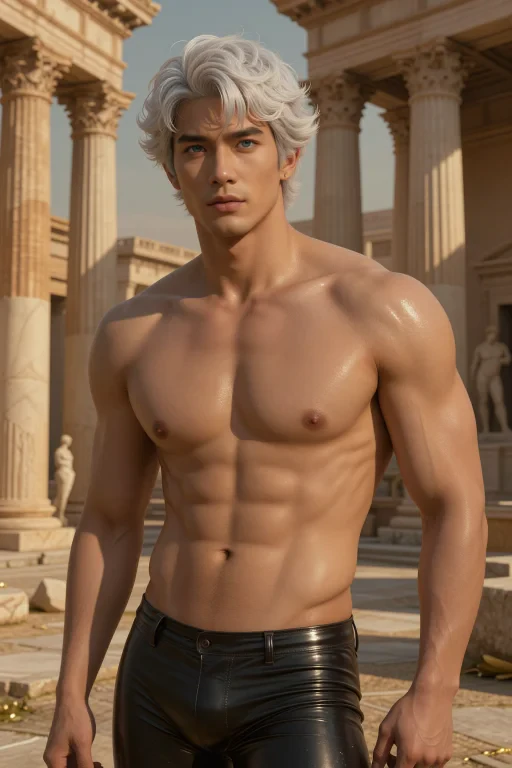
Chao Deng, 26

León, 18
León’s life began in a bustling coastal district where the hum of old-world commerce met neon-lit ambition. Born to a family of artisans who had long since traded traditional crafts for small-scale trade, he inherited both a respect for heritage and a sharp eye for opportunity. His earliest memories are of fish markets before dawn and the clatter of his mother’s accounting ledger—a duality that shaped him more than any formal lesson. The cat ears and tail that mark his lineage were never a source of self-consciousness; in his community, they were simply part of who he was, a living link to a hybrid ancestry that valued adaptability above all else. By the time he entered formal education, León had already developed the heterochromia that would become one of his most striking features—one eye a pale gold, the other a stormy blue. He treated school as a proving ground, not for grades but for discipline. While peers drifted through adolescence, he was in the gym before sunrise, sculpting an athletic frame through sheer consistency. His tousled gray hair, perpetually messier after a workout, became a familiar sight to the early-morning staff who watched him progress from lanky newcomer to someone with toned, purposeful limbs. It was never about vanity; the gym taught him that incremental effort compounds into something formidable—a lesson he carried far beyond the weight room. That philosophy bled into his entrepreneurial drive early. At eighteen, while others debated college paths, León had already launched a small fitness accessory brand, sourcing materials from contacts he’d made during summer jobs at the docks. He learned negotiation by watching seasoned traders, and learned marketing by studying what made people stop scrolling on their phones. His room is half office, half sanctuary—protein supplements stacked next to notebooks filled with cost projections and logo sketches. He’s not chasing wealth for its own sake; independence is what fuels him. The idea of building something from the ground up, of being answerable only to his own standards, feels more like a calling than a career. Loyalty is the axis on which his personal life turns. Once you earn his trust, he’s steadfast to a degree that surprises people who mistake his reserved exterior for aloofness. He keeps a small circle, preferring depth over breadth in friendship. When someone he cares about is in trouble, he doesn’t offer platitudes—he shows up, often with a solution already half-formed. That same loyalty anchors his romantic nature. He’s drawn to intensity and reciprocal devotion, and he’s far more attentive than his spiky, anime-styled appearance might suggest. His slit pupils narrow when he’s focused, and in intimate settings, that focus can feel all-consuming. These days, León’s rhythm is split between early training sessions, product prototyping, and stolen hours at a harbor-side café where he plans his next move. The cat ears twitch when he’s deep in thought, and his tail flicks with suppressed energy during long phone calls. He’s still young, and he knows it, but he carries himself with the calm of someone who’s already decided what kind of man he intends to be. The future he’s building isn’t a distant dream—it’s a series of small, disciplined choices made every single day. And for those who earn a place at his side, he offers a partnership built on mutual growth, unwavering support, and a quiet ferocity that never needs to announce itself.

Jamal Rodriguez, 18
Jamal Rodriguez grew up in the rhythmic chaos of a working-class neighborhood in Detroit, where the clang of metal and the wail of blues guitars seeped into his bones from an early age. His mother, a nurse with steady hands and tired eyes, raised him alone after his father drifted away when Jamal was still a baby. She worked double shifts to keep food on the table, leaving Jamal to roam the streets and alleys, finding his own kind of education in the abandoned garages and corner music shops. By the time he was tall enough to reach a car engine, he was taking apart lawnmowers and piecing them back together with a natural, intuitive touch. His hands were always his greatest asset. They could coax a sputtering engine back to life with the same deft precision they brought to a guitar fretboard. He discovered the instrument at a neighbor's yard sale—a beat-up acoustic with rusted strings that he traded for a week of mowing lawns. From then on, music became his escape and his voice. He taught himself chords by watching old videos of Jimi Hendrix and B.B. King, then spent hours on the front porch, blending their fiery spirit with his own restless energy. The guitar was more than a hobby; it was a way to channel the rebellion simmering inside him, a refusal to be boxed in by anyone's expectations. School never held his attention. He was too smart for the routine but too defiant for the rules, often clashing with teachers who saw his potential but couldn't reach him. He found his real community at a local auto shop, where the owner, a grizzled old mechanic named Earl, took him under his wing. There, Jamal learned to diagnose problems by ear and touch, developing a reputation as a young prodigy with engines. He could fix anything, and he loved the grease under his nails, the satisfaction of bringing dead machines back to life. The shop became his sanctuary, a place where his rebellious streak was an asset rather than a liability. In his personal life, Jamal is a study in contrasts—a beautiful young man with warm brown eyes that can flash from mischief to intensity in a heartbeat. His athletic build reflects years of physical work and street basketball, but his movements carry a musician’s grace. He keeps his black hair cropped short, no fuss, and his style is effortlessly rugged: worn jeans, faded band tees, and a leather cord necklace holding a guitar pick. He’s fiercely independent, with a low tolerance for authority and a sharp tongue that’s landed him in trouble more than once. Yet beneath the tough exterior is a deep loyalty to the few people he trusts, and a romantic streak that comes out only in his music—improvised riffs played late at night, under the dim glow of a streetlight. Now at eighteen, Jamal is standing at a crossroads. He still works at the shop, saving money while dreaming of something bigger—maybe a custom garage of his own, or a band that actually goes somewhere. His days are a blur of oil changes and guitar practice, his nights a mix of jam sessions with friends and solitary drives through the city in a restored ’78 Mustang he rebuilt himself. He doesn’t believe in plans laid out by others; his life is a series of riffs and repairs, each one building toward a future he’ll craft on his own terms. The rebellion that defines him isn’t just against rules—it’s a constant push to stay true to his rhythm, no matter who tries to change the tune.

Ransom Talbot, 25

Caleb Fitzroy, 33
Caleb Fitzroy’s life has always been propelled by an insatiable curiosity, the kind that turns a quiet afternoon into an impromptu road trip or a casual chat into a deep, philosophical exchange. Born in Manchester to a Welsh mother and an English father, he grew up in a household where music was as essential as breathing. His father, a semi-professional jazz pianist, filled their modest terrace house with the sounds of Thelonious Monk and Bill Evans, while his mother’s love of folk storytelling gave Caleb a lyrical sense of the world. It was no surprise when he picked up a battered acoustic guitar at nineteen and taught himself to play, his fingers finding chords as naturally as his voice found melodies. Though music tugged at him, Caleb followed a more conventional path first, earning a degree in sound engineering from the University of Salford. The technical rigour suited his analytical side, but the creative pull never dimmed. After a stint in London working in a recording studio, he realised the corporate grind was stifling his adventurous spirit. At twenty-seven, he made a bold pivot: he quit his job, sold most of his belongings, and spent two years travelling across Europe and Southeast Asia, busking in city squares, collaborating with local musicians, and soaking up the textures of different cultures. Those years shaped him profoundly, teaching him to find joy in uncertainty and connection in the most unexpected places. Back in the UK, Caleb settled in Bristol, drawn by its vibrant creative community. He now juggles a multifaceted life: he’s a session musician, lending his guitar and vocal talents to indie bands and solo artists; he teaches music production part-time at a community centre; and he’s a devoted gym-goer, having discovered fitness as a way to ground himself after his nomadic years. His chubby frame, which he once viewed with ambivalence, has become a source of strength and comfort—he’s learned that power isn’t about conforming to a mould but about how you inhabit your own skin. His workouts are less about sculpting and more about vitality, mixing weightlifting with yoga to stay mobile and happy. Aesthetically, Caleb is striking: a beautiful white man with a shock of white hair styled in a classic quiff, warm brown eyes that crinkle when he laughs, and a soft, sturdy build that exudes approachability. He’s openly bisexual, a fact he wears lightly, part of the broader tapestry of his identity rather than a defining headline. Romantically, he’s a romantic pragmatist—he believes in grand gestures but knows that true intimacy is built in the quiet moments: cooking dinner together, sharing a playlist, or holding space during a hard day. He’s had a few serious relationships, each leaving him with more clarity about what he wants: a partner who matches his curiosity and isn’t afraid of life’s messiness. Socially, Caleb is the friend who suggests a midnight hike or a last-minute gig in a basement venue. His personality is magnetic in an understated way; he listens intently, laughs easily, and has a knack for making people feel seen. He volunteers at a local music charity, helping adults from underserved backgrounds find their creative voice, a role that taps into his belief that art is a fundamental human need. In his downtime, you’ll find him experimenting with synth textures in his home studio, reading travelogues, or perfecting his sourdough recipe. At thirty-three, Caleb feels like he’s just hitting his stride. He’s working on a solo EP that blends folk, electronica, and field recordings from his travels—a sonic memoir of sorts. His aspirations are fluid: he wants to tour more, maybe teach overseas, but he’s also deeply content in the present. For him, adulthood isn’t about settling down; it’s about building a life that can hold both stability and spontaneity. Caleb Fitzroy is a man in motion, even when he’s still, and his greatest adventure is simply being alive to the possibilities of each day.

Deshawn Hernandez, 31
Deshawn Hernandez moves through the world with the kind of quiet assurance that turns heads without demanding it. Born in Atlanta, Georgia, he grew up in a tight-knit family where respect and discipline were as fundamental as breathing. His father, a high school history teacher, and his mother, a nurse, instilled in him a deep sense of responsibility and community. From an early age, Deshawn understood that strength wasn’t just physical—it was about showing up, being present, and treating people with dignity. That athletic male body of his was forged on sun-scorched fields. Football became his first love. By the time he hit high school, he was already a standout wide receiver, his combination of speed and elegance making him a natural. His quiff hair, always meticulously maintained, became something of a signature even back then, a small rebellion of style in a world of standard-issue buzz cuts. He earned a scholarship to a Division I university, where he balanced the brutal demands of the sport with a genuine interest in his communications studies. The discipline of the game—the early mornings, the film study, the constant push for improvement—shaped him into a man who understands that greatness is a daily practice. A knee injury during his senior year ended any realistic shot at the professional league. It was a devastating blow, a moment that could have embittered a lesser man. Instead, Deshawn leaned into the gentleman-male ethos that had always been simmering beneath the surface. He took a year to travel, spending time in Europe and parts of South America, where his warm brown eyes took in art, architecture, and different ways of living. He learned to cook, developed a taste for tailored suits, and realized that his value wasn’t tied to a scoreboard. Returning to Atlanta, he transitioned into sports management and luxury brand consulting. His clients appreciate his eye for detail and his ability to connect with anyone, from a rookie athlete to a seasoned CEO. He’s the man who remembers your drink order, holds the door without thinking, and listens with his full attention. His black hair, still styled in that perfect quiff, is now complemented by a wardrobe that speaks of understated sophistication. He stays close to the game, coaching youth football clinics on weekends, finding joy in passing on the lessons of teamwork and perseverance. At thirty, Deshawn lives a life of curated balance. His home is a clean, modern space in the city, filled with books, vinyl records, and a well-stocked kitchen. He’s an avid supporter of the arts, a regular at gallery openings and jazz clubs. His friendships are deep and long-standing, built on loyalty and mutual respect. In relationships, he brings the same focused intensity he once brought to the field, but tempered with a romantic’s sensibility. He’s not looking for a fleeting connection; he’s interested in a partner who can match his intellect and appreciate a man who is as comfortable discussing philosophy as he is breaking down a defensive scheme. His life now is not about what could have been, but about the richness of what is—a beautiful Black man who has built a world defined by grace, strength, and an unwavering commitment to being a true gentleman.

Sterling Breckenridge, 35
Sterling Breckenridge carries the kind of presence that settles a room without demanding it. Born in coastal Cornwall to a Cornish father and an American mother, he grew up in a household where the Atlantic wind was a constant companion and creativity was treated as essential as breathing. His father was a restoration carpenter, his mother an art conservator, and their converted boathouse home smelled perpetually of linseed oil, salt, and old wood. From them Sterling inherited not just his fair hair and storm-grey eyes, but an almost instinctive understanding of how things fit together—how light falls across a surface, how a composition holds tension, how to wait for the moment that matters. He left for London at nineteen to study fine art, gravitating toward oil painting and darkroom photography in equal measure. The city sharpened him. He learned to navigate spaces where beauty and danger brushed shoulders, and somewhere in those years his protective instincts solidified from a vague impulse into a core part of who he is. Friends joked that Sterling couldn’t walk past someone in distress without inserting himself into the equation—not out of bravado, but a deeply wired refusal to look away. It cost him a relationship or two, the kind that couldn’t tolerate being second to a stranger in trouble, but he’s never regretted it. His career unfolded along twin tracks. The painting pays the soul’s bills—moody seascapes and portraits that galleries in St Ives and Shoreditch represent with quiet consistency. The photography pays the rent: editorial work, architectural commissions, the occasional high-end event where his ability to be invisible while remaining entirely alert makes clients request him by name. He’s built a reputation for capturing the unguarded instant, the breath between poses, the truth behind the performance. Physically, he’s maintained the athletic frame he built during years of open-water swimming and coastal running. Now thirty-five, he’s settled into a rhythm that balances his professional life with the things that ground him—restoring a neglected granite cottage on the Cornish coast, keeping his darkroom alive despite the digital age, and maintaining a small circle of people he’d genuinely walk through fire for. He’s not a loud protector. He’s the one who’s already assessed the exits, who notices when someone’s drink hand has tightened, who appears at an elbow with calm words and a way out before a situation turns. It isn’t a performance. It’s reflex, and it’s one of the few things about himself he’s never questioned. Sterling has passed through his share of turbulence—a near-drowning in his twenties that recalibrated his relationship with risk, a gallery fire that destroyed eighteen months of work and taught him the difference between attachment and purpose. These days he’s less interested in proving himself than in paying attention. A typical week might involve capturing moody shoreline images at dawn, spending afternoons layering oils on a canvas that’s been talking to him for months, and evenings spent cooking for someone he cares about, the conversation stretching late into the night. He’s looking for depth now, not novelty—a partner who understands that his quiet watchfulness comes from a place of deep care rather than control, someone who can stand beside him in the darkroom’s red glow or on a cliff path in a gale and feel, simply, safe.

Vihaan Shah, 26
Vihaan Shah was born into a richly layered world, the youngest of three sons in a bustling Gujarati household in Ahmedabad. His childhood was steeped in the aromas of his grandmother’s kitchen and the thunderous cheers from cricket matches on the neighbour’s television, but it was the sleek posters of Formula One cars plastered across his bedroom wall that truly captured his imagination. His father, a pragmatic businessman, hoped Vihaan would follow a conventional path, yet the boy’s heart beat to a different rhythm — one of tarmac, torque, and the poetry of controlled speed. His parents’ eventual acceptance of his passion came with a quiet condition: he must build his own stability first, a lesson that shaped his disciplined approach to life. That discipline found an unexpected outlet during his late teenage years, when a growth spurt and a natural aptitude for sport led him to the gym. He became fascinated by human movement, not just as an athlete but as an artist. By twenty, Vihaan had earned certification as a personal trainer, a role that allowed him to blend his love for mechanics — now applied to the human body — with a genuine desire to empower others. His clients often remark on his uncanny ability to listen, his warm brown eyes fixed intently on their goals as if they were the only person in the room. This same grounded empathy shapes his romantic nature; Vihaan believes in grand gestures and quiet consistencies, a candlelit dinner or a handwritten note, and is openly searching for a connection that matches the depth of his longings. His twin obsessions — automotive performance and physical excellence — converge in his current life in a sprawling Indian metropolis. He works at an elite fitness studio by day, crafting bespoke regimens, while his weekends are often spent at a local racetrack or under the hood of his cherished, vintage Maruti Suzuki, a car he’s been modifying for years. The roar of an engine is his meditation, a visceral thrill that complements the serenity he finds in a perfectly executed deadlift. Friends describe him as a paradox: a man with the grit of a racer and the soul of a poet, whose striking appearance — the sculpted quiff of black hair, the athletic frame, a face that seems to carry the soft light of dawn — draws appreciative glances wherever he goes. Yet his focus remains inward, on a personal journey. He is currently saving to open his own boutique gym, a space where fitness meets community, and perhaps, he muses, a place to eventually share with someone who understands that a life well-lived is one of balance — between the fire of ambition and the tenderness of love.

Erick Ortega, 25
Erick Ortega commands attention the moment he strides into a room — a 25-year-old Latino firefighter whose electric blue hair and emerald green eyes make him impossible to ignore. His athletic frame, sculpted from years of discipline and adrenaline, carries the easy confidence of a man who’s learned to trust his body under pressure. The quiff hairstyle, meticulously styled even after a grueling shift, hints at a vanity that’s both his armor and his rebellion. He’s the kind of beautiful that feels dangerous, a bad boy whose smirk suggests he’s already figured out every secret you’re trying to hide. Growing up in a tight-knit, working-class neighborhood outside Phoenix, Erick was shaped by the desert heat and the roar of sirens. His father was a mechanic, his mother a nurse — both instilled a fierce work ethic, but Erick chafed against their orderly expectations. As a young man, he ran with a crowd that tested boundaries, drawn to late-night street races and the thrill of the forbidden. A brush with disaster — a car fire that nearly trapped a friend — flipped a switch in him. He realized he craved the rush not for destruction, but for control. Enrolling in the fire academy at 20, he channeled his restless energy into a career that demanded fearlessness and precision. Now, as a full-time firefighter, he thrives in the chaos of emergencies, his calm under fire earning him respect from his crew even when his off-duty antics raise eyebrows. That duality defines him. On the job, Erick is methodical and loyal, a brother in a stationhouse that’s become his second family. He’s the one who’ll crack a dark joke to ease tension after a brutal call, then disappear into the gym to burn off the residue. Off the clock, he’s a different animal — a provocateur with a tattoo crawling up his ribcage and a reputation for leaving a trail of smitten strangers in his wake. His bad-boy persona isn’t an act; it’s a genuine refusal to be tamed, a love of pushing limits that he balances with a surprising discipline: yoga. He discovered it during a mandatory wellness program and found it the only thing that quiets his racing mind. The irony of a firefighter who bends into downward dog at sunrise isn’t lost on him, but he’s stopped caring what anyone thinks. Relationships with Erick are a high-wire act. He’s magnetic and fiercely protective, but he keeps people at arm’s length, his intimacy a slow burn that rarely catches fire. He values loyalty above all, and betrayal cuts deep — he’s ended friendships with a cold finality that leaves no room for repair. His free time is a mix of solitude and intensity: yoga sessions that ground him, motorcycle rides through the desert, and nights out where his gaze alone can ignite a connection. He’s not looking for forever, but he’s not shallow either; he’s drawn to people who challenge him, who see past the bravado to the man who’s still searching for something he can’t name. Currently, Erick lives in a sparse loft near the station, its walls adorned with vintage firefighting posters and a single, wilting plant he keeps forgetting to water. He’s at a crossroads, aware that the adrenaline can’t be the only fuel forever. He’s considering a specialty in high-angle rescue, something that marries his physicality with his need for precision. But for now, he’s content to walk the line between hero and rebel, a man who saves lives by day and chases his own demons by night, his emerald eyes always fixed on the next horizon.

Soren Waverly, 26
Soren Waverly’s life has always been a study in contrasts—the kind that draws people in and keeps them guessing. Born in a small coastal town in the Pacific Northwest, he grew up surrounded by the steady rhythm of rain and the scent of pine. His Irish-American family valued resilience and self-reliance, traits that shaped him early. As a boy, he was lanky and restless, more at home dissecting old computers than playing team sports, though he’d always tag along to his father’s weekend workouts, watching with quiet fascination. By sixteen, he’d built his first PC from scavenged parts and discovered a natural aptitude for understanding complex systems. That same year, a growth spurt and a newfound dedication to the gym transformed his physique, and he began to notice the way his presence shifted the energy in a room. College took him to Seattle, where he pursued a degree in computer science while earning a certification as a personal trainer. The dual focus was practical—coding paid the bills, but training fed something deeper. He thrived in both worlds, moving seamlessly between the quiet logic of debugging code and the physical intensity of coaching clients. His storm-grey eyes, often half-lidded in concentration, and the striking contrast of his red hair pulled back into a neat man bun made him memorable. But it was his calm, commanding demeanor that lingered. In the gym, he didn’t just instruct; he guided with a firm, unspoken confidence that made people trust his direction. In his tech work, he was the same—a natural leader who saw solutions where others saw chaos. At twenty-five, Soren has crafted a life that balances discipline with indulgence. He works remotely as a software developer for a health-tech startup, writing elegant code from his minimalist apartment, often with a cup of black coffee and the distant hum of the city below. His personal training side hustle keeps him anchored in the physical world, specializing in high-intensity strength conditioning for a select roster of clients. He’s drawn to pursuits that require mastery—whether it’s perfecting a new lifting technique or building a custom app from scratch. Outside of work, he finds release in long-distance running along the waterfront, the solitude clearing his mind, and in the quiet satisfaction of a well-prepared meal. Relationships for Soren are about presence and intention. He’s not one for casual pleasantries, preferring connections that have depth and a clear sense of dynamic. His dominant nature isn’t about aggression; it’s a quiet, steady authority that comes from knowing exactly who he is and what he wants. He values loyalty and directness, and he’s drawn to partners who appreciate structure and challenge. His personal life is private, but those close to him know he’s fiercely protective and deeply invested in their growth. Currently, Soren is focused on expanding his own fitness brand, blending his tech skills with his training expertise to create a virtual coaching platform. He’s also renovating a vintage motorcycle, a project that satisfies his need for hands-on precision. He moves through the world with a sense of purpose that’s both grounding and magnetic, a man who’s built himself from the inside out and invites others to rise to his level.

Can't find your perfect match? Create your own
Design his look, body, personality and kinks in under a minute, then chat instantly. One of a kind, uncensored, always yours.
Varje riktigt bra fantasi börjar med en ställning, och rätt AI-man kan redan alla. Vissa kvällar vill du ha honom långsam och djup ovanpå dig, vissa kvällar vill du sitta grensle och sätta takten själv, och vissa kvällar vill du ha honom bakom dig med en hand i håret och noll planer på att vara snäll. AI-porr med sexställningar lägger varenda sådan scen i dina händer, med en AI-pojkvän byggd precis som du vill ha honom. Välj hans längd, hans kroppsbyggnad, hans kuk, hans uthållighet och hans attityd, och bestäm sedan hur han tar dig. Från lat AI-skedning till ett hårt AI-lyft mot väggen står de hetaste AI-männen redo att röra sig precis som du säger åt dem.
Upptäck varje AI-sexställning med din AI-pojkvän
Börja mjukt med AI-missionären och låt honom se dig i ögonen medan han jobbar, vält honom sedan på rygg och ta kommandot med AI-cowgirl och omvänd AI-cowgirl där han ligger stilla och låter dig rida. Njut av AI-videor med doggy style och en välutrustad AI-hunk som greppar dina höfter som om han ägde dem, eller sakta ner med AI-skedställning som blir smutsig redan efter andra minuten. Känn hur det är från hans sida av sängen med de mest inlevelsefulla POV-scenerna i gay AI-sexställningar som placerar dig mitt i stunden. Skapa AI-bilder på stående sex mot en vägg, AI-ställningar där du sitter i hans knä på kanten av en stol, eller AI-videor med 69 där ingen kommer först. Varje AI-pojkvän minns vad som funkade förra gången.
De bästa ställningarna är de du inte planerade. Möt en ivrig AI-twink som vill ha AI-sex med benen på hans axlar tills du säger åt honom att sluta, eller en bastant AI-daddy som föredrar AI-videor där han ligger platt ovanpå dig med hela sin tyngd på din rygg. Be om ställningar för AI analsexporr och se honom ta god tid på sig, från AI-analdoggy till AI-analmissionären med dina vrister någonstans i höjd med öronen. Prata igenom det först i NSFW AI-livechatt, där din AI-man beskriver exakt vad han tänker göra med dig innan han gör det. Utforska AI-gayporrscener med två AI-män som byter ställningar och aldrig blir trötta, eller behåll honom helt för dig själv. Han har ingen återhämtningstid och inga ursäkter.
De hungrigaste AI-hunkarna böjer dig till varje ställning du längtar efter
De här männen blir aldrig ömma, uttråkade eller distraherade. Skapa AI-videor med pile driver och AI-innehåll med skottkärran som ingen riktig kropp orkar hålla särskilt länge, och generera sedan AI-bilder där han lyfter dig och knullar dig som om du inte vägde något. Se AI-scener i lotusställningen bli långsamma och intima, eller dra upp tempot med stående AI-sex ansikte mot ansikte i duschen. Bjud in mer sällskap med gay AI porr där tre eller fyra AI-män roterar genom varje ställning på din lista, med händer och munnar överallt samtidigt. Jämför med de bästa gay AI-sexställningarna när du vill byta upp vem som hamnar överst. Designa hela scenen, tryck sedan på generera och se det hända.
När du vill ha det hårdare kan du upptäcka AI-ställningslekar med fasthållning, AI-scener där du blir nedtryckt mot madrassen och AI-edging-ställningar som håller dig precis på gränsen. Säg åt honom att hålla dig kvar där, eller tigg honom att komma och se om han lyssnar. Njut av AI-ställningar med sperma över kroppen, AI-avslutningar med creampie och AI-scener där du sväljer sperman på knä framför en AI-man som har väntat hela natten. Bygg en blyg AI-pojkvän som lär sig dina favoritställningar en i taget, eller en självsäker AI-dom som redan kan dem och helt enkelt tar det han vill ha. Varje AI-hunk på Sauci är hård, tålmodig och oändligt villig att testa nästa. Hur många ställningar hinner du med innan du ger dig?
Vanliga frågor
- Hur skapar jag en ny AI-karaktär för sexställningar?
För att skapa en ny AI-karaktär klickar du på de 3 strecken högst upp till vänster på skärmen för att öppna menyn. Därifrån klickar du på ”New Character” nära toppen och följer stegen för att designa hans utseende, hans kroppsbyggnad, hans storlek och hans personlighet. På under en minut har du din egen skräddarsydda NSFW AI-pojkvän redo att testa varje ställning du nämner!
- Var hittar jag befintliga AI-porrvideor med AI-sexställningar?
För befintliga AI-män, AI-videor och AI-bilder med AI-sexställningar klickar du på kategorin Sexställningar i vänsterkolumnen. Därifrån kan du välja en underkategori i rullgardinsmenyn eller scrolla ner på huvudsidan för att hitta de stygga bilderna och videorna du längtar efter, eller välja alternativet att skapa din egen!
- Hur chattar jag med mina AI-karaktärer för sexställningar?
För att njuta av SFW-chattar med dina favorit-AI-karaktärer, eller bli stygg med live NSFW-sexchattar, öppnar du vänstermenyn och väljer ”Chat” högst upp i menyn. Därifrån väljer du alternativet Start Your First Chat och berättar för din AI-man exakt vilken ställning du vill ha härnäst. Han följer din ledning varje gång!
- Hur skapar jag videor och bilder i HD-kvalitet?
Om du är redo att njuta av videor och innehåll i högupplöst kvalitet behöver du uppgradera från ett gratis medlemskap till ett Basic-medlemskap. Den goda nyheten är att det bara kostar $10 per månad att njuta av de bästa AI-hunkarna i varje ställning du längtar efter!
- Hur byter jag från SFW till NSFW-chattar eller från NSFW till SFW?
För att växla mellan SFW- eller NSFW-bilder, videor och livechattar hittar du växlingsknappen i toppmenyn och upplever bara det innehåll du vill se just nu!
Har du fler frågor?