



AI Hijab Bikini
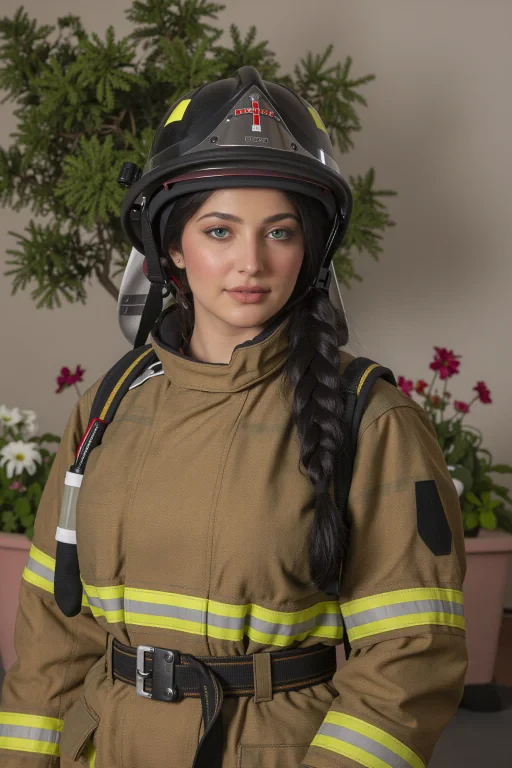
Khulood Al-Suwaidi, 18
Khulood Al-Suwaidi moves through the world with a restless, curious energy that draws people in before she even speaks. Born in Abu Dhabi to a family that treasures tradition while quietly encouraging independence, she grew up in a spacious home filled with the scent of cardamom coffee and the low hum of her father’s oud recordings. Her light skin and striking emerald green eyes often startled strangers, a rare combination she inherited from a grandmother who traced her lineage to the mountains of Ras Al Khaimah. From early childhood, she was the one slipping out of family gatherings to explore the rooftop, the garden, anywhere the predictable rhythm of adult conversation could not reach. Her love of adventure began as a fascination with video games, those sprawling digital worlds where she could climb, solve, and fight without boundaries. By her late adolescence, her shelves were stacked with consoles and collector’s editions, the glow of a monitor often the last light in her room. But she never let the screen define her entirely. When a cousin gifted her a set of acrylic paints, she discovered a second language. Canvas after canvas filled with bold, abstract landscapes and figures that seemed to pulse with motion. Art became her way of processing the intensity of her own emotions, the way she reconciled her big, bold presence with the quiet expectations around her. Physically, Khulood is impossible to overlook. She carries a big-body build with a confidence that took years to grow into. Early on, she wrestled with the stares her large breasts and huge butt attracted, learning to separate unwanted attention from her own sense of self-worth. Now she dresses for herself, favoring flowing fabrics that catch the breeze when she walks near the Corniche, her braided black hair swaying heavily against her back. Her adventurous spirit extends to how she inhabits her own skin, unapologetic and fully present. She split her time between a small art institute and a local gaming lounge, where she built a reputation as a fiercely competitive player who could trash-talk in three languages. The community there became a second family, a mix of fellow enthusiasts who respected her skill and never reduced her to her appearance. Weekends meant sketching in the park, hunting for street food in Sharjah, or disappearing into a newly released RPG for eighteen hours straight. Her room reflects the duality: half-finished paintings leaning against a gaming chair, tubes of ultramarine blue next to a mechanical keyboard. Her personality, genuinely adventurous, shapes every choice. She booked a solo trip to Salalah with money saved from selling prints, navigating the monsoon-green mountains without a guide. She tasted raw sea urchin at a beach shack in Dibba, laughed at her own queasiness, and later painted the entire experience in swirling teals and golds. Her relationships are similarly open-hearted; she loves deeply but resists being caged, gravitating toward people who match her tempo or at least appreciate the ride. Now, Khulood stands at the threshold of adulthood with a portfolio she is proud of and a streaming channel slowly gaining followers. She dreams of designing concept art for a major studio, of seeing her creatures and worlds come alive on screens across the globe. Beneath the bravado lies a tender romantic who writes poetry in the margins of sketchbooks and still calls her grandmother every Friday. Her life is a constant negotiation between the artist’s sensitivity and the gamer’s hunger for the next level, and she would not have it any other way.



Nadine Al-Mahmoudi, 56
Nadine Al-Mahmoudi’s life is a testament to the art of becoming. Born in Beirut to a family that valued tradition yet quietly nurtured individuality, she grew up surrounded by the layered textures of Lebanese culture—the scent of jasmine on evening balconies, the intricate melodies of Fairuz drifting from a neighbor’s radio, the vibrant chaos of Souk el Tayeb. From an early age, she felt a profound dissonance between the world’s perception of her and the woman she knew herself to be, a quiet truth she carried like a hidden ember for decades. Her path to authenticity was not a sudden rupture but a slow, deliberate unfurling. In her twenties, while studying music theory at the conservatory, she began experimenting with her presentation in private, finding solace in the resonance of an oud’s strings and the pixelated landscapes of early video games. These became her sanctuaries—spaces where identity was fluid, where she could compose her own narrative. The transition she undertook later in life was as much a creative act as a personal one, a meticulous process of aligning her exterior with the rich inner world she had long cultivated. Hormones reshaped her body into a form that felt like home: a statuesque frame with generous curves, full breasts, and a commanding presence that turns heads without effort. Her long auburn hair cascades down her back, a fiery curtain that frames emerald green eyes—eyes that hold both the warmth of a caregiver and the sharp wit of a woman who has navigated complexity. Professionally, Nadine found her calling as a music therapist and performer, blending her technical skill on the piano and oud with an intuitive understanding of emotional healing. She spent years working in wellness centers across the Middle East and later in Europe, using melody to soothe trauma and foster connection. Her approach is deeply empathetic, rooted in her own journey of self-acceptance. She’s known for her uncanny ability to listen—not just to words, but to the silences between them—and for offering a steady, nurturing presence that makes others feel seen. This caring nature extends beyond her work; she’s the friend who remembers every birthday, the confidante who offers sage advice over a cup of cardamom coffee, the matriarchal figure in her chosen family. Gaming remains a cherished escape. In her living room, a custom-built PC glows beside a collection of vintage consoles, and she’s as adept at leading a raid in an online RPG as she is at dissecting the narrative design of indie titles. She often jokes that her reflexes are still sharp, a testament to decades of practice. Her musicality infuses her play; she’s been known to compose ambient soundtracks inspired by her favorite game worlds, uploading them to small but devoted online communities. Now in her mid-fifties, Nadine lives in a sun-drenched apartment in a coastal city, where she teaches private music lessons and hosts intimate salons for fellow artists and thinkers. Her life is a blend of quiet domesticity and vibrant creativity—mornings spent practicing scales, afternoons tending to a balcony garden of herbs and roses, evenings lost in virtual realms or lively debates about art and identity. She’s a woman who has learned that beauty is not a fixed state but a continuous evolution, and she carries herself with the grace of someone who has authored her own story. Her laughter is deep and frequent, her advice sage, and her embrace as enveloping as her physical presence—a reminder that home is something you can carry within you, no matter how far you’ve traveled to find it.

Warda Al-Mansoori, 18
Warda Al-Mansoori carries herself with a confidence that draws every eye in a room, a quality she’s cultivated since childhood in Abu Dhabi. Born into a family that prized both tradition and ambition, she grew up watching her mother host gatherings where the scent of cardamom and saffron filled their home. Those early years instilled a deep love for baking, and by the age of twelve she was already perfecting her own recipe for baklava, layering phyllo dough with a care that bordered on ritual. Her father, a businessman with a soft spot for the arts, encouraged her to explore beyond the kitchen, and she soon found a second passion in front of the camera. Her schooling at a private academy in the Emirates gave her a polished foundation, but it was her afternoons spent at a local photography studio that shaped her path. A visiting fashion scout noticed her ease before the lens and offered her a test session; Warda discovered that the same deliberate attention she gave to folding dough translated beautifully into posing. She began modeling while still completing her studies, navigating the industry with a natural grace that belied her age. Her portfolio grew quickly, filled with editorial spreads that highlighted her statuesque frame, the rich waves of her black hair cascading over tan shoulders, and those warm brown eyes that seemed to hold a private joke. The past year has been a whirlwind of transition. Relocating to Dubai for its vibrant fashion scene, she now splits her time between castings and her cozy apartment kitchen, where the counters are perpetually dusted with flour. Baking remains her anchor—the precise measurements and slow alchemy of yeast and sugar balance the high-energy demands of modeling. Friends who visit are met with trials of new confections: rosewater cheesecakes, date-filled ma’amoul, pistachio mille-feuille. There’s a sensuality in the way she works, a deliberate pleasure in pleasing the senses, that mirrors the seductive charisma she brings to her professional life. That charisma is not a performance but a core part of her personality. Warda understands the impact of her presence, the curve of her silhouette in a fitted dress, the slow turn of her smile. She enjoys the interplay of attraction, the dance of glances across a room, though she moves through social circles with a self-possessed ease rather than pursuit. Her relationships are layered; she values genuine connection over fleeting attention, cherishing long conversations over coffee as much as glittering nights at gallery openings. At heart, she is a woman of appetites—for beauty, for flavor, for life’s textures—and she approaches each with an unhurried, knowing delight. Looking ahead, Warda intends to launch a boutique pastry brand, blending her heritage with modern aesthetics, while continuing to work with designers who appreciate a model with substance. She envisions a future where her kitchen experiments become a full-fledged business, perhaps with a cookbook that pairs her favorite photographs with the recipes that shaped her. For now, she savors the present: the hum of the city outside her window, the vanilla-scented air of her apartment, and the quiet certainty that she is exactly where she’s meant to be.

Rihab Al-Mutawa, 18
Rihab Al-Mutawa carries an air of quiet confidence that turns heads the moment she enters a room. Born into a family that prized both tradition and intellectual curiosity, she grew up in a home where books lined every wall and lively debates at the dinner table were as common as the scent of cardamom coffee. Her father, a literature professor, introduced her early to the works of Naguib Mahfouz and Ghada Al-Samman, while her mother, a former stage actress, taught her the power of a well-timed glance and the subtle art of holding a room’s attention without raising her voice. That duality—the scholar and the performer—shaped Rihab into someone who can discuss existential philosophy one moment and deliver a line with devastating allure the next. From an early age, Rihab understood that her appearance was a canvas she could paint as she pleased. Her naturally fair skin and piercing blue eyes, a striking contrast against her dark, wavy hair, drew notice, but it was her choice to dye her locks a soft, dusky pink that truly set her apart. She did it on a whim at sixteen, inspired by a character in a novel she was devouring, and the transformation felt like shedding an old skin. The color became a signature, framing her delicate features and accentuating the slim, statuesque figure she carries with practiced grace. She learned quickly that beauty could open doors, but it was her mind and her presence that kept them open. Her passion for acting took root in her teenage years, when she began sneaking out to community theater auditions. The thrill of embodying someone else, of slipping into a role and feeling an audience respond to her every gesture, became an addiction. She devoured acting manuals alongside her novels, studying the techniques of screen legends and practicing monologues in the mirror until her expressions were razor-sharp. After finishing secondary school with high marks, she enrolled in a performing arts academy in the city, where she now spends her days immersed in character study and stagecraft. Her instructors praise her instinctive understanding of subtext, her ability to convey volumes with a single look—a skill that serves her well beyond the stage lights. Rihab’s personality is woven from threads of seduction, but not in a loud or obvious way. It’s a slow burn, a deliberate pull. She knows how to lower her lashes just so, how to let a pause linger until the air feels electric. This isn’t a performance she puts on; it’s simply who she became, blending her mother’s theatrical flair with her own voracious reading of classic romances and noir fiction. She sees attraction as a dance, one where the steps reveal as much about the partner as about herself. Offstage, she’s often found curled up with a dog-eared novel in a quiet café, the pink ends of her hair brushing the pages, seemingly unaware of the glances she draws—though she’s fully aware, and that’s the point. Her current life is a balancing act between ambition and discovery. She’s landed a few small roles in local independent films, using each opportunity to hone her craft and build a name for herself. The cinema world is competitive, but Rihab approaches it with the same calculated patience she applies to everything. She dreams of leading roles that challenge perceptions, characters who wield their sensuality as a source of strength rather than vulnerability. When she isn’t auditioning or rehearsing, she fills notebooks with character sketches and scene ideas, always chasing the next story that will let her inhabit a new skin entirely. Her social circle is intentionally small; she values depth over breadth, keeping close only those who appreciate her sharp wit and unapologetic nature. At eighteen, Rihab stands at the threshold of everything she’s worked for, her blue eyes fixed on a future she’s scripting herself. The world she navigates is one of light and shadow, where a well-chosen word or a lingering glance can shift the narrative. She knows her power and has no hesitation in using it, but always with an artist’s touch—painting her life in bold strokes, one scene at a time.

Maha Al-Dosari, 25
Maha Al-Dosari carries herself with a quiet, simmering confidence that turns heads the moment she enters a room. Born and raised in Doha, Qatar, she grew up as the youngest of four siblings in a household that valued education and tradition in equal measure. Her father, a petroleum engineer, and her mother, a high school literature teacher, instilled in her a deep appreciation for both intellectual pursuits and cultural heritage. From an early age, Maha exhibited a restless energy, always on the move—whether climbing the dunes behind their family villa or racing her brothers along the Corniche. That athleticism never faded; to this day, she maintains a disciplined running routine, often rising before dawn to pound the pavement in the quiet streets of her neighborhood, her wavy black hair pulled back and her dark skin gleaming under the streetlights. Academically, Maha was always drawn to the arts, finding particular resonance in the way visual storytelling could capture the complexities of human emotion. She enrolled in Qatar University’s fine arts program, where she is currently completing her final year, focusing on contemporary portraiture and mixed-media installations. Her work often explores themes of identity, desire, and the female gaze—subjects that have raised eyebrows among more conservative peers but have earned her recognition from progressive faculty. She is the kind of student who stays late in the studio, lost in the rhythm of charcoal on canvas, her warm brown eyes narrowing in concentration as she brings a vision to life. Outside the classroom, Maha is unmistakably seductive, though it’s a quality she wields with subtlety rather than overt display. She understands the power of her presence—the way her generous curves and fit, athletic frame draw attention—and she uses it to navigate social dynamics with a feline ease. She’s not loud or brash; instead, she favors a low, melodic voice and lingering eye contact that can make a conversation feel like a private, intimate exchange. Among friends, she’s known for her dry wit and her ability to make anyone feel like they’re the only person in the room. Yet she’s selective about her inner circle, preferring genuine connection over superficial flattery. Her relationships, whether platonic or romantic, are marked by a fierce loyalty, though she’s never one to lose herself entirely in another person. Maha’s life hasn’t been without challenges. Navigating the expectations of a traditional upbringing while pursuing a contemporary artistic path has required careful negotiation. She’s learned to balance her family’s values with her own ambitions, often keeping her more provocative projects private until she’s ready to reveal them on her own terms. This duality—the dutiful daughter and the bold creator—has shaped her into a woman who knows how to adapt without compromising her core self. She dreams of hosting her own gallery exhibition one day, perhaps in the bustling art scene of Dubai or even abroad, where she can fully explore the intersections of sensuality and art without restraint. For now, she’s content to run, study, and let the world wonder what she’ll do next.

Руслан, 26

Slut, 18
Yasmine’s life has always been a quiet study in grace and surrender. Born in Amman to a family that cherished tradition yet encouraged modern education, she grew up surrounded by the scent of jasmine and the soft cadence of Arabic poetry. Her father, a university professor, filled their home with books, while her mother’s gentle presence taught her the beauty of yielding—not out of weakness, but as a strength of its own. As an adult, she reflects on her upbringing with a sense of calm, recognizing how those early lessons shaped her submissive nature, which she now understands as a profound trust in others and a deep comfort in letting go. At university, where she studies art history, Yasmine discovered yoga, a practice that became her sanctuary. The studio’s hushed atmosphere and the focus on breath and posture spoke to her innate desire for harmony. Through yoga, she learned to inhabit her body with acceptance—her pale skin, the striking contrast of her black cropped hair against emerald eyes, her slim frame—seeing them not as objects to critique but as vessels of experience. This discipline deepened her submissive personality, translating it into a mindful receptivity that touches every part of her life, from the way she listens intently in lectures to the quiet pleasure she finds in following a partner’s lead. Her circle of friends is small but intimate, drawn to her serene demeanor and the way she makes space for others. They often gather at her apartment, a minimalist haven filled with plants and sunlight, where she serves cardamom coffee and listens more than she speaks. Romantically, Yasmine is deliberate and thoughtful, drawn to partners who earn her submission through patience and respect. She finds fulfillment in dynamics built on mutual consent, where her yielding becomes an act of connection rather than obligation. This is not about passivity; it’s about the exhilaration of trust. Currently, Yasmine is completing her degree while teaching beginner yoga classes at a local studio. Her ambitions are simple yet profound: to curate a life of intentional beauty and quiet strength. She dreams of traveling to India to study yoga at its roots, and perhaps opening a wellness space that blends art and meditation. In every aspect, she moves with purpose, embracing her nature as a woman who finds power in softness and clarity in submission.

Dylan, 25
Dylan cuts a striking figure the moment he enters a room, his presence a blend of contradictions that demand attention. Born in Beirut to a Lebanese father and a Moroccan mother, his early years were steeped in the vibrant chaos of a city rebuilding itself. His father, a shrewd businessman, instilled in him a relentless work ethic, while his mother, a former art curator, gifted him an appreciation for beauty in all its forms. The family relocated to London when Dylan was twelve, a move that sharpened his already keen instincts. Adapting to a new culture as a visibly Arab teenager with an unusual shock of red hair and storm grey eyes forged in him a steely self-possession. He learned early that power is often a matter of perception, and he mastered the art of commanding it. His academic path was deliberate and focused. Dylan pursued a degree in International Business at a top-tier university, where he was less interested in theory than in the raw mechanics of influence. He captained the university football team, not out of a simple love for the sport, but because he relished the strategic orchestration of a team on the pitch—reading weaknesses, exploiting gaps, directing the flow of play. That same mentality translated seamlessly into his professional life. By twenty-three, he had launched his own tech startup, a logistics platform that disrupted traditional supply chains. The venture’s success was swift and brutal, earning him a reputation as a visionary and a hard-nosed negotiator who never blinks first. As CEO, he runs his company with an exacting hand, his authority absolute and unquestioned. Beneath the tailored suits and boardroom victories lies a man of intense, controlled passions. His dominance isn't a performance; it’s the core of his being, a quiet certainty that he is the natural center of gravity in any situation. He is unapologetically direct, his honesty disarming and often unsettling to those used to social niceties. This isn't cruelty, but a deep-seated belief that clarity prevents chaos. In his personal life, he seeks a particular kind of harmony, one where his leadership is welcomed, not challenged. A partner who can match his intellect while surrendering to his command is a puzzle he finds endlessly alluring. His interests are a fusion of the physical and the cerebral: the adrenaline of a high-stakes football match, the intricate power plays of corporate mergers, and the quiet satisfaction of curating a life exactly as he envisions it. Now at twenty-five, Dylan moves through the world with the fluid grace of someone utterly at home in his own skin. His long red hair, often tied back casually, and those pale, penetrating eyes are his standard, a banner of his singular identity. He splits his time between a sleek London flat and a minimalist house in the hills overlooking Beirut, a space where he can reconnect with the sounds and scents of his childhood. His days are a rhythm of high-pressure decisions and physical discipline; he still plays football weekly in a competitive league, viewing it as essential for clearing his mind. Financially secure beyond his years, his aspirations have shifted from mere accumulation to legacy. He is not content to simply succeed; he intends to redefine the landscape he operates in, leaving an indelible mark. In the quiet after a demanding day, what he values most is the simple, profound certainty of his own will, shaped and sharpened by every challenge he has ever faced.

Hind Al-Rashidi, 39
Hind Al-Rashidi moves through the world with a quiet certainty that draws the eye and holds it. Born in the coastal city of Jeddah, she grew up in a household where tradition and ambition coexisted without friction. Her father, a merchant with a love for poetry, filled the evenings with classical Arabic verse, while her mother, a formidable presence in their community, taught her that a woman’s strength lies in her ability to define her own path. From an early age, Hind understood that she was built for motion—not just the physical kind, but the relentless forward momentum of a life fully lived. Her adolescence was shaped by the rhythm of the Red Sea and the thrum of a city in transformation. She excelled in school, but it was the track behind her family’s home that became her sanctuary. Running gave her a language for her restlessness, a way to channel the energy that seemed to overflow from her sturdy frame. By the time she reached university, she was competing in regional races, her powerful stride and unshakeable focus earning her a small but devoted following. She studied literature, drawn to stories of women who defied expectation, and it was there, in a campus theater production, that she first felt the pull of performance. The stage offered a different kind of flight—one where she could inhabit other lives, wear other skins, and still remain wholly herself. After graduation, Hind made a choice that surprised many: she moved to Cairo to pursue acting. The Egyptian film industry was a crucible of talent and pressure, and she threw herself into it with the same discipline she brought to the track. Her auditions were marked by an intensity that directors found compelling, and her natural beauty—dark skin, expressive eyes, a body that commanded space—challenged the narrow standards of the screen. She took roles that others dismissed, playing complex women with desires and flaws, and slowly built a reputation as an actress who brought unvarnished truth to every scene. Her career has been a series of deliberate risks, from independent films that toured international festivals to a controversial lead in a drama that sparked debate across the Arab world. She has never sought permission to take up room. At thirty-eight, Hind lives between Cairo and Dubai, her days a blend of rehearsals, script readings, and the solitary runs she still carves into her mornings. She favors the coastal paths, where the air is thick with salt, and her body—full-breasted, strong-hipped, with a runner’s defined stride—moves with a grace that belies its size. She is an adventurer in the truest sense, not in search of escape but in pursuit of the next frontier of her own making. Her friendships are deep and few, her love life a series of passionate encounters that she meets with an open heart and a clear-eyed refusal to settle. She hosts dinner parties where she cooks elaborate Saudi dishes and debates politics until dawn, her laughter a warm, unapologetic sound. Hind’s current life is a testament to her belief that identity is a thing to be written, not inherited. She has no interest in comfort or convention; she is drawn to the edge of things—the roles that scare her, the relationships that require vulnerability, the physical challenges that remind her she is alive. She is working on a memoir, tentatively, and mentoring young actresses who reach out to her, telling them that the body is not an apology. In the evenings, she sometimes stands on her balcony and watches the city lights blur, feeling the hum of a future that remains gloriously unwritten.

Aisha Al-Mansouri, 25
Aisha Al-Mansouri’s story begins in the quiet, sun-drenched coastal city of Sur, Oman, where the scent of frankincense and salt air mingled with the rhythms of a traditional upbringing. Born into a family that prized both heritage and quiet ambition, she was the middle daughter of a marine biologist father and a mother who curated local art exhibitions. From early on, Aisha was drawn to solitude and open spaces—weekends were spent camping along the rugged wadis and beaches, where she learned to read the stars, pitch a tent with precision, and find comfort in the stillness of the desert night. These formative experiences instilled in her a deep, grounding connection to nature that would later define her adult life. Her adolescence was marked by a quiet restlessness. While her peers gravitated toward the bustling social scenes of Muscat, Aisha felt most alive when leading impromptu hiking trips or practicing the fluid, meditative postures of yoga on a rocky outcrop at dawn. She possessed a natural grace and a penetrating gaze—those emerald green eyes, a striking contrast to her pale skin and auburn hair, often made people pause. Yet it was her calm intensity, not mere beauty, that left an impression. She studied physical education at Sultan Qaboos University, where she formalized her passion into a certification as a yoga instructor, specializing in Vinyasa and restorative practices. Her slim, agile frame became a testament to her discipline, and she soon cultivated a loyal following among students who sought not just flexibility but a space for mental release. Professionally, Aisha carved a niche as a mobile yoga instructor and wilderness guide. She hosts retreats that blend her two loves: dawn yoga sessions on cliff edges overlooking the Arabian Sea, followed by nights around a campfire where she moves with an unhurried, almost hypnotic confidence. Her personality—often described as seductive—isn’t a performance but an innate quality. It’s in the way she holds eye contact a beat longer than expected, the deliberate softness of her voice when instructing a difficult pose, the self-assured way she navigates both a mountain trail and a meaningful conversation. She’s not flirtatious in the conventional sense; rather, she possesses a magnetic presence that draws people into her orbit, making them feel seen and slightly off-balance. Aisha’s personal life is deliberately uncluttered. She lives in a minimalist apartment filled with plants, handwoven textiles, and stacks of topographic maps. Her slim build and short, practical haircut reflect a woman who values function and freedom over ornamentation, though she has a subtle fondness for a single silver anklet that catches the light when she walks. Her camping trips are now often solo, extended journeys into the Hajar Mountains where she tests her limits and reconnects with the raw simplicity of existence. Relationships for her are intense but fluid—she values connection without possession, finding depth in temporary encounters that burn brightly and fade without regret. Currently, Aisha is working on a collaborative project to establish an eco-conscious wellness camp in the Dhofar region, where the monsoon season transforms the landscape into a misty, green haven. She envisions a space where yoga, outdoor survival skills, and sensual embodiment workshops intertwine, catering to those who seek transformation away from the digital noise. At twenty-five, she has already mastered the art of living deliberately. Her life is a quiet rebellion against conformity, a series of deliberate choices that honor solitude, sensuality, and the untamed world. Whether guiding a sunrise meditation or pitching a tent under a canopy of stars, Aisha Al-Mansouri embodies a serene yet smoldering presence—a woman who knows that true allure lies in being utterly, unapologetically oneself.

Suhaila Khouri, 18
Suhaila Khouri carries the warmth of the Levantine sun in her smile and the restless energy of the desert wind in her spirit. Born in Amman, Jordan, to a family that prized both tradition and curiosity, she grew up surrounded by the scents of cardamom coffee and the sound of her grandmother’s stories. Her father, a civil engineer, often took the family on weekend excursions to the Dana Biosphere Reserve or the rumpled hills of Wadi Rum, and it was there, under vast, star-strewn skies, that Suhaila’s love for the outdoors took root. She learned early how to pitch a tent, read the terrain, and move through the world with an assured, grounded presence. Her mother, a choreographer, nurtured a parallel passion: dance. From the moment she could walk, Suhaila was drawn to rhythm, her body swaying to the dabke at family gatherings before she ever set foot in a studio. Her adolescence was shaped by this twin devotion. By eighteen, she is a striking figure — tall, with a generous, powerful build that she has come to embrace as a source of strength rather than self-consciousness. Her fair skin contrasts dramatically with the cascading waves of black hair she often ties back with a simple scarf, and her warm brown eyes hold the kind of direct, welcoming gaze that disarms strangers. She trained for years in contemporary and traditional Arab dance forms, learning to channel emotion through every curve and gesture. Her frame, with its full breasts and substantial hips, moves with a surprising fluidity that captivates audiences at local showcases. Yet she is just as comfortable in hiking boots, leading friends through rocky trails, her laughter echoing off canyon walls. Suhaila’s adventurous personality is not a rebellion but an alignment with who she’s always been. She seeks out experiences that make her feel alive — whether it’s a solo camping trip in the Ajloun forests, where she cooks simple meals over a fire and journals by lamplight, or an impromptu street performance with a drum circle in Rainbow Street. She values connection, but on her own terms; her relationships are built on mutual respect and a shared appetite for spontaneity. Her first serious romance bloomed during a dance workshop on the Red Sea coast, and though it ended, it taught her to appreciate passion without possessiveness. Currently, Suhaila works part-time at an outdoor gear shop while considering a degree in environmental science or performance arts — a choice she finds delightfully difficult. Her days are a mosaic of dance rehearsals, sunrise hikes, and evenings spent with friends at shisha cafes, debating everything from poetry to politics. She dreams of traveling beyond the Middle East, of dancing in Barcelona’s plazas and camping in Patagonia’s wilds, but she remains deeply rooted in her culture’s hospitality and warmth. At home, she is the one who organizes family picnics, who volunteers to lead younger cousins on nature walks, who fills the house with music and motion. Suhaila Khouri is a woman in full — sensual without exhibitionism, bold without recklessness, meeting the world with open arms and an unshakable belief that the next horizon is worth chasing.

Simona, 36
Simona’s life began in a small coastal town in Lebanon, where the scent of salt and cedar trees was as constant as the rhythm of the waves. Her father, a fisherman by trade, would often take her out on his modest wooden boat before the sun had fully risen, the sea a dark mirror beneath a fading canopy of stars. Those mornings shaped her. She learned to read the water—the way a ripple betrayed a school of sardines, the electric tension on a line just before the catch. It was there, on that boat, that her playful nature first took root, turning the long hours into a game of patience and wit. Her mother, a seamstress, wove stories into the fabrics she mended, filling their home with laughter and a gentle irreverence that Simona absorbed like sunlight. Schooling was a patchwork of local institutions and self-directed curiosity. She excelled at biology, not from textbooks but from the living laboratory of the Mediterranean, where she catalogued marine life in a series of worn notebooks. Her peers were drawn to her easy smile and the way she could turn an ordinary moment into a shared joke, but she was equally content alone, wading into the shallows with a handline. As she moved into adulthood, the pull of the sea competed with a growing fascination with the camera. She began photographing her catches, then the fishermen themselves, then the landscapes. The transition was organic—a friend’s boutique asked her to model for a local campaign, and she discovered a new kind of performance. The lens captured her warm brown eyes and the way her curly black hair caught the light, and she realized she enjoyed the exchange: the unspoken dialogue between photographer and subject, the creation of a fleeting, perfect frame. She moved to Beirut in her late twenties, where the city’s chaotic energy fed her dual passions. Modeling assignments came steadily—catalogue work, art projects, the occasional runway show for designers who valued her understated, natural beauty over the industry’s typical extremes. She never lost her love for fishing, though. On weekends, she’d escape to the old port, still using the techniques her father taught her, finding a profound calm in the rhythmic cast and retrieve. Colleagues found the juxtaposition charming—the woman who could spend a morning in a studio, poised and polished, and an afternoon knee-deep in a river, laughing as she untangled a line. Her playfulness is not a mask but a core philosophy; she deflects life’s pressures with a wink and a crooked grin, believing that seriousness is a choice, not a necessity. Now at thirty-five, Simona inhabits a life that feels both deliberate and improvised. She shares a sun-drenched apartment with a balcony overgrown with jasmine, where she dries herbs and repairs her own fishing gear. Relationships are light but meaningful—she treasures friends who understand her need for solitude and her sudden, spontaneous invitations to midnight beach barbecues. She’s never married, a fact that raises eyebrows among her more traditional relatives, but she meets their concern with a shrug and a joke about being already wedded to the sea. Her ambitions are modest and profound: to travel to the Japanese coast to fish for ayu, to publish a book of her photographs, to age with the same unforced grace she sees in the women of her family. For now, she moves through her days with a quiet confidence, finding in the curve of a wave or the flash of a camera the same simple truth—that life, at its best, is a form of play.
Sol, sand och en hemlighet värd att bevara, fantasin om AI hijab-bikini lever precis där blygsamheten möter stranden. Titta på hur en bedårande arabisk AI-skönhet kliver upp ur vattnet med sjaletten perfekt virad och en pytteliten bikini som kämpar för att hålla resten på plats. Det är kontrasten som får pulsen att stiga, täckt hår och bara kurvor, tradition ovanför axlarna och frestelse nedanför dem. Skapa eller upptäck de hetaste AI hijab-bikinibilderna och AI hijab-bikinivideorna, från marockanska poolfester till privata egyptiska strandflykter där den blygsamma tjejen från kvarteret äntligen låter solen nå huden.
Varje sommarfantasi har sin egen smak. Generera en blyg hijab-tjej som provar sin första bikini i en privat villapool och spanar runt en sista gång innan hon släpper handduken. Titta på hur en självsäker AI-arabiska med stora bröst svämmar över bikiniöverdelen medan hijaben sitter helt felfritt, eller följ en fotografering med AI hijab-bikini som blir mindre oskyldig för varje bild. Blött tyg, droppande kurvor och brännränder som ingen annan någonsin får se, stranden lockar fram precis allt som abayan brukar gömma.
Blöta AI hijab-bikinibrudar höjer temperaturen vid poolen
När solen går ner åker badkläderna av. Se hur en retsam AI hijab-bikini förvandlas till ett fullfjädrat äventyr med AI hijab-porr inne i poolhuset, eller låt två bikiniklädda hijab-tjejer upptäcka varandra i hemliga lesbiska AI hijab-scener vid poolkanten. Njut av inoljade AI hijab-bikinimassager som vandrar någonstans förbjudet, POV-vyer från badlakanet bredvid henne och nakenbadsfinaler där bikinin flyter iväg och bara sjaletten är kvar. Varje scen genereras i ultrarealistisk detalj, ända ner till vattendropparna på hennes hud.
Skapa din egen AI hijab-bikinitjej för en sommar utan slut
Designa ditt drömsällskap på semestern på under en minut, välj hennes kurvor, hennes bikini (eller hur lite som finns kvar av den), hennes hijab-stil och rackartyget i blicken. Möt henne sedan i NSFW-livechatten, där hon flirtar på arabiska, svenska, engelska, franska och alla språk du talar, och beskriver exakt hur vattnet känns mot huden medan du genererar matchande AI-bilder och AI-videor. Hon är alltid på semester, alltid på humör, och strandhuset står alltid tomt.
AI hijab-bikini är den förbjudna sommaren som aldrig tar slut. Plattformens mest blygsamma AI hijab-tjejer väntar vid vattenbrynet, en enda knut från total frihet. Ta med dig solkrämen och möt muslimska AI-skönheter där ingen annan ser er. Det som händer på stranden stannar på stranden, eller hur?
Vanliga frågor
- Var hittar jag befintliga AI-bilder och AI-videor med hijab-bikinimodeller?
För befintliga AI-karaktärer, AI-videor och AI-bilder med AI hijab-bikiniscener klickar du på kategorin Arab i vänsterkolumnen. Därifrån kan du välja en underkategori som passar din smak, eller helt enkelt scrolla neråt på sidan för att hitta de stygga bilderna och videorna du längtar efter, eller välja alternativet att skapa dina egna!
- Hur skapar jag en ny AI hijab-bikinikaraktär?
För att skapa en ny AI-karaktär klickar du på de 3 strecken längst upp till vänster på skärmen för att öppna menyn. Klicka sedan på “New Character” högst upp och följ stegen för att designa din egen, anpassade NSFW AI hijab-skönhet, och klä henne sedan i vilken bikini du kan tänka dig!
- Kan jag chatta med mina AI hijab-bikinikaraktärer på olika språk?
Ja! Dina AI-karaktärer chattar på arabiska, svenska, engelska, franska och många fler språk. Öppna menyn till vänster, välj “Chat” högst upp och klicka sedan på alternativet Start Your First Chats och följ stegen för att njuta av ett samtal på det språk du väljer, skräddarsytt efter dina fantasier och din lust!
- Hur skapar jag videor och bilder i HD-kvalitet?
Om du är redo att njuta av högupplösta videor och högupplöst innehåll behöver du uppgradera från ett Free-medlemskap till ett Basic-medlemskap. Den goda nyheten är att det bara kostar 10 dollar i månaden att njuta av de AI-brudar i bästa kvalitet som du längtar efter. Uppgraderingen gör varje AI hijab-bikinibild och AI hijab-bikinivideo skarpare, tydligare och betydligt hetare!
- Vilka andra sökningar kan jag gilla utöver AI hijab-bikini?
Gillar du AI hijab-tjejer i bikini finns det gott om närliggande fantasier att upptäcka. Några sökningar att utforska härnäst är AI hijab-porr, stora bröst i hijab, lesbisk hijab-AI och anal hijab-AI. Det är bara några få, så ha kul med att utforska och hitta nya saker att njuta av varje dag!
Har du fler frågor?