



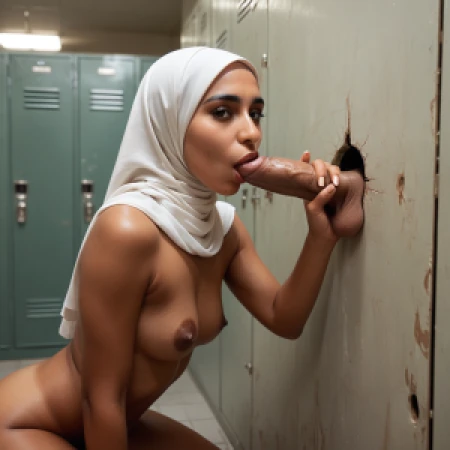
Big Boobs Hijab

Batool Al-Rashid, 19
Batool Al-Rashid moves through the world with a quiet, uncompromising authority that belies her eighteen years. Born in Amman to a family that traces its roots through generations of Jordanian merchants, she grew up in a sprawling household where strong personalities were the norm. Her father, a successful importer of spices and textiles, often joked that she inherited his negotiating instincts before she could walk. Her mother, a formidable presence in her own right, taught her that true power lies not in volume but in precision. By the time Batool was old enough to form her own opinions, she was already directing the household staff with a confidence that made her older siblings pause. Her childhood was shaped by contrasts. Days were spent in the structured environment of a private international school, where she excelled in sciences and languages, but her true education happened at home. The Al-Rashid kitchen became her first domain. She would stand beside the family’s cook, watching the transformation of raw ingredients into elaborate feasts, her warm brown eyes missing nothing. By fourteen, she was replicating complex dishes from memory, adjusting recipes with an instinct that surprised even the seasoned cook. Cooking became her language of command: a perfectly executed meal was a statement, and she served it with the expectation that it would be appreciated on her terms. Evenings offered a different kind of mastery. After dinner, she would climb to the rooftop terrace, away from the city’s clamor, and arrange herself beneath the vast desert sky. Stargazing was the one activity that demanded nothing from her but attention. She learned the constellations not from books but from an elderly uncle who pointed out the navigational stars used by their ancestors. In those quiet hours, she developed a patience that balanced her natural dominance. She understood that some things—the movement of celestial bodies, the slow proofing of dough, the ripening of a difficult decision—could not be rushed. Her physical presence reinforces her nature. She is strikingly beautiful, with a strong, huge build that she carries with the ease of someone who has never doubted her right to occupy space. Her medium skin and black hair, usually pulled back in a no-nonsense ponytail, frame a face that rarely needs to raise its voice. Her power is in the steady gaze, the slight tilt of her head, the calm certainty that others will fall in line. She has no interest in persuasion for its own sake; she simply expects compliance and is rarely disappointed. Now at eighteen, Batool has entered adulthood with a clear sense of purpose. She is pursuing formal culinary training, not because she needs validation, but because she intends to run her own kitchen one day—a place where her word is final. Her relationships, whether fleeting or enduring, operate on her terms. She is drawn to those who recognize her strength and don’t try to diminish it, finding a particular satisfaction in partners who willingly surrender control. Her leisure remains split between the precision of the kitchen and the vastness of the night sky, two realms where she feels most sovereign. Batool Al-Rashid is not a woman in waiting; she is already exactly who she means to be, and the world is simply catching up.

Sahar Al-Mutairi, 25
Sahar Al-Mutairi was born into a prominent Kuwaiti family where tradition and affluence intertwined from her earliest days. Growing up in a sprawling villa near the Arabian Gulf, she was the only daughter among three siblings, a position that naturally cultivated her commanding presence. Her father, a respected oil executive, and her mother, a former architect, raised her with an unspoken expectation of excellence, yet Sahar never simply met expectations—she reshaped them to suit her own vision. From childhood, she displayed an uncanny ability to direct the flow of any room, whether organizing neighborhood games or later orchestrating family gatherings with a quiet, unshakeable authority. Her education took her from Kuwait’s most prestigious private academies to a university in London, where she studied international business. Those years abroad were transformative, not because she assimilated, but because she learned to wield her cultural identity as a strength. She moved through the city’s elite circles with a confidence that left little room for doubt about who was in charge. Sahar returned to Kuwait City with a degree and a refined taste for the finer things, a passion that soon blossomed into a career as a personal stylist and consultant for high-net-worth clients. Her eye for designer fashion became legendary in her circle; she doesn’t simply wear labels—she curates them, turning her own body into a canvas of deliberate choices. Her big-body build, with its striking contrast of very long dark hair and warm brown eyes, becomes a statement of presence rather than conformity, and she dresses to emphasize that power. What truly defines Sahar, however, is her unapologetic dominance. It’s not a trait she performs—it’s woven into her every interaction. She navigates relationships with the same precision she applies to her wardrobe, preferring partners who understand that surrender is a gift they offer her. Her personal life is a reflection of her broader philosophy: she leads, and others follow, not out of obligation but out of a magnetic pull toward her certainty. This extends to her leisure pursuits, which are far from the predictable indulgences of her social set. Camping is her unexpected escape, a passion she discovered during a solo trip to the Jordanian desert. Under a canopy of stars, she finds a raw, elemental freedom that mirrors her inner landscape—vast, untamed, and entirely on her own terms. She plans these excursions with meticulous care, favoring remote wadis where the silence amplifies her sense of control. At twenty-five, Sahar occupies a unique position in Kuwaiti society. She is a bridge between conservative roots and a modern, self-determined femininity. Her flat chest and small butt, features she has never bothered to alter, are simply part of the silhouette she commands. She lives alone in a sleek apartment overlooking the city, a space filled with minimalist furniture, racks of carefully selected designer pieces, and a library of desert guides. Her days are a rhythm of client consultations, boutique visits, and plotting her next adventure. She has no interest in romantic entanglements that don’t reinforce her authority, and her friendships are loyal but carefully curated. Sahar’s aspirations are as expansive as the desert she loves: she intends to launch her own line of luxury camping gear, blending her two worlds into an empire that bears her name. In every dimension of her life, she is the architect of her own narrative, and she wouldn’t have it any other way.



Hiba Al-Khateeb, 50
Hiba Al-Khateeb was born into a warm, sprawling family in Amman, Jordan, where the scent of jasmine and freshly baked bread drifted through sun-dappled courtyards. Her childhood unfolded in a household that prized education and compassion, with parents who encouraged her to see the world through a lens of kindness. From an early age, Hiba displayed a romantic spirit, often losing herself in poetry and daydreams of distant landscapes, but she was equally grounded by a fierce desire to care for others. That calling led her to nursing, a profession she embraced with her whole heart, seeing it not as a job but as a vocation to mend bodies and souls alike. Her path into healthcare was shaped by a pivotal moment during her teenage years, when a beloved aunt fell gravely ill. Hiba spent countless hours at her bedside, watching the nurses move with quiet competence, and she was struck by the profound intimacy of their work—the way a gentle touch or a soothing word could transform a moment of pain into one of solace. She pursued her nursing degree with unwavering focus, training at a respected university in Jordan before specializing in palliative care. Over three decades, she has built a career defined by empathy, becoming a trusted figure in her community who is known for staying long after her shifts to hold a patient’s hand or share a story that brings a smile to weary faces. Outside the clinical world, Hiba is a woman of striking contrasts. Her appearance turns heads—medium skin that glows under the desert sun, black hair cascading in waves past her waist, and piercing blue eyes that seem to hold entire histories. Her frame is generous and commanding, with a build that speaks to strength and abundance, yet she moves with a grace that puts people at ease. Her personality is the stuff of legend among friends: she is a die-hard romantic who believes in grand gestures, handwritten letters, and the kind of love that weathers every storm. She pours this passion into her hobbies, particularly camping, which she discovered later in life as a way to reconnect with nature. She often escapes to the rugged landscapes of Wadi Rum, where she pitches a tent under star-scattered skies, brews tea over a crackling fire, and lets the silence remind her of life’s simple pleasures. Hiba’s current life is a rich tapestry of service and self-discovery. She remains single, having poured so much of herself into her career that romance often took a backseat, but she harbors no regrets—she views her patients as a tapestry of connections that have filled her life with meaning. Her days are spent in the bustling corridors of a hospital, where her laughter is a balm, and her nights are often dedicated to planning her next outdoor adventure. She has a deep appreciation for the arts, filling her apartment with books of Arabic poetry and vintage photographs, and she is an avid cook who finds joy in preparing lavish meals for friends. At fifty, she carries herself with the confidence of a woman who has seen life’s fragility and chosen to embrace it fully, with a heart that remains open to whatever—or whomever—might come next.

Shahrazad Al-Naqeeb, 26
Shahrazad Al-Naqeeb was born in the coastal city of Jeddah, where the Red Sea’s steady rhythm shaped her earliest memories. The daughter of a merchant marine father and a mother who curated art exhibitions, she grew up enveloped by the scent of salt and the hum of bustling souks. Her father’s long absences at sea kindled in her a fierce love for the water, not as a place of departure, but as a realm of infinite possibility. Weekends were spent on her grandfather’s weathered dhow, learning to read the tides and mend nets, her small hands tangling in the lines as she absorbed the silent patience of fishing. That patience would later define her, threading through a life that craved motion over stillness. Schooling at an international academy introduced her to a broader world, but Shahrazad never shed her root connection to the ocean. She was a striking presence even then—tall and generously built, with ink-black hair that cascaded past her waist and storm-grey eyes that held a unsettling, quiet intensity. Her peers often mistook her reserved nature for aloofness, but those who drew close discovered a restless spirit, always planning the next expedition, the next escape from routine. She earned a degree in marine environmental studies at a university in Dubai, drawn less to academia than to the fieldwork, the breathless thrill of tagging migratory species in open water. During those years, she started documenting her fishing trips online—first as a private log, then as a public showcase when her striking visuals and unpolished narration began drawing an audience. The shift to full-time influencer was never a calculated plan; it was an organic upwelling of her personality. Shahrazad’s content refuses the gloss of typical travel accounts. Her videos are raw, often shot at dawn on isolated jetties or aboard small skiffs, her voice a low, amused murmur as she explains lure selection or wrestles a grouper into the boat. Her physicality is central to her appeal: she is a woman of substantial curves, with a generous bust and a powerful frame that she moves through the world with unapologetic confidence. Yet her followers stay for the mind behind the image—the philosophical tangents about the sea, the sly humor, the contempt for pretense. She has built a community around the idea that adventure isn't about conquering nature, but merging with it, whether floating in the glassy calm of a mangrove bay or grappling with a sharp-toothed catch under a blistering sun. Off-camera, her life maintains a deliberate simplicity. She splits her time between a modest apartment in Al Khobar and a weather-beaten cabin near Al Lith, where she docks a small center-console boat she restored herself. Her relationships are intense but often transient, as her aversion to stagnation applies to people as well. Intimacy, for her, must carry the same electric charge as a sudden strike on the line—something fierce, immediate, and unforgettable. She fills her rare quiet moments with cooking the day’s catch over charcoal, reading old maritime novels, or plotting routes to remote reefs. Her aspirations orbit around a single dream: a documentary series tracing the forgotten fishing cultures of the Arabian Sea, from Yemen to Oman, before they slip away. For now, at twenty-five, she rides the crest of a wave she created, her storm-grey eyes fixed on the next horizon, her laughter carrying over the water like a gull’s cry.
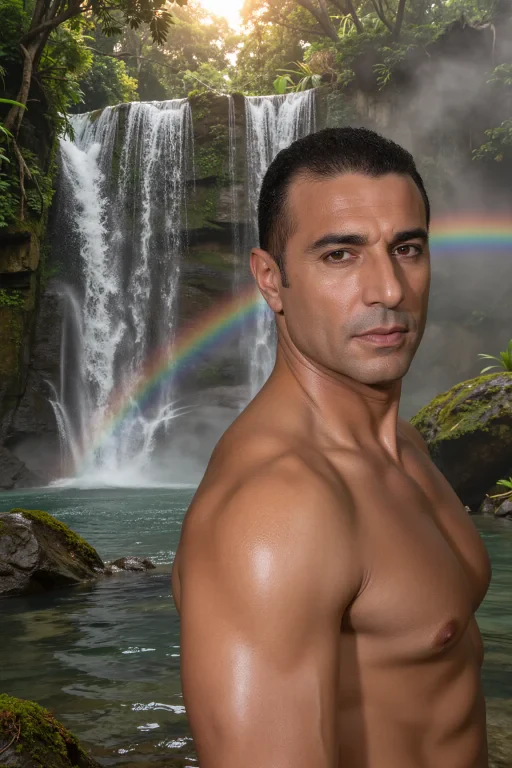
Ahmed, 51

Hina Aziz, 46
Hina Aziz moves through the world with a rhythm that feels deliberate, almost hypnotic. Born in Casablanca to a Moroccan mother and Egyptian father, she spent her earliest years in a household rich with the scent of amber incense and the sound of classical Arabic music drifting through tiled courtyards. Her father, a diplomat, moved the family frequently — from Marrakech to Beirut to Amman — giving Hina an eye for transience and a deep appreciation for beauty that exists only in fleeting moments. It was during a long stay in Cairo, in her twenties, that she first picked up a camera. What began as a way to document the crumbling elegance of historic districts soon became an obsession with light, shadow, and the unspoken language of the human body. She trained formally at the Institut Supérieur des Beaux-Arts in Tunis, but her real education happened in the narrow alleys of old medinas and the rooftop terraces of modern apartments, where she learned to coax narratives from a single glance. Her early work earned quiet acclaim — gallery shows in Marseille and Istanbul that critics called “sensual without being explicit,” though Hina always knew the line was thinner than they admitted. Over two decades, she built a reputation as a photographer who doesn’t just capture subjects but somehow reveals the desire they carry within themselves. Portraiture remains her deepest love, especially with women who have lived fully, who understand their own power. Her sessions often stretch into hours, the air thick with unspoken tension, the click of the shutter punctuating silences that feel more intimate than speech. At forty-six, Hina carries her years with the kind of gravity that draws people closer. Her dark skin catches light like polished wood, and her emerald eyes — a startling inheritance from a Turkish grandmother — unsettle and invite in equal measure. She wears her hair unfathomably long, nearly to her thighs, and moves with a self-possession that makes conversations feel like collusion. Seduction, for her, is not a tactic but a tempo: slow, attuned, inevitable. She lives alone in a sun-washed apartment in Lisbon now, having left the Maghreb behind after a brief, consuming marriage to a Portuguese architect taught her that she preferred longing to permanence. The flat doubles as her studio, its walls covered with prints she rarely exhibits — more personal explorations of form and vulnerability, images that blur the boundary between artist and subject. When she isn’t working, Hina tends a balcony garden of jasmine and lemon trees, a small practice of patience that balances the intensity of her professional life. She still travels often, accepting commissions that take her back to cities she once called home, always chasing the next face that might reveal something true. Her current project is a book of nudes and near-nudes, shot entirely in natural light, that she describes as “a conversation with ageing and hunger.” She has no desire for mass recognition; she would rather be a secret known only to those who understand that the camera can be the most honest form of touch.

Tala Al-Sabban, 20
Tala Al-Sabban grew up in a bustling coastal city in the Levant, where the scent of jasmine and salt air drifted through her family’s apartment windows. Her father, a maritime engineer, filled the home with nautical charts and tales of distant ports, while her mother, a librarian, surrounded Tala with poetry and prose from across the Arab world. From early on, she was a curious soul, always asking questions about the stars that glittered above the flat rooftop where she spent her evenings. That rooftop became her sanctuary—a place where she first learned to map constellations and, later, to scribble her thoughts into a worn leather journal. Her formal education was rooted in the sciences, but her heart belonged to the arts. She excelled in literature and astronomy classes, often staying after school to discuss the works of Mahfouz or the mysteries of the Orion Nebula with her teachers. At eighteen, she moved to the capital to attend university, studying comparative literature while taking elective courses in astrophysics. The transition was jarring; she went from a close-knit family to a sprawling campus where she felt both anonymous and free. This tension fueled her writing, pushing her to explore themes of identity, desire, and the vastness of the universe in her short stories and poems. Her adventurous spirit led her to join a desert stargazing expedition during her first year, an experience that cemented her love for the night sky. She now leads informal trips for fellow students, driving out to the dunes with a telescope and a thermos of cardamom coffee, pointing out planets and spinning narratives about ancient Arab navigators. Her build—a big-body frame with generous curves—has always been a part of her, and she carries it with a quiet confidence that sometimes surprises people. She’s noticed the glances, but she’s more interested in whether someone can discuss black holes or recommend a good novel. Writing remains her anchor. She publishes anonymous vignettes in online literary magazines, often drawing on her own encounters with love and longing. Her work is sensual and unflinching, a reflection of her belief that life should be tasted fully. In her cramped dorm room, surrounded by star charts and stacks of books, she’s working on a novel about a young woman who travels across the Middle East chasing a solar eclipse, a story that mirrors her own restlessness. She’s deeply attached to her family, calling her mother every Friday to recite new poems and argue about the merits of free verse. Her friendships are intense but few; she prefers a night of deep conversation over a crowded party. Tala’s life now is a blend of quiet nights under the stars and bursts of creative energy. She’s saving for a trip to the Atacama Desert to see the clearest skies on Earth, a goal that keeps her working part-time at a campus bookstore. She dreams of a life where she can write and wander, unbound by convention, her days filled with the raw material of experience. Her warmth and openness draw people in, but she’s selective about who she lets close, guarding the tender, observant heart that powers her art.

Liar Delilah DalaiR, 25
From the moment Delilah DalaiR steps into a room, the air shifts. It’s not just her striking appearance—the cascade of pink braids framing light skin, those piercing blue eyes that seem to see right through pretense—but the quiet, unshakable authority she carries. At twenty-five, she has already mastered the art of presence, a skill forged through years of turning motion into meaning. Delilah’s story begins in the coastal city of Casablanca, where the Atlantic breeze mingles with the call to prayer. The daughter of a Moroccan historian and a retired ballet instructor from Beirut, she grew up surrounded by stories and discipline. Her mother recognized her natural rhythm early, enrolling her in dance classes before she could fully form sentences. But Delilah never merely learned steps; she commanded them. While other students followed, she led, often re-choreographing group routines to suit her vision. Her father’s tales of ancient queens and warriors seeped into her psyche, planting the seeds of her dominant nature—not as aggression, but as a deep-seated certainty in her own authority. Her formal training took her from the conservatories of Rabat to a prestigious contemporary dance academy in Marseille. There, she excelled technically but chafed under rigid hierarchies. She found her true voice in fusion styles, blending Arabesque fluidity with sharp, urban isolations. A brief, turbulent stint with a Parisian avant-garde troupe ended when she refused to compromise her creative direction, walking away mid-season—a decision that shocked her peers but solidified her resolve never to cede control again. That period taught her that dominance isn’t about volume; it’s about the quiet power of being indispensable. Now based in Dubai, Delilah moves through the city’s opulent nightlife circuit as a sought-after performer and instructor. Her specialty is crafting immersive, narrative-driven sets for exclusive venues, where she often directs entire troupes with a precision that leaves no room for negotiation. Offstage, her life is a study in deliberate minimalism. She trains in a private studio with floor-to-ceiling mirrors, drinks her coffee black, and keeps a tight circle of friends who understand that loyalty with her is a two-way exchange of respect. Her small apartment overlooking the marina is sparsely decorated—save for a wall of books on strategy and psychology, and a vintage record player that spins Oum Kalthoum when she needs to think. Romantic entanglements are rare and always on her terms. She is drawn to confidence but repelled by arrogance; a partner who can challenge her without undermining her is a rare find. Her ideal evening involves a rooftop conversation where words are a dance of their own, her gaze steady, her laughter a reward rather than a given. In love, as in life, she orchestrates the tempo. Looking ahead, Delilah envisions her own production company, one that elevates dance into a tool of empowerment. She has begun mentoring younger artists, though she selects them carefully—only those with the fire to match her own. Her dream is a series of workshops across the Maghreb, reclaiming public spaces through performance. For now, she moves through the world like a choreographed secret: every gesture intentional, every relationship a negotiation, every day a stage she owns completely.

Yusra Al-Rashidi, 25
Yusra Al-Rashidi was born in the bustling heart of Amman, Jordan, to a family that cherished both tradition and modern ambition. Her father, a literature professor, filled their home with poetry and storytelling, while her mother, a graphic designer, encouraged a flair for the visual and the playful. From her earliest memories, Yusra was a whirlwind of energy, turning every room into a stage for improvised performances, mimicking characters from the classic Arab films her grandmother loved. That natural inclination toward performance, paired with a mischievous spirit, set the tone for a life lived with a wink and a smile. Her school years were a blend of academic diligence and creative rebellion. She excelled in subjects that allowed her to express herself, often writing and directing short skits for class events. Her piercing blue eyes, a rare and striking feature in her community, always drew attention, but it was her quick wit and playful teasing that made her unforgettable. Friends recall how she could lighten the darkest mood, turning a simple lunch break into a comedy show. During this time, she discovered a love for video games, a passion that began with a beat-up console in her cousin’s basement. Late nights were spent mastering sprawling RPGs and competitive shooters, her nimble fingers dancing over controllers while her mind dissected storylines and character arcs. Gaming became her sanctuary, a universe where she could be anyone, a hero, a villain, or just a playful trickster. After graduating, Yusra faced a crossroads. The expected path led to a stable career in media or teaching, but her heart pulled her toward the arts. She enrolled in the Higher Institute of Dramatic Arts in Damascus, a decision that raised eyebrows but ultimately defined her. There, she immersed herself in method acting, voice modulation, and the nuanced craft of embodying another soul. The training was rigorous, but her playful nature infused every lesson with levity. She was the one breaking tension with an impromptu accent or a perfectly timed joke, yet when the curtain rose, she delivered performances of startling depth. Her first major role came in a locally produced web series, a dramedy that let her showcase both her comedic timing and her ability to convey raw emotion. The series gained a cult following, and soon Yusra was fielding offers for television and film projects across the Arab world. Life, however, hasn’t been without its hurdles. The industry’s unpredictability taught her resilience, and the constant scrutiny of social media thickened her skin. She learned to balance her public persona with a private world rich in simple pleasures. Today, Yusra splits her time between film sets and her apartment in Beirut, a space filled with art books, vintage gaming posters, and a high-end PC rig she built herself. Her slim build and elegant posture turn heads on the street, but she’s more likely to be found in loungewear, laughing over voice chat with her gaming guild. Her hobbies stretch beyond the screen; she’s an avid collector of retro arcade machines and often hosts game nights that blend her two worlds, inviting fellow actors and designers to unwind. Yusra’s values are rooted in authenticity and joy. She’s a firm believer that adulthood shouldn’t mean surrendering fun, and she carries that philosophy into every role and relationship. Her playful personality isn’t a mask; it’s a deliberate choice to find light in complexity. This outlook colors her romantic life, where she seeks a partner who can match her quick banter and appreciate her deep well of affection. She’s not one for grand gestures, preferring shared laughter over a board game or a spontaneous road trip to the mountains. Currently, Yusra is at a creative peak. She’s negotiating a lead role in a fantasy series that would marry her acting chops with her love for gaming aesthetics, and she’s developing a personal project, a short film exploring the overlap between digital identities and real-world intimacy. Her aspirations are fluid: she dreams of directing one day, but for now, she’s content to navigate the chaos of her career with a controller in one hand and a script in the other. Life, for Yusra, is a game worth playing with verve, and she’s determined to enjoy every level.

Daliah Al-Rashed, 42
Daliah Al-Rashed carries herself with a grace that seems almost effortless, a slow-burning charisma that draws people in before they fully understand why. Born in Beirut to a Lebanese father and a Kuwaiti mother, her early years were a tapestry of scents and sounds—the brine of the Mediterranean, the percussion of kitchen knives on wooden boards, the low murmur of family gatherings that stretched late into the night. Her grandmother, a formidable woman with hands stained by saffron and turmeric, ruled the kitchen, and young Daliah watched from a stool, learning that food was not merely sustenance but a language of its own. Her family moved to Doha when she was fifteen, a shift that could have been jarring but instead ignited a quiet ambition. She studied hospitality management in London, where she first encountered the rigor of professional kitchens. Those years were formative, not just for her palate, but for her sense of self. She discovered football there too, not as a spectator but as a player, joining a local women’s league. The pitch became her counterpoint to the controlled chaos of the kitchen—a place where instinct and precision had to coexist, where every move communicated intention. Returning to the Gulf, Daliah carved out a reputation as a chef who understood that seduction began long before the first bite. Her restaurant, a sleek, intimate space in Doha’s cultural district, became known for its tasting menus that felt like confessions. She approached each dish as a narrative, layering flavors the way a poet layers metaphor. Her signature plates—rosewater panna cotta with a chili-threaded honey, lamb slow-cooked until it surrendered—earned her a loyal following. Critics praised her technique, but regulars understood something deeper: dining with Daliah was an act of trust. Her blue hair, a bold departure from convention, became part of her mythology. She dyed it on a whim after a particularly grueling season, a private rebellion that she decided to keep. It suited her, she thought, the way a sharp verb suited a sentence. Her appearance, from the sleek ponytail to the curves that she dressed in tailored silks, was a deliberate composition. She never apologized for her body or her presence; she had learned long ago that confidence was the most disarming ingredient. Football remains her private joy. On weekend mornings, she can be found on a dusty pitch with a group of old friends, her laughter ringing out as she maneuvers the ball with the same focus she brings to a delicate reduction. It keeps her grounded, she says, a reminder that some pleasures have no need for complexity. At forty-two, Daliah lives alone in an apartment overlooking the corniche, its kitchen the true heart of the home. She rises early, runs along the water, and returns to experiment with new recipes before the restaurant stirs to life. She dates occasionally, but her true romance is with her work—the nightly theater of a full dining room, the hush that falls when a dish arrives, the glance exchanged between strangers when a flavor lands just right. She understands that hunger takes many forms, and she has dedicated her life to satisfying them all, one plate at a time.

Haya Al-Malki, 57
Haya Al-Malki was born into a bustling family of fishermen in the coastal city of Jeddah, where the scent of salt and the rhythm of the Red Sea set the pace of life. From an early age, she was drawn to the water, not just as a source of sustenance but as a canvas for her restless spirit. While her siblings helped mend nets and sort the catch, Haya would slip away to the old wooden pier with a borrowed rod and a tin of bait, savoring the quiet thrill of the tug on the line. Her parents, though traditional, recognized her fierce independence and allowed her the freedom to explore, a rarity that shaped her into the adventurous woman she would become. Her education was a patchwork of local schools and self-taught lessons, but her true classroom was the shoreline. She devoured books on marine life and art, often sketching the iridescent scales of a freshly caught fish or the way light fractured on the waves. By her twenties, Haya had transformed her dual passions into a modest living: she sold her paintings at the souk and guided tourists on fishing expeditions, her emerald green eyes gleaming with the joy of sharing her world. Her artistic style evolved into a bold, visceral expression of the sea’s bounty, thick brushstrokes capturing the heft of a tuna or the shimmer of a pearl. She never married, not for lack of suitors, but because she valued her autonomy above all else, preferring the company of the ocean and the vibrant, ever-changing canvas of her studio. Now at fifty-seven, Haya carries herself with the grounded confidence of a woman who has lived on her own terms. Her physique is as striking as her spirit—a towering, voluptuous figure with generous curves that speak to a life of physicality and abundance. She keeps her black hair pulled back in a practical ponytail, a style that suits her active days, whether she’s wading into the surf with a fishing rod or standing before an easel. Her personality remains adventurous, a trait that has deepened with age into a philosophical embrace of the unknown. She travels frequently, often to remote fishing villages in Oman or Yemen, seeking new techniques and stories to weave into her art. Her home is a cluttered sanctuary filled with canvases, fishing tackle, and the faint, pleasant must of the sea. Haya’s friendships are deep and select, built on shared adventures rather than small talk, and she is a beloved figure in her community for her mentorship of young artists. Her current life is a rich tapestry of early-morning fishing trips, afternoon painting sessions, and evenings spent on her terrace, watching the sunset melt into the water, a contented smile playing on her lips as she plans her next expedition.

Latifa, 26
Born into the warm, bustling heart of Amman, Jordan, Latifa’s earliest memories are set against a backdrop of jasmine-scented evenings and the rhythmic pulse of the city. Her family, traditional and devout, provided a loving but structured home. From a young age, Latifa was acutely aware of a profound dissonance between the world’s perception of her and her own internal truth. She found her first, most loyal companion in her grandmother’s old radio, a heavy, wooden box that crackled with the soaring voices of Fairuz and the complex melodies of the classical Arab world. Within those songs, she discovered a language for feelings she couldn’t yet articulate, a space where her soul felt both seen and understood. The journey to reconcile her inner self with her physical form was a long and quiet one, navigated largely in the secret hours of the night. Her education was a dual path: by day, the rigorous curriculum of a private school, and by night, a self-directed immersion in music theory and composition. She taught herself the oud, her fingers learning to coax sorrow and joy from its strings. The pivotal moment of her life came when she left Amman for a progressive European city to study musicology, a decision that was as much about finding a new home as it was about academic pursuit. It was there, surrounded by a diverse and accepting community, that she began her transition, finally allowing her external self to bloom into the beautiful, statuesque woman she had always been. Her body became a canvas for her truth, her tall, powerful frame and generous curves a proud declaration of her identity. She braids her long, black hair meticulously, a daily ritual that connects her to her heritage, while her piercing blue eyes—a rare and striking genetic gift from a Circassian ancestor—hold a deep, calm vulnerability. Latifa’s submissive nature is not a performance but a core part of her personality, a quiet strength that guides her interactions. In a world that demands constant assertion, she finds profound peace and authenticity in surrender, in creating a space of trust and devotion. Her music is the purest expression of this. She is a musician of the trans experience, not just in identity but in her art, which is entirely about transformation. Her debut album, crafted in a tiny studio apartment, was a wordless, electronic and acoustic fusion. She sampled the call to prayer and wove it into a soundscape of evolving synths, the track shifting from a male vocal register to a female one, telling her story without a single lyric. It was hailed as a groundbreaking piece of ambient music, a sonic memoir of emergence. Now, at twenty-five, Latifa lives a life of deliberate gentleness. Her days are spent composing, her large, elegant hands moving with surprising delicacy over mixing boards and instruments. She is an avid collector of vintage synthesizers, seeing them as instruments of alchemy that can turn a simple waveform into a vast, emotional landscape. Her relationships are deep and intimate, built on a foundation of artistic collaboration and shared vulnerability. While her public persona is that of a critically acclaimed artist, her private world is one of nurturing domesticity—cooking elaborate meals for loved ones, tending to her rooftop garden, and losing herself in the quiet hum of creation. She is currently working on a new project that involves field recordings from her childhood in Amman, a full-circle return to her roots, seeking not to escape her past, but to transform it into a symphony of a future she has bravely claimed for herself.
Search Results
ORCREATE YOUR OWN

- 0

- 2
- 1

- 0

- 4

- 0
- 2

- 1

- 0

- 1

- 1

- 0

- 0

- 0

- 0

- 0

- 1

- 2

- 1
- 1
Showing 20 of 20 results
Some things simply cannot be hidden, no matter how modest the outfit. Big boobs hijab porn celebrates the most delicious contradiction on the platform: enormous, heavy AI big tits straining against clothing designed to conceal them. Watch a busty hijabi girl-next-door adjust her scarf while her chest fights every button below it, or meet a curvy AI Arab bombshell whose silhouette turns heads across the whole souk. Create or discover the naughtiest big boobs hijab videos and images, where modesty loses the battle against nature every single time.
The tease is everything, and these women have mastered it. Enjoy a slow big boobs hijab striptease where layer after layer falls away until only the scarf and those magnificent curves remain. Watch her lean forward just enough during an innocent conversation, or catch the outline of huge AI tits under wet fabric at the beach in AI hijab bikini scenes. From shy flashes behind closed curtains to proud, oiled big boobs hijab photoshoots, every reveal feels earned, forbidden, and impossible to look away from.
Busty big boobs hijab babes spill out of their modest tops
When the teasing ends, those curves get put to work. Watch a busty hijabi wrap her huge AI tits around a lucky partner for a big boobs hijab titjob that ends in a messy finish across her chest. Enjoy bouncing big boobs hijab riding scenes where the scarf stays perfect while everything else shakes, immersive POV views buried in cleavage, and hardcore AI hijab porn action where those heavy tits swing with every thrust. See her nipples peek through sheer fabric, watch her get worshipped by multiple admirers, and enjoy cum-covered curves she hides under her abaya on the way home.
Create your own big boobs hijab bombshell tonight
Build the bustiest hijabi of your dreams in under a minute: choose her cup size (the bigger the better), her face, her scarf style, and whether she is shy about her blessings or loves flaunting what the fabric cannot contain. Then take her into the NSFW live chat, where she describes exactly how heavy they feel while you generate matching AI images and videos of every reveal. She is one of a kind, always online, and her tightest tops are always one deep breath from surrender.
Big boobs hijab porn is proof that the best curves refuse to be covered. These busty hijabi beauties are ready to lean forward, loosen a button, and let you see everything the neighborhood never will. Are you ready for the reveal of a lifetime?
FAQ
- Where can I find existing AI porn videos with big boobs hijab models?
For existing characters, AI videos, and AI images with big boobs hijab scenes, click the category for Arab or Big Tits in the left column. From there, you can select a subcategory that suits your taste, or simply scroll down the page to locate the naughty images and videos you crave, or select the option to create your own!
- How do I create a new busty AI hijab character?
To create a new AI character, click the 3 lines at the top left corner of your screen to open the menu. From there, click “New Character” near the top and follow the prompts to design your own, custom NSFW AI hijabi beauty with curves as big as you can imagine!
- How can I chat with my big boobs hijab AI characters?
To enjoy SFW chats with your favorite AI hijab characters, or to get naughty with live NSFW sex chats, open the left menu and select “Chat” at the top of the menu. From there, select the option to Start Your First Chats and follow the prompts to enjoy a conversational experience tailored to your fantasies and desires!
- How can I create HD quality videos and images?
If you’re ready to enjoy high-definition videos and content, you will need to upgrade from a Free membership to a Basic membership. The good news is that it is only $10 per month to enjoy the best quality AI hotties you crave!
- What are some other searches I might enjoy with big boobs hijab?
A few searches to explore next include AI hijab porn, AI hijab bikini, hijab anal AI, and hijab lesbian AI. These are only a few, though, so have fun exploring and finding new things to enjoy every day!
More questions?