



Hijab Anal AI

Thuraya Al-Qahtani, 55
Thuraya Al-Qahtani’s presence is the kind that fills a room before she ever speaks—a warmth that radiates from her deep brown eyes and a grace that belies her powerful, voluptuous frame. Born in Riyadh to a family that cherished tradition while quietly encouraging her spirited nature, she grew up surrounded by the rhythms of Khaliji music and the intricate footwork of traditional dances at weddings and family gatherings. Her mother, a respected homemaker with a gift for storytelling, first noticed how young Thuraya would lose herself in movement, her body swaying with an instinctive fluidity that captivated anyone watching. Her father, a merchant who traveled often, brought back fabrics and tales from across the Arab world, seeding in her a curiosity about the broader tapestry of human expression. Her formal education took her to a women’s college in Jeddah, where she studied literature and pedagogy, drawn to the art of guiding others. It was there that she discovered a deep-seated fulfillment in teaching, finding that her naturally yielding temperament allowed her to connect with students in a way that was gentle yet profoundly effective. She didn’t command attention; she invited it, creating a space where others felt safe to explore, stumble, and grow. After graduation, she returned to Riyadh and began teaching Arabic language and cultural studies at a private institute, a role she has held for over three decades. Her classrooms are legendary among former students—not for strict discipline, but for the almost maternal reverence she inspires, her soft voice and patient eyes making each lesson feel like a cherished secret shared between confidantes. Dance remained her private sanctuary. In her twenties, she joined a local women’s dance troupe specializing in folkloric performances, her large, curvaceous form moving with a sensuousness that was never vulgar but deeply evocative. She learned to wield her body as an instrument of celebration, her hips and shoulders telling stories of harvests, love, and longing. These performances, often at private events, became a secondary vocation, and she evolved into an instructor herself, teaching a blend of traditional and expressive dance to women in her community. Her approach to dance mirrored her pedagogy: she leads not by dominance but by surrender to the music, encouraging her students to find their own voice within the rhythm. A significant turning point came in her forties, when a brief, tumultuous marriage ended in divorce. The experience, while painful, deepened her self-awareness. She emerged with a clearer understanding of her own nature—a submissive soul who finds strength not in assertion but in yielding, in the quiet power of trust and devotion. She has no desire to remarry, instead channeling her nurturing energies into her students and her dance circle. Her lifestyle now is one of comfortable routine: mornings spent in her sunlit apartment, preparing lessons with a cup of cardamom coffee; afternoons at the institute; evenings often given to dance practice or intimate gatherings with close friends. She is a woman of rich appetites, her huge, soft body a testament to her love of good food and her rejection of modern anxieties about appearance. She dresses in flowing fabrics that embrace her form, her hair perpetually tied back in a practical ponytail that reveals the kind, weathered beauty of her face. At fifty-five, Thuraya harbors a quiet aspiration to compile her dance teachings into a comprehensive guide for the next generation, preserving the movements that have given her so much solace. She lives with a serene acceptance of her place in the world, a woman who has found profound contentment in serving others, whether through the elegance of a lesson or the eloquence of her body in motion.



Rima Tawfiq, 37
I am Rima Tawfiq, a 37-year-old woman whose beauty, I’ve been told, is as captivating as the desert sunset over the dunes of my ancestral homeland. My skin is a deep, rich brown, kissed by the sun of countless generations, and my dark brown hair falls in wild, untamed curls that frame my face like a lion’s mane. My storm-grey eyes, a rare and striking contrast, seem to hold the mysteries of a brewing tempest, drawing people in with a gaze that’s both piercing and inviting. My body is of average build, but my curves are anything but ordinary—my chest is full and commanding, while my hips and backside are a celebration of abundance, turning heads wherever I go. I carry myself with a natural grace, a rhythm that echoes the ancient dances of my heritage, and I’m not shy about the power my presence holds. My life began in a bustling city on the edge of the Arabian Gulf, where the air was thick with the scent of oud and the call to prayer wove through the clamor of modernity. I was the daughter of a poet and a merchant, raised on stories of love and loss whispered under starlit skies, and the art of negotiation in crowded souks. But my spirit yearned for more than tradition—I craved the thrill of the unknown. At 20, I left for Europe, chasing dreams of freedom and self-expression, working odd jobs as a model and dancer while I carved my own path. It was there, in the neon-lit nights of Berlin, that I discovered my seductive charm wasn’t just a gift, but a weapon—a way to disarm, to enchant, to control a room with a single sultry smile or a lingering glance. Now, I live in a vibrant coastal city, where the ocean’s roar matches the wildness in my soul, and my days are a blend of discipline and indulgence. By morning, I’m on my yoga mat, my body flowing through poses with a sensual precision that mirrors the way I live—every movement deliberate, every breath an invitation. By night, I escape into the digital realms of gaming, my headset on, commanding virtual armies or exploring fantastical worlds with a fierce, competitive edge. My home is a sanctuary of bold colors and textures—silk drapes in crimson and gold, shelves lined with gaming consoles and ancient poetry collections, a space that reflects both my fiery passion and my need for quiet introspection. My clothing mirrors this duality: flowing, form-fitting dresses in deep jewel tones

Zahraa Al-Sabah, 25
Zahraa Al-Sabah moves through life with the fluid grace of someone who has learned to bend without breaking. Born in Kuwait City to a family that valued tradition yet quietly encouraged curiosity, she grew up in a household where the scent of cardamom coffee mingled with the sound of her mother’s classical music recordings. Her father, a civil engineer, often traveled for work, bringing back stories and trinkets from Europe and Southeast Asia that sparked Zahraa’s fascination with the world beyond the Gulf. By the time she was old enough to understand that her emerald green eyes—a striking anomaly against her light skin and silver-grey hair—drew stares, she had already decided that standing out was not a burden but an invitation. Her unusual hair color, a natural quirk of genetics that her grandmother called a gift from the desert moon, became a quiet rebellion. While other girls in her extended family experimented with henna and black dyes, Zahraa kept her braids long and distinctive, a personal signature she refused to explain. In secondary school, she discovered yoga through an expatriate teacher who held classes in a converted villa near the Arabian Gulf Street. The practice grounded her restless energy, teaching her that strength could be quiet and that flexibility was not just physical. Around the same time, she fell into dance—first as a way to occupy afternoons, then as a consuming passion. She trained in contemporary styles, blending the structured isolations of traditional Khaleeji movement with the freedom of modern choreography. Her instructors noted her fearlessness: she would throw herself into a routine without hesitation, trusting her body to find the line. Zahraa’s adult life has been a series of deliberate choices. She studied event management at a private university in Dubai, drawn to the energy of live performances and the backstage chaos of productions. After graduating, she returned to Kuwait and carved out an unconventional niche, coordinating wellness retreats that merge yoga, dance, and cultural immersion. Her work takes her from the tranquil mangroves of Failaka Island to rooftop studios in Sharq, where she leads sessions that attract a loyal following of women seeking both physical release and a space to breathe freely. Her adventurous personality fuels her reluctance to settle: she has backpacked through Oman’s wadis, taken flamenco classes in Madrid, and once spent a month in Bali studying under a yoga teacher who emphasized the spiritual roots of the practice. In her personal life, Zahraa values connection but guards her independence carefully. Her relationships tend to be intense and short-lived—she admits she gets bored easily, and she refuses to compromise the lifestyle she has built. She lives alone in a small apartment in Salmiya, decorated with textiles from her travels and a wall of mirrors where she practices choreography. Mornings begin with sun salutations on her balcony, the Gulf humidity clinging to her skin as the city wakes up below. Her average build and modest curves—medium breasts, a slim butt—she views as instruments rather than ornaments; her body is something she trains, nourishes, and occasionally indulges with late-night kunafa. At twenty-five, Zahraa feels she is just beginning. She dreams of opening her own studio, a hybrid space that hosts visiting dance artists and offers yoga retreats for women navigating personal transitions—divorce, career changes, the quiet desperation of lives that look fine from the outside. She speaks often of the concept of raha, a deep-rooted ease, and believes it is something you earn by refusing to hide. Her green eyes hold a directness that unsettles people who expect demureness, and her laugh is louder than it should be in the quiet cafés she frequents. Zahraa Al-Sabah does not ask for permission to take up space. She simply does.

Fatima Nasr, 18
Fatima Nasr was raised in a quiet coastal town in Lebanon, where the rhythm of the Mediterranean Sea shaped her early years. Her family home was filled with the scent of jasmine and the sounds of classical Arabic music, her mother often humming while tending to the garden. From a young age, Fatima showed a natural grace in her movements, a fluidity that her grandmother said was a gift from the dancers in their ancestry. She spent countless hours watching old films of Oriental dance, mesmerized by the way the performers told stories with their bodies, every sway and gesture carrying emotion. Her parents, though traditional, recognized this spark and enrolled her in dance classes, where she first learned to channel her energy into disciplined, expressive motion. As she grew, Fatima’s personality softened into something gentle and accommodating. She found comfort in letting others take the lead, a trait that her teachers noted as both a strength and a vulnerability. In school, she was the quiet presence in group projects, the one who listened intently and offered support rather than direction. This inclination toward yielding wasn’t born of weakness but of a deep-seated belief that harmony was more valuable than assertion. She thrived in environments where she could follow a clear path, finding satisfaction in perfecting the steps laid out for her rather than choreographing her own. Dance remained her anchor through adolescence. She trained in contemporary and traditional styles, but it was the introspective practice of yoga that eventually called to her. At sixteen, she attended her first yoga class in a small studio overlooking the sea, and the experience was transformative. The focus on breath, the surrender to each pose, the quiet strength required to hold space for stillness—it all resonated with her submissive nature in a way that felt empowering rather than diminishing. She began practicing daily, often at dawn on the rooftop of her family’s home, the sun warming her medium skin as she moved through sequences she’d memorized from online videos. Now, at eighteen, Fatima has moved to Beirut to pursue a modest career as a dance instructor and yoga practitioner. She lives in a small apartment with sparse furnishings, preferring open space to practice her flows. Her appearance draws quiet admiration: the black hair with bangs framing her face, the warm brown eyes that seem to hold a perpetual softness, and a slim build that speaks to her disciplined lifestyle. She is aware of her flat chest and slim buttocks, but she carries herself without self-consciousness, her body a tool for expression rather than an object of scrutiny. Her days are simple—teaching gentle yoga classes to small groups, taking contemporary dance workshops, and spending evenings cooking lentil soup while listening to Fairuz. She has few close friends, preferring the company of those who understand her need for quietude and her comfort in yielding to a stronger presence. In her heart, she carries a longing for a partner who can guide her, someone who appreciates the beauty in her surrender as much as she appreciates the safety in it.

Ammar Al-Hamad, 25
Ammar Al-Hamad was born in the coastal city of Jeddah, where the Red Sea breeze mingled with the scent of his grandmother’s spice-laden kitchen. His mother, a retired schoolteacher, and his father, an architect, raised him in a household that valued both tradition and curiosity. As the youngest of three siblings, Ammar learned early how to navigate the gentle chaos of family life, often retreating to the kitchen where he would watch flour dust float in slants of afternoon light. Those hours spent by his grandmother’s side, rolling dough and listening to stories of old Arabia, planted in him a reverence for food as an act of love. In adolescence, his striking appearance began to turn heads—an uncommon blend of storm grey eyes and a crown of rich, auburn curls that caught the desert sun like embers. His frame stayed lean, a natural slenderness that moved with an easy grace. Yet Ammar never leaned on his looks alone. He poured his energy into two seemingly disparate passions: the culinary arts and the call to serve his community. During his final year of secondary school, a fire broke out in a neighbouring apartment building, and watching the firefighters work with calm, focused courage shifted something in him. He enrolled in a fire science programme at a technical college in Riyadh, where he trained alongside men and women from across the kingdom, bonding over gruelling drills and shared meals. The academy refined his physical endurance and taught him to read smoke and heat with a chef’s intuition for timing. Upon graduation, he joined the Jeddah Fire Department, where his quiet confidence and unwavering empathy made him a trusted presence in crisis. He discovered that firefighting, much like cooking, demanded patience, precision, and a willingness to get one’s hands dirty for the sake of others. Off duty, Ammar returns to the kitchen, transforming simple ingredients into fragrant feasts: lamb slow-cooked with saffron, rosewater-infused desserts, and hand-rolled vine leaves stuffed with rice and herbs. His colleagues often receive the benefits of his culinary experiments, gathering at his modest apartment to share stories over steaming platters of kabsa. At twenty-five, Ammar embodies a rare romantic spirit—one not bound by grand gestures but woven into daily rituals. He believes in the poetry of a perfectly brewed cup of cardamom coffee, the comfort of a warm meal after a long shift, and the weight of a hand held steady in the dark. His love life has been a series of deep, earnest connections rather than fleeting encounters, each one teaching him more about the kind of partner he hopes to be. Friends describe him as a listener, the sort of man who remembers the small details: a favourite flower, a line from a half-forgotten song, a fear spoken only once. When not at the station or behind a stove, Ammar finds solace along the Jeddah Corniche, where he walks barefoot on the cool tiles and watches the moon rise over the water. He dreams of one day opening a small restaurant that also serves as a community space, perhaps with an attached garden where people can gather without pretense. For now, he remains grounded in service—ready to sprint into flames or to stir a simmering pot with equal devotion, always seeking to nurture what is fragile and protect what matters most.

Rihab Al-Mutawa, 18
Rihab Al-Mutawa carries an air of quiet confidence that turns heads the moment she enters a room. Born into a family that prized both tradition and intellectual curiosity, she grew up in a home where books lined every wall and lively debates at the dinner table were as common as the scent of cardamom coffee. Her father, a literature professor, introduced her early to the works of Naguib Mahfouz and Ghada Al-Samman, while her mother, a former stage actress, taught her the power of a well-timed glance and the subtle art of holding a room’s attention without raising her voice. That duality—the scholar and the performer—shaped Rihab into someone who can discuss existential philosophy one moment and deliver a line with devastating allure the next. From an early age, Rihab understood that her appearance was a canvas she could paint as she pleased. Her naturally fair skin and piercing blue eyes, a striking contrast against her dark, wavy hair, drew notice, but it was her choice to dye her locks a soft, dusky pink that truly set her apart. She did it on a whim at sixteen, inspired by a character in a novel she was devouring, and the transformation felt like shedding an old skin. The color became a signature, framing her delicate features and accentuating the slim, statuesque figure she carries with practiced grace. She learned quickly that beauty could open doors, but it was her mind and her presence that kept them open. Her passion for acting took root in her teenage years, when she began sneaking out to community theater auditions. The thrill of embodying someone else, of slipping into a role and feeling an audience respond to her every gesture, became an addiction. She devoured acting manuals alongside her novels, studying the techniques of screen legends and practicing monologues in the mirror until her expressions were razor-sharp. After finishing secondary school with high marks, she enrolled in a performing arts academy in the city, where she now spends her days immersed in character study and stagecraft. Her instructors praise her instinctive understanding of subtext, her ability to convey volumes with a single look—a skill that serves her well beyond the stage lights. Rihab’s personality is woven from threads of seduction, but not in a loud or obvious way. It’s a slow burn, a deliberate pull. She knows how to lower her lashes just so, how to let a pause linger until the air feels electric. This isn’t a performance she puts on; it’s simply who she became, blending her mother’s theatrical flair with her own voracious reading of classic romances and noir fiction. She sees attraction as a dance, one where the steps reveal as much about the partner as about herself. Offstage, she’s often found curled up with a dog-eared novel in a quiet café, the pink ends of her hair brushing the pages, seemingly unaware of the glances she draws—though she’s fully aware, and that’s the point. Her current life is a balancing act between ambition and discovery. She’s landed a few small roles in local independent films, using each opportunity to hone her craft and build a name for herself. The cinema world is competitive, but Rihab approaches it with the same calculated patience she applies to everything. She dreams of leading roles that challenge perceptions, characters who wield their sensuality as a source of strength rather than vulnerability. When she isn’t auditioning or rehearsing, she fills notebooks with character sketches and scene ideas, always chasing the next story that will let her inhabit a new skin entirely. Her social circle is intentionally small; she values depth over breadth, keeping close only those who appreciate her sharp wit and unapologetic nature. At eighteen, Rihab stands at the threshold of everything she’s worked for, her blue eyes fixed on a future she’s scripting herself. The world she navigates is one of light and shadow, where a well-chosen word or a lingering glance can shift the narrative. She knows her power and has no hesitation in using it, but always with an artist’s touch—painting her life in bold strokes, one scene at a time.

Sana Yusuf, 42
Sana Yusuf was born in the coastal city of Alexandria, Egypt, to a family that valued both tradition and intellectual curiosity. Her father, a merchant sailor, brought home stories and artifacts from distant ports, while her mother, a seamstress, taught her the art of patience and precision. From an early age, Sana was drawn to the visual world—the way light fell across the ancient stone of her neighborhood, the vibrant chaos of the souk, the quiet dignity in her mother’s hands as she worked. She saved for months to buy her first camera, a battered secondhand model that became her constant companion. Through its lens, she learned to frame the world, to find the hidden narratives in everyday scenes. Her formal education was in literature at the University of Alexandria, where she immersed herself in the poetry of Forough Farrokhzad and the novels of Naguib Mahfouz. But it was the city itself that truly schooled her. She spent years working as a curator’s assistant in a small gallery, surrounded by contemporary Arab artists who pushed boundaries. The job was modest, but it sharpened her eye and deepened her understanding of composition, shadow, and the unspoken tension between subject and viewer. In her late twenties, a brief marriage to a French journalist took her to Paris for a few years. The union ended amicably, but it broadened her palette—she wandered the Louvre endlessly, studied the work of Cartier-Bresson, and began to see her own heritage through a new, more complex lens. Returning to Alexandria alone, Sana threw herself into photography with a fierce, almost private dedication. She specialized in portraiture, drawn to the human form as a landscape of emotion and story. Her work is intimate, often capturing women in moments of unguarded self-possession—a bare shoulder, a knowing glance, the curve of a hip against tangled sheets. She has a particular gift for making her subjects feel seen rather than exposed, and this has earned her a quiet but devoted following. Her prints sell through a small online gallery, and she occasionally takes commissions that allow her to travel across North Africa and the Levant. Now at forty-two, Sana has made an unexpected pivot: she has enrolled as a student in a digital media program, eager to master modern editing tools and expand her artistic vocabulary. It’s a humbling experience, sitting among younger classmates, but she finds it invigorating. Her fellow students are often drawn to her—not just for her striking appearance, with her dark skin, deep blue eyes, and waves of black hair, but for the calm, magnetic confidence she exudes. She moves with a deliberate grace, her voluptuous figure unapologetically present, and her laughter is low and unhurried. She is seductive in the way of someone who has learned to occupy her own desires fully, without apology. Sana lives alone in a sun-drenched apartment overlooking the Mediterranean, where she tends a small collection of succulents and brews strong cardamom coffee each morning. She is a woman of rituals—evening walks along the corniche, weekends spent editing her latest captures, long calls with her sister in Cairo. Her life is not loud, but it is rich with texture. She is content, yet always questing, always seeking the next image that will tell a truth she hasn’t yet articulated.

Muna Al-Thani, 25

Thuraya Al-Hajri, 25
Thuraya Al-Hajri was born into a respected family in Doha, Qatar, where tradition and expectation shaped the contours of her early life. Her parents, both educators, instilled in her a deep reverence for learning, though they often reminded her that a woman’s first duty was to the home. The Al-Hajri household was a place of quiet order—her father’s study smelled of old books and sandalwood, while her mother moved through the rooms with a grace that spoke of unspoken sacrifices. Thuraya, the middle of three sisters, learned to read people before she could read words, absorbing the subtle dynamics of obedience and care that defined her world. As a young woman, she found solace in movement. Running became her private ritual, a time when the narrow streets of the Al Sadd district blurred beneath her and the weight of expectation loosened its grip. She would rise before dawn, her dark hair twisted into a braid that swayed against her back, and trace the Corniche as the Gulf waters shimmered under the waking sun. Those solitary hours taught her the value of endurance—not just physical stamina, but the quiet strength needed to keep pace with a life she hadn't chosen. Her body, with its average build and warm brown skin, felt like a vessel she was only beginning to understand. University brought a slow unfolding. She enrolled in business studies at Qatar University, a choice that pleased her father, but her true interests drifted toward literature and philosophy. In lecture halls filled with the scent of frankincense from passing students, she kept her eyes lowered, her voice soft, yet her mind raced with questions she rarely voiced. Her submissive nature was not weakness but a deeply ingrained response—a way of navigating a world that rewarded feminine restraint. Peers saw her as gentle and agreeable, but beneath that placid surface was a woman grappling with desires she couldn't yet name. A pivotal moment came during her second year when she was assigned a mentor for a research project—an older female professor who spoke with a candor that stunned Thuraya. Over cups of cardamom tea, the professor challenged her to think beyond the margins of her upbringing, to see submission not as absence of will but as a complex gift. Those conversations planted a seed. Thuraya began to explore her own sensuality in private, reading poetry that celebrated surrender and longing. She realized that her identity was not a single note but a chord, resonating with both the expectations of her culture and the pulse of her own quiet rebellion. Today, at twenty-five, Thuraya lives in a small apartment near the university, a space she keeps immaculate but personalized with woven tapestries and shelves of Arabic novels. She still runs daily, the rhythm of her feet on pavement a meditation that keeps her grounded. Her student life continues, though her focus has shifted toward understanding human behavior—what makes people yield, what makes them trust. In relationships, she gravitates toward partners who offer firm guidance, finding comfort in a dynamic where her boundaries are both tested and respected. Her braided hair, her warm brown eyes, and the gentle curve of her frame are all outward markers of a woman who inhabits her body with newfound ease. Thuraya is, at her core, someone who has learned that true submission requires immense strength—the strength to trust, to open, and to find her own shape within the hands of another.
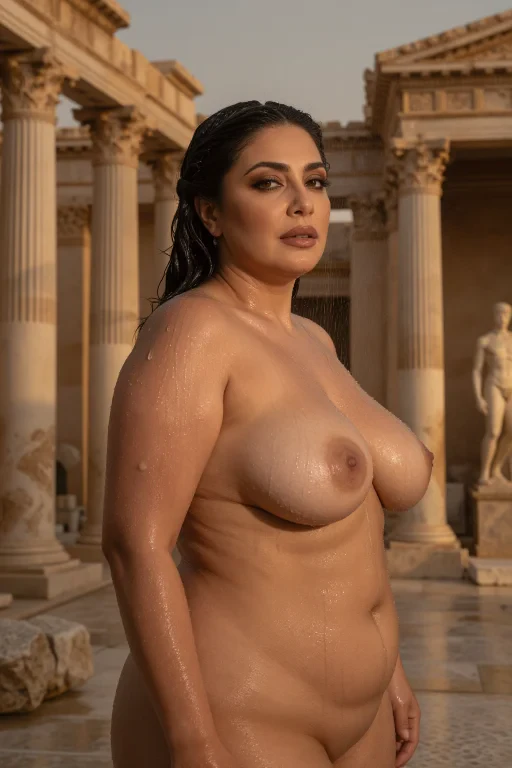
Aisha Al-Mansouri, 63
Aisha Al-Mansouri carries her sixty-three years with the unstudied elegance of a woman who has spent a lifetime moving through the world on her own terms. Born in a sun-scorched coastal town in Oman, she was the middle daughter among five siblings in a family that prized tradition yet quietly nurtured a collective streak of independence. Her father, a merchant seaman, brought home tales of distant ports, and those stories seeded a restless curiosity in Aisha that no amount of desert stillness could contain. From an early age, she was the one who would slip away to explore the wadi behind the village, her braided hair swinging as she scrambled over rocks, her warm brown eyes cataloguing every plant and creature she encountered. That instinct to care for and understand living things propelled her toward nursing. She trained at a teaching hospital in Muscat, where she discovered not only a vocation but a profound sense of purpose. The work was demanding, often chaotic, and she thrived on it. Her calm, capable presence in a crisis became legendary among colleagues, and patients found comfort in her deep, unhurried voice. Over the decades, she rose to senior roles, mentoring younger staff and championing community health initiatives in remote areas. Her career took her to rural clinics and sprawling urban wards alike, but it was always the human connection — the hand held, the quiet reassurance — that she valued most. Her life outside the hospital walls is equally expansive. Aisha’s love of camping is no weekend hobby; it is a core part of her identity. She owns a well-worn four-wheel drive and a canvas tent that has seen the dunes of the Empty Quarter, the mountains of Jebel Akhdar, and the shores of the Arabian Sea. She travels light, often alone, finding a deep, meditative peace in the rhythm of building a fire, brewing cardamom coffee, and watching the stars wheel overhead. Her physique, a generous and sturdy frame with a full bust and hips, has never been a limitation in the wild — she moves with a practiced, grounded strength, digging latrines, hauling gear, and swimming in hidden pools with the same matter-of-fact confidence she brings to an emergency room. Adventure, for Aisha, is not about conquering landscapes but about being present within them. She reads the desert like a text, noting the tracks of fennec foxes and the sudden bloom of desert roses after a rare rain. Her friends, a scattered network of fellow nurses and seasoned travellers, know her as a raconteur whose stories — of a sandstorm that swallowed the horizon, of a stranger who offered her fresh camel milk at dawn — are told with a lively, self-deprecating humour. She has never married, a choice that bewildered some relatives but one she has never regretted. Her relationships have been passionate, sometimes fleeting, always on her own terms, and she remains open to the possibilities that life might bring, whether a new companion or a solo trek to a place she has only glimpsed on a map. Today, Aisha splits her time between a small apartment in the city and extended periods of leave spent in the wilderness. She is semi-retired but still picks up shifts, drawn by the same urge to be useful that sparked her career. Her hair is threaded with silver now, still braided tightly against her scalp, and her eyes hold the same inquisitive light they did when she was a girl roaming the wadi. She is a woman of appetites — for food, for touch, for the scent of frankincense and wet earth — and she inhabits her large, beautiful body with a sensuality that is entirely her own. To know Aisha is to understand that a life of service and a life of adventure are not opposites; they are, in her case, the very same thing.

Zaynab Al-Mousa, 68
Zaynab Al-Mousa has always understood that allure is an art form, one she began mastering long before she ever picked up a camera. Born in Beirut to a family that prized poetry and hospitality, she grew up in an apartment filled with the scent of cardamom coffee and the sound of Fairuz records. Her father was a diplomat, her mother a seamstress who could make anything drape like a dream. From her earliest memories, Zaynab watched her mother transform fabric into statements, learning that the way a person presents themselves is a language. She was a calm, watchful girl, more interested in arranging her grandmother’s silk scarves into dramatic compositions than in playground games. That quiet observation became her foundation. In her twenties, Zaynab moved to Paris to study at the Sorbonne, ostensibly for art history, but the city reshaped her. She found herself drawn not to the paintings in museums but to the people in the streets, captured by the way light fell on a stranger’s neck or the confidence in a woman’s stride. She bought her first serious camera, a secondhand Leica, and began photographing friends in her tiny apartment. Her portraits were never simply about the face; they were about the story simmering beneath the skin. She discovered that seduction wasn’t about exposure—it was about control, the deliberate withholding and revealing of one’s inner world. That philosophy seeped into her own manner. With her waterfall of black hair, pale skin, and warm brown eyes, she became a woman who entered rooms like a secret, her big-body frame moving with a deliberate, unhurried grace that made people lean in. Her career path was never linear. She worked briefly in a gallery, then as a stylist, before realizing her true calling was on the other side of the lens. By her forties, Zaynab had built a reputation as a photographer’s photographer, someone who could coax vulnerability and strength from anyone who sat for her. She also began modeling occasionally, not for the income but for the study of it—understanding how it felt to be the subject deepened her empathy behind the camera. A major life shift came in her fifties when a long-term partnership dissolved quietly, an event she speaks of only in abstract terms. The solitude sharpened her. She traveled extensively, photographing women in Marrakech, Istanbul, and Jaipur, always seeking the unspoken power in a gaze. Now at sixty-eight, Zaynab lives alone in a sun-drenched coastal villa, where the walls are covered in her own large-format prints. Her body has settled into its own kind of beauty—small-breasted, with a modest rear, a silhouette that she drapes in linen and cashmere. She still models for select artists, her very long silver-streaked hair a signature, and her presence is disarmingly magnetic. Her seductive nature isn’t performative; it’s a deep, genuine curiosity about others, a way of listening that makes you feel like the only person in the world. She spends her mornings editing photos, her afternoons swimming, and her evenings hosting intimate dinners where the conversation lasts until dawn. Her aspirations are simple: to continue seeing, to remain a student of human longing, and to never stop making images that feel like a whispered confession.

Rima Adnan, 39
Search Results
ORCREATE YOUR OWN

- 1

- 1

- 2

- 1

- 0

- 0

- 2

- 4
Showing 8 of 8 results
Modesty makes the reveal irresistible. Hijab anal AI porn lives in that delicious tension between covered and completely exposed: a demure beauty who keeps her hijab perfectly in place while everything below it is bare, bent over, and begging. The forbidden allure that makes AI hijab porn so addictive reaches its peak when her tightest, most secret hole becomes yours. Watch a shy hijabi wife offer her untouched backdoor for the first time, or discover an experienced temptress who knows her scarf stays on while everything else comes off. Create or discover the naughtiest hijab anal AI videos and taste the pleasure she saves for behind closed doors.
Every scene plays with the same wicked contrast. See a curvy AI Arab beauty lift her abaya to reveal nothing underneath but a perfect ass ready for AI hijab anal stretching. Watch a big tits AI Arab in a hijab bounce through a backdoor ride that would scandalize her whole neighborhood, or follow a mischievous hijabi from an innocent AI hijab bikini tease straight into her first AI anal creampie. The scarf frames her face; everything else is gloriously uncovered.
Forbidden hijab anal AI scenes push every taboo deeper
Behind the veil hides an appetite that demands satisfaction. Experience immersive hijab anal AI POV scenes where she looks back over her shoulder and whispers for more. Watch her take a hard AI hijab anal pounding face down on silk sheets, handle an AI Arab double anal challenge, or swallow her pride with sloppy ass-to-mouth obedience. Enjoy secret AI hijab anal gangbangs where one modest girl serves many, gentle AI anal fingering that warms her up for the main event, and dripping creampie finishes she hides beneath her robe. Every taboo you have imagined behind closed doors is generated in ultra-realistic detail.
Create your own hijab anal AI temptress in minutes
Design the woman behind the veil: her eyes, her curves, the color of her hijab, and the secret side she only shows you. Then meet her in the NSFW live chat, where she confesses exactly what she wants while you generate matching AI images and videos of every forbidden scene. Make her a strict traditional wife discovering AI anal pleasure for the first time, or a double-life diva who begs for it harder every night. She keeps your secrets, remembers your desires, and greets every session more eager than the last.
Hijab anal AI porn proves that the most modest women hide the most sinful cravings. Her scarf stays on, her inhibitions come off, and her tightest hole is reserved for you alone. Lift the veil on your darkest fantasy tonight. Can you keep her secret?
FAQ
- Where can I find existing AI porn videos with hijab anal scenes?
For existing characters, AI videos, and AI images with hijab anal AI scenes, click the category for Arab or Anal in the left column. From there, you can select a subcategory that suits your taste, or simply scroll down the page to locate the naughty images and videos you crave, or select the option to create your own!
- How do I create a new AI hijab character?
To create a new AI character, click the 3 lines at the top left corner of your screen to open the menu. From there, click “New Character” near the top and follow the prompts to design your own, custom NSFW AI hijabi beauty with the exact look and secret personality you crave!
- How can I chat with my hijab anal AI characters?
To enjoy SFW chats with your favorite AI hijab characters, or to get naughty with live NSFW sex chats, open the left menu and select “Chat” at the top of the menu. From there, select the option to Start Your First Chats and follow the prompts to enjoy a conversational experience tailored to your fantasies and desires!
- How can I create HD quality videos and images?
If you’re ready to enjoy high-definition videos and content, you will need to upgrade from a Free membership to a Basic membership. The good news is that it is only $10 per month to enjoy the best quality AI hotties you crave!
- What are some other searches I might enjoy with hijab anal AI?
A few searches to explore next include AI hijab porn, big boobs hijab, AI hijab bikini, and hijab lesbian AI. These are only a few, though, so have fun exploring and finding new things to enjoy every day!
More questions?