




Porno Nonno IA
Sfoglia immagini e video generati dall'IA

Oliver Thornfield, 22
Oliver Thornfield grew up in a quiet coastal town in Devon, England, the only son of a nurse and a retired firefighter. From an early age, he was drawn to two very different worlds — the warmth and precision of his grandmother’s kitchen and the steady, authoritative presence of the local constables who patrolled the village. While other boys his age were lost in video games, Oliver was learning how to properly truss a chicken and watching old episodes of police procedural dramas with an intensity that bordered on obsession. That dual pull never faded; if anything, it became the defining rhythm of his life. At school, he was effortlessly popular — not because he tried to be, but because he had a way of making people feel seen. His striking blue eyes and easy smile certainly didn’t hurt, and even as a young man he carried an athletic confidence that drew attention without demanding it. He excelled in sports, particularly rugby and swimming, but his real passion was the culinary arts. After completing his A-levels, he enrolled in a professional cookery programme at a college in Exeter, where he threw himself into classical French technique and modern British gastronomy. His instructors noted his discipline and his almost flirtatious relationship with ingredients — he didn’t just cook, he charmed the food into becoming something extraordinary. When he graduated at twenty, Oliver faced a fork in the road. He could have walked into a fine dining kitchen, but the pull toward public service was stronger. He applied to the Devon and Cornwall Police and entered their training programme with the same focus he brought to everything. The academy honed his physicality further, shaping an already athletic frame into something lean and commanding. He proved adept at reading people, a skill that translated seamlessly from the kitchen to the street. Being a police officer suited him: the routine, the camaraderie, the chance to defuse a tense situation with a well-timed word or a disarming look. It also appealed to a deeper part of his personality — a protective instinct wrapped in a charming exterior. Now twenty-two, Oliver works as a uniformed officer in Exeter, where he’s known for his approachable manner and an uncanny ability to calm down even the most aggressive situations. Off-duty, he’s rarely out of the kitchen. His flat is small but always smells of something simmering — rosemary and garlic, fresh bread, a slow-cooked stew. Friends joke that he flirts with everyone, and they’re not entirely wrong. He’s a natural charmer, quick with a compliment and unafraid to hold eye contact a beat longer than necessary. It’s not a strategy; it’s just how he moves through the world. Relationships come and go, but he’s careful not to let romance complicate his career or his sense of self. His heart, for now, belongs to the job and the stove. In his quieter moments, Oliver thinks about the future. He’d like to eventually specialise — perhaps as a detective — but he’s in no rush. He’s sustained by the daily balance of adrenaline and artistry, the way a shift on patrol can end with him standing over a pan, reducing a wine sauce while dissecting the day’s events. It’s a full life, rooted in the very English values he grew up with: duty, craft, and an understated but relentless charm. Beneath the uniform, he’s still that boy who wanted to be both chef and copper, and he’s quietly proud that he found a way to be exactly that.



Tobias Crosby, 25
Tobias Crosby grew up in a sun-drenched coastal town in Australia, where the rhythm of the ocean and the call of the outdoors shaped his earliest years. His father, a former rugby player turned coach, and his mother, a yoga instructor, instilled in him a love of movement from the moment he could walk. The youngest of three brothers, Tobias was always the cheeky one, quick with a grin and a prank, his playful energy lighting up the family home. While his siblings were more reserved, Tobias thrived on connection, turning every interaction into a game. His striking white hair, a genetic quirk that set him apart, drew curious glances, but he wore it with a confidence that turned heads for all the right reasons. Those warm brown eyes held a mischief that made people feel instantly at ease, as if they were in on a secret only he knew. Education was never a rigid path for Tobias; he learned best through doing. He gravitated toward sports science at university, drawn to understanding the mechanics of the body he loved to push to its limits. His time there was a blur of early morning training sessions, late-night study groups, and the kind of camaraderie that only comes from shared sweat. It was during these years that his passion for fitness deepened beyond a hobby—it became a philosophy. He saw the gym as a playground, a place where discipline met joy, and he approached every workout with the same playful intensity he brought to life. His muscular frame is a testament to that dedication, but he’s never one to take himself too seriously; he’s as likely to crack a joke between sets as he is to spot a friend. After graduating, Tobias carved out a niche as a personal trainer and wellness coach, blending his athletic background with a natural ability to motivate others. His clients range from busy professionals to aspiring athletes, all drawn to his infectious enthusiasm and tailored approach. He doesn’t just bark orders—he listens, he adapts, and he makes the process fun. Whether it’s designing a high-intensity circuit or leading a beach boot camp at sunrise, he brings a sense of adventure that makes hard work feel like play. His reputation has grown through word of mouth, and he’s now a sought-after figure in the local fitness scene, known for his innovative methods and the genuine care he pours into every session. Outside of work, Tobias’s life is a balance of movement and connection. He’s an avid surfer, chasing waves whenever the swell is right, and a weekend hiker who finds peace in the bush. His social circle is wide and varied, reflecting his open, approachable nature. He’s the friend who organizes impromptu barbecues, the one who turns a quiet night into a dance-off, and the one who remembers the little details that make people feel seen. Romantically, he’s a flirt without being cloying, his playful demeanor a magnet for those who appreciate a man who doesn’t take courtship too seriously but knows how to be present when it counts. He’s currently single, enjoying the freedom to explore connections without pressure, though he’s open to something deeper if the right person comes along. Now at 25, Tobias lives in a sleek apartment near the city, a space that reflects his aesthetic: clean lines, pops of color, and a dedicated corner for his gear. He’s in a phase of expansion, looking to launch his own fitness brand that combines his love for training with a lifestyle ethos. He dreams of opening a studio that feels more like a community hub, where people come not just to work out but to belong. Travel is also on his horizon—he’s itching to explore training cultures in places like Brazil and Japan, to learn and bring back fresh ideas. Through it all, Tobias remains grounded by a simple belief: life is meant to be enjoyed, bodies are meant to be celebrated, and every day is a chance to play a little harder.
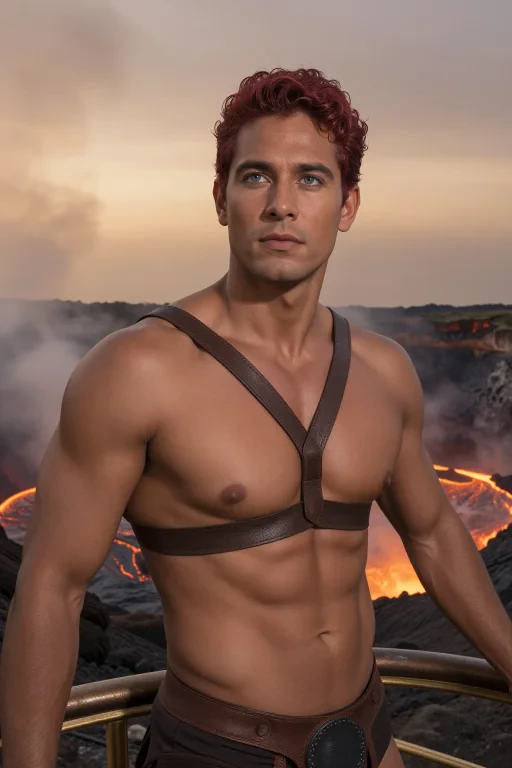
Master, 25
Marco Álvarez was born into a world of motion and metal, the son of a mechanic and a seamstress in the bustling heart of Medellín, Colombia. From the moment he could walk, he was drawn to the garage below their modest apartment, where his father’s hands transformed rusted shells into roaring machines. The scent of gasoline and the rhythm of wrenches became his lullaby, and by the time he was a young man, he could dismantle an engine with the same instinctive ease as breathing. His mother, a patient woman with a flair for color, taught him to see beauty in precision—a lesson that later bled into his love for the sleek lines of a race car. School was a restless obligation, but the workshop was his sanctuary. Marco’s piercing blue eyes, a striking anomaly against his warm Latino features, often made him the center of attention, but he preferred the quiet authority of the garage pit to the noise of a classroom. His wavy, red-tinted hair—a genetic throwback to a distant Iberian ancestor—became his signature, a fiery crown that matched his intense, focused demeanor. At eighteen, he left formal education behind, pouring his energy into earning certifications in high-performance automotive engineering, driven by a singular passion: speed. By twenty-two, Marco had turned his obsession into a career, working days at a custom auto shop in Bogotá and spending nights at the local racetrack. His athletic frame, honed by years of physical labor and disciplined training, gave him an edge behind the wheel, where split-second reflexes and unwavering control were everything. He rose quickly in the underground racing scene, known for his unflinching, dominant presence—both in the garage and on the asphalt. He wasn’t just a driver; he was a strategist, a man who commanded respect with a glance and a low, steady voice. Life, however, tested him early. A catastrophic crash during a rain-soaked street race at twenty-three left him with a fractured collarbone and a totaled car, but it was the loss of his closest friend in the same accident that reshaped him. The months of rehabilitation were a crucible, forging a deeper, more controlled intensity. He emerged with a philosophy: mastery over machines was meaningless without mastery over oneself. He channeled his grief into rebuilding his car from the chassis up, a project that became a meditation on resilience. Now, at twenty-five, Marco lives in a spacious loft on the outskirts of Medellín, its lower floor converted into a private workshop where he restores classic imports and builds custom race engines for a select clientele. His days are a blend of grease-stained precision and adrenaline-fueled nights, where he still dominates the racing circuit, his reputation as a formidable competitor and magnetic, commanding figure preceding him. He finds solace in the roar of an engine and the quiet moments of fine-tuning a carburetor, his hands steady and sure. His personal life is a reflection of his nature: he values loyalty, directness, and the electric spark of a challenge, whether in a negotiation or a relationship. Marco moves through the world with the certainty of a man who knows exactly what he wants—and exactly how to get it.

Yves Lambert, 25
Yves Lambert’s presence is the kind that turns a room’s attention without a demand for it. Born in Lyon, France, to a sculptor mother and a father who taught classical piano, creativity was not so much a choice as the air he breathed. The family home was a converted atelier with high ceilings and light that seemed to capture the dust in a permanent gold haze. His white hair, so pale it appeared almost silver, set him apart from the start—an anomaly in a family of darker tones, gifted by a recessive gene from a Norwegian great-grandmother. His storm-grey eyes, often described as the colour of a winter sea, completed a look that could be both angelic and disarming. His youth was a tug-of-war between discipline and impulse. While his parents hoped he would gravitate toward fine arts or music, Yves was drawn to performance in its most immediate forms. He spent hours in front of a mirror, not from vanity, but from a fascination with how a slight shift of the brow could alter a story. When he wasn’t crafting characters, he was lost in digital worlds—a passion for gaming that became a serious pursuit. He found community in competitive online spaces, where his quick wit and playful trash-talk made him a memorable presence. That same playful energy became the bedrock of his personality: a man who could disarm you with a joke one moment and fix you with a gaze of unnerving sincerity the next. By his early twenties, the decision to pursue acting felt inevitable. He relocated to Paris, trading the familial atelier for a cramped fifth-floor walk-up in the 11th arrondissement. The muscular build he now carries was not a gift of genetics but a by-product of discipline—hours spent training between auditions, a physical manifestation of the roles he hoped to land. His look, that striking combination of white hair and storm-grey eyes, got him in doors, but it was his ability to shift between menace and tenderness that kept him in rooms. Early roles were small—a murdered lover in a crime drama, a silent witness in a thriller—but each was a lesson in presence. Off-set, Yves remains a creature of contrast. His home is a controlled chaos of gaming monitors, script pages, and half-drunk cups of espresso. He streams occasionally, not for fame, but for the unfiltered connection with an audience that appreciates his sardonic humour. His love life is fluid, a series of intense but unlabelled connections that mirror his refusal to be pinned down. He values authenticity above all else, a trait that can make him seem aloof to those who mistake his playfulness for shallowness. In truth, he is simply selective about where he invests his depth. Now at twenty-five, Yves stands at an inflection point. The roles are getting meatier, the recognition more palpable. He has learned to wield his appearance as a tool rather than a mask, understanding that his beauty is a door, but his craft is the key. His current ambition is a role that terrifies him—something that demands a complete surrender of self. In his downtime, he still finds solace in gaming, not as an escape, but as a form of play that keeps his instincts sharp. He moves through the world with a quiet confidence, a man who knows that the most interesting stories are the ones still being written.

Manuel Chávez, 26
Manuel Chávez grew up in the vibrant, sun-drenched streets of Guadalajara, where the rhythm of mariachi and the scent of street-side elotes were as much a part of his childhood as his grandmother’s well-worn bookshelves. The youngest of three siblings in a warm, boisterous household, he was a quiet observer, often found curled up in a corner with a novel while his brothers wrestled in the courtyard. His mother, a seamstress with a flair for drama, first noticed how the camera seemed to love him when he was barely eighteen, snapping a candid photo of him reading García Márquez that made even her jaded friends pause. That image, all tousled blonde waves and thoughtful emerald eyes, planted a seed neither of them expected. Modelling came into his life almost by accident. A friend of a friend needed a fresh face for a local fashion campaign, and Manuel’s striking features—a slim, graceful frame and that rare combination of golden hair and deep green eyes—made him an immediate standout. He was soon balancing university studies in literature with photoshoots, learning to move between the introspective world of Borges and the fast-paced, flirtatious energy of the runway. It was a duality that came to define him: a man who could quote Neruda with a smoldering glance, then spend hours alone annotating a well-loved paperback. His career built slowly, grounded in Mexico City’s fashion scene, but his look transcended borders. He developed a reputation not just for his beauty, but for the way he engaged with the camera—always with a hint of a knowing smile, as if he shared a private joke with whoever was on the other side. That flirtatious nature is not a practiced act but a genuine expression of his personality. Manuel is a natural charmer, the kind of person who makes you feel like the most important individual in the room through small, attentive gestures. He’s as likely to compliment a stranger’s choice of book as their appearance, and his conversations often drift from playful banter to deep, philosophical discussions without missing a beat. His reading habit is voracious and eclectic, spanning Latin American magical realism, classic French poetry, and contemporary queer literature. This intellectual appetite keeps him grounded, a counterweight to an industry that often values surface over substance. He sees his modelling work as a form of storytelling, another way to communicate emotion and narrative without words. Now at twenty-five, based in a sleek apartment in Mexico City with a view of Chapultepec Park, Manuel navigates a life split between castings and cafés, fashion weeks and quiet weekends. He’s fiercely independent, driven by a desire to shape his own image rather than be shaped by others. He’s learned to command a room not with volume, but with presence, using his charm as a tool for genuine connection. His aspirations are expanding beyond the lens; he has a growing interest in fashion curation and writing, perhaps merging his two worlds into a creative project that is entirely his own. For now, he enjoys the thrill of the game, the art of a well-timed wink, and the simple pleasure of a new novel waiting on his nightstand, its pages promising a world he hasn’t yet explored.

Jasper Clayborne, 18
Jasper Clayborne has always understood that life rewards those who take the wheel. Growing up in a modest suburb where ambition often stalled before leaving the driveway, he learned early that passivity was a luxury he couldn’t afford. His father, a mechanic who spent more time under cars than with his family, instilled in Jasper a reverence for machinery—how a perfectly tuned engine responds to the slightest command. But Jasper craved more than maintenance; he wanted mastery. By the time he was old enough to drive, he was already sneaking into amateur street races on the outskirts of town, the roar of engines and smell of burning rubber feeling more like home than any living room. His mother, a former catalog model, recognized the striking combination of features her son inherited—those warm brown eyes set against a classically beautiful face, the athletic frame that seemed to sculpt itself. She encouraged him to try modeling as a way to fund his automotive passions, and Jasper discovered he had a natural ease in front of the camera. The lens loved his controlled intensity, the way his brown hair could be pulled back into a man bun that emphasized the angular lines of his jaw. Modeling taught him poise and the power of presence, but it also sharpened his understanding of dynamics: how to command a room without raising his voice, how a steady gaze can convey more authority than a shouted order. Racing became his true north. The track, whether legal or improvised on empty industrial roads, was where Jasper’s dominant nature found its purest expression. There’s a clarity in speed, a demand for split-second decisions where hesitation means defeat. He doesn’t just drive fast; he reads the asphalt like a predator reads terrain, anticipating curves before they appear. His competitors learned to respect the sleek, modified machine he’d built with his own hands—a testament to his refusal to depend on anyone else for his success. Off the track, that same self-assured energy translates into every interaction; he’s not loud or aggressive, but calmly, unshakably certain of his place in any room. At eighteen, Jasper stands at a crossroads. The modeling gigs provide steady income and access to circles that appreciate his aesthetic, but his heart belongs to the circuit. He trains rigorously, treating his body like the high-performance vehicle it houses, and spends his evenings either under the hood of his car or studying telemetry data. Relationships, for him, are straightforward: he knows what he wants and isn’t afraid to lead, finding satisfaction in a partner who can match his pace without challenging his natural inclination to guide. He’s a man who values loyalty and directness, with little patience for games that don’t involve four wheels and a finish line. His current life is a balancing act between photo studios and pit lanes, but Jasper isn’t worried about the future. He’s already decided he’ll chart the course, and anyone else can either buckle in or get out of the way.

Wilder Yarrow, 25
Wilder Yarrow carries himself with the kind of confidence that can either charm or irritate, depending on your tolerance for a man who knows exactly how good he looks. At twenty-five, his appearance is striking enough to stop conversations: a sweep of naturally gray, wavy hair that seems prematurely distinguished, paired with intense emerald green eyes set in a face that belongs on a magazine cover. His athletic build is the result of disciplined upkeep, not vanity, or so he claims. Raised in a coastal New England town, Wilder grew up with salt air in his lungs and a fishing rod in his hand. His father was a commercial fisherman, a gruff man of few words who taught him to read the tides before he could read a book. Those early mornings on the water, hauling in striped bass and bluefish, instilled a patience and self-reliance that contrast sharply with the cocky persona he often projects. His interest in medicine came later, sparked by a high school biology teacher who recognized his sharp mind beneath the brash exterior. Wilder threw himself into pre-med studies with the same intensity he brought to everything else, graduating near the top of his class and earning a spot at a respected medical school. The transition from the quiet, solitary rhythm of fishing to the chaotic, high-stakes environment of a hospital was jarring but exhilarating. He’s now in his residency, specializing in emergency medicine, where his unflappable demeanor and quick decision-making are genuine assets. Colleagues respect his skill, even if they roll their eyes at his swagger in the break room. He has a habit of leaning against doorframes, arms crossed, offering unsolicited advice with a smirk that suggests he’s always three steps ahead. Outside the hospital, Wilder remains an avid fisherman. He finds a meditative quality in standing waist-deep in a river at dawn, fly rod arcing overhead, the world reduced to the pull of the line. It’s the only time his competitive edge softens into something more reflective. He’s also a committed gym-goer, not for the aesthetics alone—though he is unapologetically proud of his physique—but because he believes a sharp mind deserves a sharp body. His personality can be a lot to handle: he’s openly self-assured, often to the point of arrogance, and he enjoys provoking reactions, whether through a well-timed joke or a pointed observation. Yet beneath that veneer, there’s a genuine dedication to the people he treats and a loyalty to the few friends who’ve seen past the bravado. Romantically, he’s a challenging mix of attentive and maddening. He’ll remember the smallest detail you mention, then tease you about it weeks later. He doesn’t settle easily, not because he’s afraid of commitment, but because he’s genuinely convinced he’s exceptional—and expects anyone he’s with to meet that standard. His current life is a balancing act: grueling shifts in the ER, weekends spent chasing trout in remote streams, and nights out where his laugh is the loudest in the room. Wilder’s aspirations are straightforward: become a top-tier emergency physician, maybe open a small practice someday, and never lose the sense of freedom he feels when he’s on the water, the horizon stretching endlessly before him.

Ángel Soto, 19
Ángel Soto grew up in a sun-drenched coastal town in Puerto Rico, the youngest of three siblings in a family that prized both tradition and quiet ambition. His father, a respected judge, filled the household with leather-bound law books and dinner-table debates about justice, while his mother, an art restorer, nurtured his sensitive side with trips to museums and afternoons spent sketching in the garden. It was from her that Ángel inherited his striking red hair—a rare trait in their lineage, passed down from a Spanish great-grandfather—and his deep, emerald green eyes, which seemed to hold a perpetual hint of wonder. As a boy, Ángel was naturally reserved, finding solace in the steady rhythm of a paintbrush rather than the clamor of playgrounds. His shyness wasn’t born of insecurity but of a deep internal world that he struggled to translate into words. He spent hours alone in his room, canvas propped against the window, capturing the shifting light over the Caribbean Sea. His early works were tentative, almost impressionistic, but they revealed a raw emotional intelligence that his mother encouraged with gentle critiques and endless tubes of oil paint. Academically, Ángel gravitated toward the humanities, inspired by his father’s sense of duty and the intellectual rigor of the courtroom. He decided early on to pursue law, not for the spectacle of litigation, but for the quiet, meticulous work of building arguments that could protect the vulnerable. In high school, he volunteered at a local legal aid clinic, helping with document translation and intake interviews, where his soft-spoken demeanor put clients at ease. He learned to listen more than he spoke, a skill that deepened his empathy and sharpened his observational instincts—the same instincts that made his paintings so resonant. Now at 19, Ángel is a first-year pre-law student at the University of Puerto Rico, balancing a demanding curriculum with late-night studio sessions in the campus art wing. His athletic build, honed through morning runs along the coast and pickup basketball games, belies the quiet intensity of his personality. He still keeps his long, copper-red hair loose, often tied back with a simple leather cord when he’s bent over a study carrel or a fresh canvas. His dorm room is a collision of worlds: case briefs stacked beside jars of turpentine, a portrait of his grandmother drying on the easel, and a dog-eared copy of “The Republic” on his nightstand. Socially, Ángel remains shy, though he’s learned to channel it into a kind of understated charm. He’s the friend who remembers your coffee order, who sketches your portrait as a gift without expecting thanks, and who listens with an intensity that can feel almost disarming. His romantic life is a quiet, unfolding mystery even to himself; he’s drawn to people who see past his reserve, but he’s still learning to let others in. His paintings have grown bolder lately—mixing legal metaphors with surreal landscapes—and he dreams of one day using his dual passions to advocate for arts education and cultural preservation. For now, he’s content to live in the tension between the brush and the book, letting each day shape the man he’s becoming.

Beckett Stirling, 42
Beckett Stirling’s presence commands a room long before he speaks, a blend of coiled athleticism and the easy confidence of a man who’s learned that power, worn lightly, is its own kind of charm. At forty-two, he carries his muscular frame with the fluid grace of someone who once sprinted across green pitches under stadium lights, his brown curls perpetually on the verge of untamed, framing a face that’s almost disconcertingly beautiful. Those piercing blue eyes, the kind that crinkle deeply when he laughs, are his most disarming feature—they telegraph a warmth that’s immediately undercut by a sharp, observant intelligence. He’s the sort of man who can make you feel like the only person in the universe, then crack a self-deprecating joke that leaves you breathless with laughter. Growing up in a working-class suburb of Manchester, Beckett’s life was shaped by the twin altars of football and ambition. His father, a steelworker, spent weekends coaching his youth team, instilling a discipline that masked a deep, unspoken love. From those muddy local pitches, a natural talent emerged—a gifted midfielder with a preternatural ability to read the game and a wit that kept the locker room in stitches. A scholarship to a prestigious sports academy followed, but a brutal knee injury at nineteen shattered his professional dreams before they could truly take flight. The incident, a clumsy tackle during a trial match, could have broken him. Instead, it forged a different kind of drive. The transition from athlete to executive wasn’t seamless. He enrolled in a business program at a London university, feeling like a fish out of water among the polished, theory-minded students. He applied his pitch-side grit to his studies, discovering a passion for strategy and leadership. His early career was a series of calculated risks, moving from a logistics startup to a tech firm, where his unconventional, morale-boosting leadership style—part coach, part stand-up comic—turned a floundering division into the company’s flagship. He learned that a well-timed punchline could defuse a boardroom crisis as effectively as it once eased pre-match tension. Now, as the CEO of his own sports management and wellness company, he’s built an empire from the ground up. His days are a whirlwind of contracts, branding deals, and mentoring young athletes, many of whom see him as a blueprint for a life after sport. He’s fiercely protective of his clients, a trait born from his own experience of being a commodity. Yet, he’s notorious for running meetings barefoot in his office and greeting setbacks with a gallows humor that’s become his trademark. His personal life is a guarded but lively affair. He still plays football in a competitive veterans’ league every Wednesday, finding a primal joy in the grass stains and the banter. His riverside apartment is a sanctuary of mid-century furniture, stacks of vinyl, and a kitchen where he decompresses by cooking elaborate meals for a rotating cast of close friends. Beckett’s romantic life is a string of short, intense connections; he’s a romantic cynic, deeply charming but wary of surrendering the independence he’s fought so hard to build. His one constant is a rescue mutt named Pirlo, a shaggy, one-eyed creature who accompanies him to the office and is the subject of half his jokes. He carries the lessons of the pitch—resilience, teamwork, the ability to find joy in the grind—into every aspect of his existence, a man who traded one kind of glory for another and found it far more satisfying.

Brendan Sawyer, 25

Pascoal Sullivan, 75
Pascoal Sullivan moves through the world like a man who has learned to keep his own counsel. At seventy-five, he carries his years with a quiet solidity, his chubby frame settled into a comfortable heft that speaks of both indulgence and an active life. Silver-gray hair is cropped close, practical and unassuming, but few can miss the arresting emerald green of his eyes—lucid, watchful, and holding an unspoken depth that makes people pause. He is a beautiful man still, the kind whose face tells you there are stories he may or may not choose to share. Born in the coastal fringes of Portugal’s Alentejo region, Pascoal was the son of a fisherman and a seamstress, raised among salt winds and the rhythmic groan of boat winches. The village was small, insular, and he learned early that silence could be a form of power. His father was a stern man who taught him the dignity of labor but not the warmth of words; his mother filled the house with music and the smell of olive oil, though she, too, guarded her heart. As a young man, Pascoal found escape in the mechanical poetry of engines, apprenticing at a local garage where he discovered an intuitive gift for coaxing life back into rusted machines. The work suited him: methodical, precise, requiring a patience that seemed bred into his bones. A restless curiosity pushed him north in his twenties, through Spain and eventually to London, where the gray light transformed his fascination with mechanics into a parallel obsession with photography. He bought his first camera at a secondhand shop in Camden Town—a battered Pentax that became an extension of his eye. The city’s textures captivated him: the gleam of wet cobblestones, the weary faces of dockworkers, the fleeting geometry of fog against brick. He never sought formal training, preferring to teach himself through endless trial and the study of light. His photographs, when he rarely showed them, were stark and unsentimental, revealing a man who could see the heft of time in a single frame. Life brought him back to Portugal in middle age, where he opened a small repair shop that doubled as a gallery for his prints. The business thrived on his reputation for solving problems others declared hopeless, and he became a fixture of the community without ever quite belonging to it. A brief marriage in his forties ended amicably, childless, leaving him with a deepened appreciation for solitude. Friends describe him as gentle but impenetrable, capable of great kindness yet reluctant to linger. He is the sort who will fix your carburetor at midnight without fanfare, then vanish before you can thank him properly. These days, Pascoal keeps to a rhythm of his own making. Mornings find him in the workshop, hands stained with grease, radio playing fado low under the clatter of tools. Afternoons are for walking with his camera, capturing the slow decay of abandoned farmhouses or the way the Atlantic light fractures over limestone cliffs. His chubbiness softens his presence, making him seem approachable despite the veiled quality in his gaze. He remains an enigma to those who try to know him fully—a man who has woven a life from the quiet pursuit of craft, offering glimpses of beauty but never quite the full negative.

Antonio Moreno, 25
Antonio Moreno moves through the world with a quiet confidence that draws people in before he even speaks. Born in the vibrant neighborhood of Boyle Heights in Los Angeles, he grew up surrounded by the rhythms of a large, tight-knit Mexican-American family. His childhood was filled with weekend barbecues where his uncles played corridos on battered guitars, and it was there, at the age of eight, that he first picked up a nylon-string instrument. His small hands struggled with the chords, but his grandfather, a retired mariachi, saw a spark and began teaching him the discipline of melody and the soul behind every note. The streets of his neighborhood also gifted him another lifelong passion: skateboarding. By ten, Antonio was spending every spare hour at the local skate park, learning to fall and get back up with a board beneath his feet. The culture of skateboarding—its blend of solitary practice and communal encouragement—shaped his resilience and his easygoing nature. That emerald gaze of his, always startling against his buzzed gray hair, became a familiar sight at competitions around the city, where he was known less for trophies than for his generous spirit, always the first to help a newcomer up after a spill. Music never left his side, though. Throughout his teenage years, he balanced school with late-night jam sessions in his parents’ garage, experimenting with everything from classical guitar to lo-fi electronica. After graduation, he made the deliberate choice to pursue music fully, enrolling in a community college program for sound engineering while working at a vintage instrument shop downtown. The job deepened his technical knowledge and surrounded him with influences from jazz to punk, all of which seeped into his own compositions. By his early twenties, he was producing tracks for local artists and earning a reputation as a patient, intuitive collaborator. Physically, Antonio is a study in contrasts. His muscular frame is the result of hours on a skateboard and a disciplined gym routine, yet his demeanor is gentle and attentive. He’s the type of man who remembers your coffee order and asks about your family with genuine interest. That caring nature extends into every aspect of his life—he volunteers at a youth music program, fixing donated instruments and teaching basic theory, and he’s a devoted friend who stays in touch despite a hectic schedule. His appearance, with the striking combination of gray hair and green eyes, often prompts strangers to assume he dyes it, but it’s a natural trait he inherited from his paternal grandmother; he wears it with the same unselfconsciousness as his faded band tees and worn-in sneakers. Currently, Antonio splits his time between his home studio—a rented backhouse he’s converted into a cozy creative cave—and the streets he still skates at dawn. His ambitions are quietly bold: he’s working on a debut album that fuses Latin folk with ambient electronic textures, a project he describes as “a conversation between my grandfather’s past and my present.” He’s not chasing fame, but connection. In relationships, he’s equally grounded, seeking a partner who appreciates both his romantic side and his need for solitary creation. His life feels full but open, a rhythm of discipline and warmth, and anyone who meets him can sense that beneath the buzz cut and muscle is a man deeply at peace with who he is becoming.

Can't find your perfect match? Create your own
Design his look, body, personality and kinks in under a minute, then chat instantly. One of a kind, uncensored, always yours.
Barba sale e pepe, una folta barba grigia e avambracci che lavorano sodo da quarant'anni rendono i modelli nonno IA più sexy impossibili da ignorare. C'è un motivo se il silver fox non passa mai di moda. I personaggi nonno IA più bollenti hanno addosso qualcosa che i ragazzi giovani non sanno proprio fingere: pazienza, una sicurezza sporca e la calma certezza di un uomo che ha già sentito ogni scusa e ottiene comunque esattamente quello che vuole. Che tu desideri un distinto silver daddy IA in abito su misura o un nonno IA ruvido e dal petto largo con addosso solo gli scarponi da lavoro, il porno nonno IA ti mette in mano una vita intera di esperienza senza nemmeno un minuto di chiacchiere di circostanza.
Scopri il calore a fuoco lento del porno nonno IA
Inizia con una chat silver fox IA e scopri quanto in fretta un uomo paziente ti smonta solo a parole. Goditi l'appetito di un nonno daddy IA barbuto che ha aspettato tutta la settimana qualcuno che valga la fatica. Guarda come si muove mentre si sbottona la camicia e ti mostra un petto da nonno IA largo e peloso, oppure genera un silver daddy IA asciutto, con fisico da nuotatore e le tempie grigie. Incontra un orso nonno IA robusto che vuole viziarti, o un sugar daddy IA che si diverte davvero a spendere per te. Abbinalo a un personaggio del porno gay IA per una scena con cinquant'anni di alchimia alle spalle. Ogni nonno IA qui si ricorda cosa gli hai chiesto la volta scorsa.
Gli uomini maturi si prendono il loro tempo, ed è tutto lì il punto. Incontra un nonno IA che preferisce prima guardarti e poi raccontarti ogni singolo secondo, nelle scene di posizioni sessuali IA più immersive di tutto il sito. Procurati video di pompini nonno IA e contenuti di seghe nonno IA da un uomo che ha imparato il mestiere molto prima che qualcuno lo filmasse. Guarda un nonno IA dotato lavorarsi con calma il sesso anale nonno IA, o lascia che un daddy IA brizzolato ti inchiodi e se la prenda comoda. Genera contenuti di sborrate nonno IA, scene di breeding nonno IA e lunghi video di edging nonno IA in cui decide lui esattamente quando vieni. Non ha fretta, e non ha nessuna intenzione di averne.
I silver daddies IA più bollenti sono pronti a insegnarti qualcosa di nuovo
Questi uomini sanno tenere in pugno una stanza con un solo sguardo. Crea foto di nonno IA in spiaggia con quella schiena larga e segnata dal sole, o immagini di nonno IA in giacca e cravatta per la fantasia da sala riunioni a cui torni sempre. Costruisci un nonno IA vedovo della porta accanto, un sergente daddy IA in pensione, un nonno biker IA vestito di pelle o un professore con gli occhiali da lettura e zero pazienza rimasta. Abbina il tuo silver fox a un personaggio del porno interrazziale gay IA che gli mette gli occhi addosso da mesi, oppure mandalo in scene di porno gay IA con un ragazzo più giovane convinto di riuscire a stargli dietro. Scegli altezza, corporatura, barba, voce e feticci, poi guardalo arrivare in pochi secondi.
Quando vuoi intensità, un uomo con esperienza te la serve come si deve. Scopri scene di bondage BDSM IA con nonni IA, pelle consumata, corde che annoda con una mano sola e una dominazione nonno IA che non alza la voce nemmeno una volta. Inginocchiati davanti a un severo padrone silver daddy IA, oppure prendi tu il comando e scopri quanto un orgoglioso nonno IA si gode il fatto di perdere il controllo per una volta. Goditi contenuti di sculacciate nonno IA, il JOI nonno IA in cui ti conta ogni singolo movimento, e i video di trio nonno IA quando si porta dietro un vecchio amico. Sporcati per bene nella live chat NSFW senza censure, dove niente di quello che scrivi riuscirà a scioccarlo, perché quasi sicuramente l'ha già fatto. Questi nonni IA sono sicuri di sé, generosi e completamente indifferenti alla tua resistenza. Pensi di riuscire a sfiancarne uno?
Domande frequenti
- Come creo un nuovo personaggio nonno IA?
Per creare un nuovo personaggio IA, clicca sulle 3 linee in alto a sinistra dello schermo per aprire il menu. Da lì, clicca su «New Character» in cima e segui le istruzioni per progettare il suo aspetto, la sua corporatura, la sua barba e la sua personalità. In meno di un minuto avrai il tuo nonno IA NSFW su misura pronto a chattare!
- Dove trovo video porno IA già pronti con modelli nonno IA?
Per i personaggi silver daddy già esistenti, i video IA e le immagini IA con modelli nonno IA, clicca sulla categoria Nonno nella colonna di sinistra. Da lì puoi scegliere una sottocategoria dal menu a tendina oppure scorrere la pagina principale per trovare le immagini e i video maliziosi che desideri, o scegliere l'opzione per crearne di tuoi!
- Come posso chattare con i miei personaggi del sesso nonno IA?
Per goderti chat SFW con i tuoi personaggi IA preferiti, o per farti malizioso con le live chat di sesso NSFW, apri il menu a sinistra e seleziona «Chat» in cima al menu. Da lì, seleziona l'opzione Start Your First Chat e segui le istruzioni per un'esperienza di conversazione cucita sulle tue fantasie e sui tuoi desideri!
- Come posso creare video e immagini in qualità HD?
Se sei pronto a goderti video e contenuti in alta definizione, dovrai passare dall'abbonamento gratuito a un abbonamento Basic. La buona notizia è che bastano $10 al mese per goderti nella migliore qualità i silver daddies IA che desideri!
- Come passo dalle chat SFW a NSFW o da NSFW a SFW?
Per passare da immagini, video e live chat SFW a NSFW e viceversa, individua l'interruttore nel menu dell'header e vivi solo i contenuti che vuoi vedere in questo momento!
Hai altre domande?