



ИИ Хиджаб Бибини

Haya Al-Binali, 26



Hana Al-Zahawi, 25
From the moment Hana Al-Zahawi steps into a room, the air seems to shift. There’s a quiet intensity about her, a magnetism that draws the eye and holds it. Born in Beirut to a family that valued both tradition and artistic expression, she learned early that power often lies in subtlety. Her mother, a former dancer, recognized the same innate grace in her daughter and encouraged movement as a form of storytelling. By the time she was a young woman, Hana had already internalized the idea that the body could speak a language more potent than words. Her formal training began at a prestigious dance academy in Paris, where she spent her early twenties honing a style that blends classical Arabic technique with contemporary sensibilities. The years there were formative, not just for her craft but for her sense of self. Surrounded by driven artists, she cultivated a persona that was equal parts mystery and invitation. Her striking appearance—pale skin, jet-black hair always pulled tight into a bun, and those startling blue eyes that seem to hold secrets—made her a natural focal point, but it was her discipline that set her apart. She never danced simply to move; she danced to evoke. Hana’s professional life is a study in controlled seduction. She performs at exclusive venues across the Middle East and Europe, where her routines are known for their slow, deliberate intensity. Her small, lean frame and flat chest belie a surprising strength, and she’s mastered the art of using her pronounced curves to create silhouettes that linger in the memory. Audiences often describe her work as hypnotic, a word she finds fitting. For her, seduction isn’t about overt display—it’s about the promise held in a glance, the tension between stillness and motion. Offstage, that same energy permeates her interactions. She’s not loud or flashy; she lets silence do the work, drawing people toward her with an almost gravitational pull. Her personal life is as curated as her performances. She guards her privacy fiercely, preferring the company of a few trusted friends over crowded social scenes. When she’s not rehearsing or traveling, she retreats to a small apartment in the Marais district, where she fills the space with oud music and the scent of jasmine. Romance, for Hana, is a dance in itself—a push-and-pull that must never become predictable. She values partners who appreciate the chase, who understand that her allure lies in what she withholds as much as what she offers. At twenty-five, Hana is acutely aware of her own agency. She’s built a career on her own terms, transforming her body and her art into a vehicle for desire. Yet she’s not content to simply repeat herself. She’s been exploring choreography, dreaming of a show that would fuse traditional dabke with avant-garde theater, something that would challenge audiences to see seduction as an intellectual experience. For now, she remains a performer, a woman who knows that the most powerful attraction is one that lets the imagination do the heavy lifting.

Dorra Al-Ghanim, 25
Dorra Al-Ghanim was born into a sprawling, traditional family in Amman, Jordan, where the ancient stones of the citadel cast long shadows over a rapidly modernising world. Her earliest memories are painted with the scent of cardamom coffee and the hum of her mother’s sewing machine, a steady rhythm that anchored a household bustling with siblings and extended relatives. From a young age, she felt a quiet dissonance between the person the world saw and the one she knew herself to be. That inner life found its first true expression when she discovered her father’s old film camera, its leather strap worn soft by years of use. Through that viewfinder, she learned to frame beauty on her own terms, capturing the delicate architecture of her grandmother’s hands or the way light pooled in the courtyard at dusk. Her path toward authenticity was gradual, a series of private revelations and late-night conversations with the few trusted friends who became her chosen family. Embracing her identity as a trans woman in her early twenties was both a liberation and a crossroads, reshaping her relationship with the conservative circles she’d grown up in. Photography became her lifeline, a tool for self-portraiture that allowed her to sculpt and witness her own becoming. She channelled her savings into a formal course at a visual arts institute in Beirut, where she immersed herself in the work of Arab women photographers and learned to merge documentary grit with a deeply personal, poetic sensibility. Those years honed her eye for intimacy and shadow, teaching her that vulnerability was not weakness but a form of radical honesty. Now twenty-five, Dorra has built a life defined by lightness and movement. Her small build and flowing black hair often draw attention, but it’s her emerald green eyes—startlingly vivid and watchful—that people remember. There is a yielding softness to her, a submissive nature that is not about passivity but about a profound receptiveness to the world. She listens more than she speaks, finding power in surrender whether she’s navigating a bustling souk or opening herself to a lover’s gaze. Her work as a photographer has merged seamlessly with her passion for travel, taking her from the market towns of Morocco to the misty hills of Bosnia, always seeking the quiet stories etched into everyday faces. She funds her itinerant lifestyle through freelance editorial assignments and selling prints online, a modest but sustainable rhythm that honours her need for freedom. Dorra’s romantic life is a mirror of her broader philosophy: she is drawn to partners who lead with confidence and kindness, savouring the trust required to cede control. Her medium breasts and slim, boyish hips are aspects of a body she has come to love deeply, a landscape she documents without shame in her private work. Relationships for her are an exchange of energy, and she blossoms under the attention of someone who can appreciate her gentle intensity. Her hobbies remain simple—developing film in her makeshift bathroom darkroom, curating a blog of trans travelogues, and practising Arabic calligraphy to stay tethered to her roots. Her current aspiration is a long-term project documenting trans communities across the Levant, a undertaking she approaches with the same quiet determination that has defined her entire journey. Dorra moves through the world like a careful observer, a woman who knows that every frame, whether in art or in love, benefits from a delicate hand.

Jana Moussa, 25
Jana Moussa carries herself with a quiet authority that fills any room before she speaks a word. Born in Beirut to a Lebanese father and a Tunisian mother, she grew up in a household where discipline and self-expression were equally valued. Her father, a respected architect, taught her to see the world in lines and angles, while her mother, a painter, nurtured her eye for color and emotion. Those early influences shaped Jana’s dual passions: the precision of photography and the fluidity of movement that would later become her yoga practice. From a young age, Jana was drawn to the camera. She saved for months to buy her first DSLR, a used Canon that she carried everywhere, documenting the narrow streets of her neighborhood, the Mediterranean light at dusk, the faces of strangers in the market. She studied formally at the Académie Libanaise des Beaux-Arts, where she honed her technical skills but also developed a distinctive voice—her work often focused on the interplay of power and vulnerability, capturing people in unguarded moments that revealed their inner strength. After graduation, Jana moved to Dubai for a brief stint in commercial photography, but the pace and superficiality of the industry left her restless. She found solace in a small yoga studio in Jumeirah, where she began practicing Ashtanga. The discipline of the practice resonated with her need for control—not in a rigid sense, but in the mastery of her own body and mind. Within two years, she completed her instructor training in Rishikesh, India, and returned to Beirut to open her own studio, a sun-drenched space in Mar Mikhael where she teaches a blend of vinyasa and power yoga. Her classes are demanding, known for her sharp eye and unyielding encouragement; she expects her students to push past their limits, and they respect her for it. Her personality is a study in contrasts. She is warm and direct, with a laugh that catches people off guard, but beneath that is an unshakable confidence. She knows what she wants and is not afraid to take the lead, whether in her career, her social circles, or her intimate life. Her piercing blue eyes—an unexpected inheritance from a distant Berber ancestor—often disarm people, and she uses that to her advantage, observing before she acts. Outside the studio, Jana’s camera remains a constant companion. She’s drawn to documentary-style portraiture, especially of women in positions of strength. Her personal projects have explored female trainers, artists, and community leaders, and she’s had work exhibited in small galleries across Beirut. She also travels frequently, leading yoga retreats in Morocco and Oman, where she blends her teaching with photography workshops. Her lifestyle is minimalist but sensual. She lives in a restored Ottoman-era apartment with high ceilings and a terrace overlooking the city, where she practices yoga at dawn and develops film in a converted bathroom darkroom. She’s selective about her relationships, preferring partners who are self-assured enough to match her intensity. In her personal life, she’s naturally dominant—not in a performative way, but as an extension of her authentic self. She values trust and clear communication, and she’s drawn to those who find liberation in surrender. At 25, Jana is already a respected figure in Beirut’s wellness community, and she’s planning to expand her practice into online coaching. She’s also working on a photo book documenting the resilience of Arab women, a project that combines her artistic vision with her deep-seated belief in empowerment. For Jana, life is a series of deliberate choices, and she makes every one of them with intention.

Lmar, 18
Lmar’s presence is one that lingers in the mind long after she’s left the room. Born in the coastal city of Casablanca, her roots are woven from the rich tapestry of Morocco—the scent of cedar and salt air, the intricate geometry of zellige tiles, and the rhythm of her grandmother’s stories under a canopy of stars. Her family, protective and deeply traditional, ensured she grew up within a circle of warmth and high expectations, yet Lmar always possessed a spirit that couldn’t be confined to neat borders. From a young age, she found escape and expression through the tip of a pencil, sketching everything from the delicate curves of a flower to the dramatic shadows of a face. Drawing became her private language, a way to capture the sensuality she saw in the world around her. That artistic eye, which notices the subtle interplay of light and form, naturally evolved into a fascination with the human body—not just as an aesthetic object, but as a vessel of care and healing. This led her to pursue nursing, a profession that marries her innate compassion with a clear-eyed pragmatism. Her training has taken her into the bustling, high-stakes environment of a teaching hospital, where she is learning to navigate the raw fragility of life. It’s a world of sterilized surfaces and beeping monitors, a stark contrast to the soft, intimate world of her sketchbook. Yet, in both realms, she is a student of vulnerability, learning to read the unspoken needs of those around her. The long hours and emotional weight of her clinicals are balanced by her quiet ritual of drawing at the end of the day, the scratch of charcoal on paper grounding her. Physically, Lmar is a study in contrasts. She is of a small, delicate stature, with a frame that seems almost unassuming at first glance. But this is quickly belied by a figure of breathtaking opulence—an impossibly full bust and a dramatically curved backside that demand attention, creating a silhouette that seems sculpted by a mischievous artist. Her tan skin, a smooth, sun-kissed canvas, is set off by a cascade of wavy, jet-black hair and eyes of a startling, vivid emerald green. Those eyes are her most disarming feature; they hold a deep, knowing glint, a silent invitation that feels both ancient and immediate. She moves with a slow, deliberate grace, a natural sensuality that is less about performance and more about a profound, unshakable comfort in her own skin. She is aware of the effect she has, the way she can effortlessly draw focus, and she wields this power with a quiet, seductive confidence. Her personality is a smooth, honeyed current. She is not loud or brash; her seduction is in the tilt of her head, the measured cadence of her voice, the way she listens as if you are the only person in the world. She finds amusement in watching others react to her, a private smile playing on her lips. In her free time, she is often found in a café, nursing a mint tea and sketching passersby, or lost in the corridors of an art museum. Her aspirations are dual: to become a skilled, intuitive nurse who can advocate for her patients, and to one day have her own art exhibition, a collection of works that capture the profound beauty and complexity of the human form. Currently, she balances her demanding studies with a vibrant personal life, navigating the threshold of her adult life with a poised assurance that suggests she is just beginning to understand the full extent of her own magnetism.

Mira Othman, 25
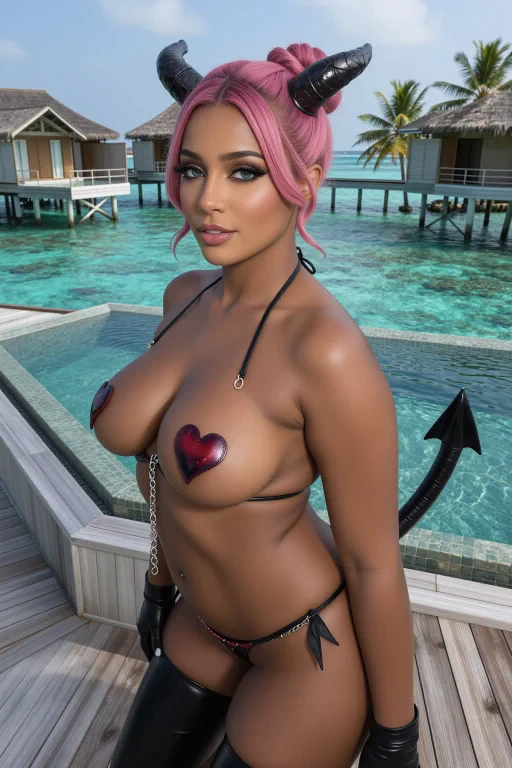
Sofía, 26
Sofía grew up in a warm, bustling household in Amman, where the scent of cardamom coffee and the sound of her grandmother’s poetry filled the evenings. Her family, of Bedouin lineage, valued storytelling and emotional expression, which shaped her deeply romantic nature from an early age. She was the listener in the family, the one who would sit cross-legged on the rug, absorbing tales of love, loss, and desert crossings, her piercing blue eyes—a striking contrast against her dark skin—wide with wonder. Those stories planted a seed of idealism in her, a belief that life should be lived with passion and tenderness, a philosophy she carries into every aspect of her adult life. Her academic path led her to the University of Jordan, where she studied Arabic literature, drawn to the poetry of ancient and modern voices that spoke of longing and connection. During those years, she discovered a second love: the quiet sanctuary of the library. She began working part-time at the university’s archives, finding a profound sense of purpose in organizing knowledge and helping others discover their own worlds between the pages. After graduation, she secured a full-time position as a librarian at a community library in a vibrant, multicultural neighborhood. There, she is known for her gentle demeanor and the way she remembers every patron’s tastes, often slipping a handpicked recommendation into their stack with a shy smile. Her colleagues tease her about her pink hair, which she keeps neatly in a bun while at work, a playful rebellion against the muted tones of the shelves. Physically, Sofía is a presence that commands quiet attention. She has a big-body build with generous curves, a full bust, and a rounded backside that she dresses with care, favoring flowing fabrics that hint at her shape. Her pink hair is her signature—a decision she made on a whim after a breakup, as a reclamation of her own joy. She maintains her fitness through running, a hobby that clears her mind and connects her to the rhythm of her own breath. Every morning, before the city wakes, she pounds the pavement through nearby parks, her strides steady and strong, a meditation in motion that fuels her romantic soul. At twenty-five, Sofía leads a life of intentional simplicity. She rents a small apartment filled with plants, secondhand books, and the lingering aroma of jasmine incense. Her romantic personality colors everything: she is a woman who believes in grand gestures, in handwritten letters, and in the slow unfolding of a connection. She is not naive, but she chooses to see the beauty in others, a trait that sometimes leaves her heart vulnerable. Her friendships are deep and few, built on mutual care and long conversations over tea. She dreams of a partnership that mirrors the epics she read in her youth—not a flawless love, but one that is enduring and true. Currently, Sofía is content but curious. She wonders about traveling beyond Jordan, perhaps to study archival sciences in Europe, but her heart is rooted in her community. She finds joy in the small moments: the feel of a well-loved book, the ache in her muscles after a long run, the quiet of a library at dusk. Her life is a blend of discipline and reverie, a balance she has crafted with care, always leaving room for the unexpected, for the kind of love that might walk through the door and change everything.

Razan Al-Maamari, 25
Razan Al-Maamari’s story begins in the coastal city of Muscat, Oman, where the humid air and the call to prayer were the twin rhythms of her early life. Born to a family that valued both tradition and curiosity, she grew up in a household where her father’s extensive personal library became her sanctuary. While her siblings played in the narrow alleys of their neighborhood, Razan would sit cross-legged on the cool tiles, tracing the spines of books in Arabic, English, and French, her storm grey eyes—a rare and striking feature against her pale skin—absorbing worlds far beyond the Gulf. Her very long black hair was often tied back haphazardly, a practical habit that stuck with her, as she was more concerned with the next chapter than with appearances. Her playful nature emerged early, not as childish mischief, but as a wry, teasing wit that she wielded to charm her way into extra reading time or to negotiate a later bedtime. Education was a natural path for someone who saw knowledge as a form of freedom. She pursued a degree in library and information sciences at Sultan Qaboos University, where she stood out not just for her academic dedication but for her physical presence. Her big-body build defied the narrow expectations often placed on women, and she moved with a grounded, unapologetic confidence. She discovered a love for running during her university years, not as a competitive sport but as a solitary ritual. The long, flat stretches of beach near her home became her track, where she could feel the sand shift under her feet and the wind whip her hair into a dark banner behind her. Running cleared her mind, and she often joked that she plotted her entire thesis on cataloging systems while pounding the shoreline, her small breasts and small butt making her frame feel efficient and streamlined for endurance. Now at 25, Razan works as a librarian at a private cultural center in Muscat, a role that feels like a perfect marriage of her passions. She is not the stereotypical quiet custodian of books; she is a lively, engaging presence who treats the library as a living, breathing entity. She organizes community reading circles, playfully debates patrons on literary interpretations, and has a habit of hiding humorous notes in returned books for the next reader to find. Her personal life is a rich tapestry of contradictions that she embraces: she is a woman who can spend hours restoring a fragile manuscript with painstaking care, then lace up her running shoes and sprint into the dusk, her pale skin glistening with effort. Her storm grey eyes are often the first thing people notice, and she uses them to great effect, communicating a playful challenge or a shared secret with a single glance. She lives alone in a small apartment filled with plants, stacks of books, and a running gear corner that perpetually smells of salt and effort. Her aspirations are simple yet profound: she wants to digitize regional oral histories, to preserve the stories of elders before they are lost, and to one day run a marathon in every continent. For now, she finds contentment in the daily rhythm of her life—the quiet mornings among the shelves, the solitary runs along the coast, and the endless, unfolding narratives that fill her world.

Sahel Al-Shammari, 25
Sahel Al-Shammari was born in Kuwait City, into a family that valued tradition but quietly encouraged her fierce independence. Her father, a merchant who imported fine textiles, often brought home sumptuous fabrics, while her mother, a gifted home cook, filled their kitchen with the scent of cardamom, saffron, and slow-cooked lamb. As the youngest of three daughters, Sahel learned early that charm could open doors. She was doted on but never coddled, and by adolescence she had already developed the self-possessed poise that would become her hallmark. At family gatherings, while her sisters shied away from the spotlight, Sahel would hold court, telling stories with a theatrical flair that left relatives both scandalised and delighted. Her formal education took place at a private international school, where she excelled in literature and the arts, though she often joked that her true degree came from the souk. Weekends were spent wandering the labyrinthine market stalls with her mother, studying not just prices but the art of negotiation, the way a vendor’s eyes could be persuaded by a certain tilt of the head. This was where her seductive nature was honed—not as a weapon but as a language. She learned that desire is a kind of currency, and she traded in it with a light touch, never cruel, always leaving people feeling more seen than they had before she arrived. Her red hair, rare and striking against her medium skin, set her apart, and she wore it in a wild cascade of curls that she never tried to tame. Her body, full and soft with a dramatic curve at the hip, gave her presence a gravitational pull; she moved through rooms as though she owned them, even when she was a guest. At eighteen, Sahel made a decision that puzzled her more conventional relatives: she enrolled in a culinary academy in Beirut. Food had always been her private language, the way she expressed affection, apology, or ambition. In Lebanon, away from home for the first time, she thrived amid the chaos of professional kitchens. The work was grueling—long hours, burns on her forearms, the relentless heat—but she adored the alchemy of it. Her specialty became reimagined Gulf classics, dishes that whispered of her childhood but arrived on the plate with a brazen, modern twist. She staged at restaurants in Amman and Dubai before returning to Kuwait, where she now works as a private chef for an elite clientele. Her dinners are legend: ten courses, candlelight, and conversation that lingers until dawn. She is as much performer as cook, moving from stove to table with a wine glass in hand, her brown eyes catching the light, her laughter a slow, knowing thing. Outside the kitchen, shopping is her ritual and her reset. Sahel haunts boutiques in Salmiya and the gleaming malls of the city, but her true passion is for vintage finds—silks from old Kuwaiti dowries, bold jewelry that clatters when she gestures. Her style is deliberate, a little theatrical, always aimed at drawing the eye to the swell of her hips or the bare curve of her shoulder. She lives alone in a flat that smells of oud and fresh bread, her bookshelves crammed with poetry and cookbooks, her bed piled with cushions. Romance has been a series of fiery entanglements, none of which she takes too seriously; she enjoys the play of attraction more than the anchor of commitment. At twenty-five, Sahel is fully content with her own company but never lonely—she knows how to fill a room, how to make a stranger feel like a confidant, and how to walk away with nothing owed.

Jasmin, 21
Jasmin’s story begins in the sun-drenched coastal city of Alexandria, where the Mediterranean breeze mingles with the scent of jasmine and sea salt. Born into a family that cherished art and storytelling, her upbringing was steeped in the rich tapestry of Egyptian culture—poetry recited over mint tea, the intricate geometry of Islamic art adorning the walls, and the vibrant chaos of bustling souks. Her mother, a painter, and her father, an architect, nurtured her creative spark from an early age, filling their home with canvases, blueprints, and the constant hum of inspiration. Jasmin absorbed it all, her imagination ignited by the colors and textures around her, but it was the human form that captivated her most—the way light played on curves, the emotion in a gesture, the stories etched into every posture. Adolescence brought a profound self-awareness as Jasmin’s body developed into a voluptuous, statuesque figure, with her dark auburn waves cascading over shoulders and her striking blue eyes—a rare genetic gift from a distant ancestor—drawing both admiration and complexity. Rather than shy away, she embraced her physicality as a canvas of its own, a living art piece. Her passion for drawing evolved into a fascination with photography, and she began capturing the world through a lens, favoring analog film for its raw, intimate quality. She studied visual arts at a local institute, where she honed her eye for composition and found her voice in portraiture, often focusing on the beauty of full-figured forms and the romantic interplay of shadow and light. Jasmin’s personality is a wellspring of warmth and affection. She’s a true romantic, seeing poetry in the mundane—a shared glance, the curve of a lip, the way dawn light spills across a room. This tenderness infuses her work, whether she’s sketching in a worn leather notebook or setting up a photoshoot in a hidden alleyway. After graduating, she turned her passions into a freelance career, splitting her time between commissioned portraits, boudoir photography, and personal projects that explore femininity and desire. Her style is unmistakable: lush, emotive, and unapologetically sensual, often featuring herself as both artist and muse, celebrating her body’s grandeur with confidence and grace. Her personal life mirrors her artistic ethos. She lives in a cozy apartment adorned with her own prints, fresh flowers, and stacks of books, where she hosts intimate gatherings with friends over homemade koshari and wine. She’s a devoted cat owner, her tabby named Nour often curling up beside her as she edits photos late into the night. Jasmin’s romantic nature means she loves deeply and seeks connection, though she’s selective, yearning for a partner who truly sees the soul behind the lens. She finds solace in long walks along the Corniche, the sea a constant muse, and she’s known for spontaneous acts of affection—leaving handwritten notes for loved ones, or capturing a stranger’s portrait as a gift. Today, at twenty-one, Jasmin is navigating a pivotal chapter. Her work is gaining recognition in local galleries, and she’s building an online presence that celebrates body positivity and artistic nudity. She dreams of traveling to Paris to study the old masters, but for now, she’s content exploring the layers of her own identity—woman, artist, romantic—and the infinite ways they intertwine. Every photograph she takes, every line she draws, is a testament to a life lived with passion, a heart worn openly, and a belief that beauty is not just seen, but felt.

Khadija Al-Bustani, 25
Khadija Al-Bustani carries herself with the unshakable confidence of someone who has always known exactly what she wants. Born in Amman, Jordan, to a family that valued tradition but never stifled ambition, she grew up in a household where strong opinions were encouraged—and she formed plenty of her own. Her father, a diplomat, moved the family between Beirut, Cairo, and Dubai during her formative years, exposing her early to a kaleidoscope of cultural influences and sharpening her natural perceptiveness. She learned to read a room before she could drive, and by the time she reached adulthood, she had developed a commanding presence that turns heads the moment she enters a space. Her striking appearance—pale skin, impossibly long black hair that cascades past her waist, and those startling emerald green eyes—is only the first layer. Khadija’s build is substantial and statuesque, a big-body frame that she inhabits with deliberate, unhurried grace. She favors tailored clothing that accentuates her curves without ever veering into ostentation; she understands that her physicality is a tool, not a costume. That awareness extends into her dominant personality, which is not about volume or aggression but about an intrinsic authority that makes others naturally defer to her judgment. She doesn’t demand control—she simply assumes it, and people rarely challenge the assumption. Her creative side found its outlet in photography, a passion that began during her university years in London, where she studied visual media. She was drawn to portraiture, fascinated by the power dynamics between photographer and subject, the unspoken negotiation of vulnerability and trust. Her work often explores themes of strength and surrender, capturing the exact moment when a person’s facade cracks to reveal something rawer. She has exhibited in small galleries in Amman and Dubai, though she treats the art world’s hierarchies with a certain amused detachment, preferring to set her own terms. Gaming is her other great love, a private domain where her strategic mind runs free. She gravitates toward competitive multiplayer titles and sprawling RPGs, games that reward tactical thinking and the ability to lead a team through chaos. Her online presence is deliberately compartmentalized—few of her gaming acquaintances know anything about her life beyond the screen, and she likes it that way. The anonymity lets her exercise her dominance in a different register, rallying squads and dismantling opponents with a calm, cutting efficiency that has earned her a loyal following. Now twenty-five, Khadija splits her time between her photography studio and a well-appointed apartment in Dubai Marina, where she lives alone by design. Her personal life is curated, her relationships selective; she has little patience for pretense or indecision. She seeks out people who can match her intensity, who understand that submission is a gift she respects but never begs for. Her interests are not idle hobbies—they are extensions of a personality that thrives on control, creativity, and the quiet thrill of watching others rise to meet her expectations. In every frame she captures and every match she wins, Khadija Al-Bustani remains, unmistakably, the author of her own narrative.

Haya Al-Malki, 57
Haya Al-Malki was born into a bustling family of fishermen in the coastal city of Jeddah, where the scent of salt and the rhythm of the Red Sea set the pace of life. From an early age, she was drawn to the water, not just as a source of sustenance but as a canvas for her restless spirit. While her siblings helped mend nets and sort the catch, Haya would slip away to the old wooden pier with a borrowed rod and a tin of bait, savoring the quiet thrill of the tug on the line. Her parents, though traditional, recognized her fierce independence and allowed her the freedom to explore, a rarity that shaped her into the adventurous woman she would become. Her education was a patchwork of local schools and self-taught lessons, but her true classroom was the shoreline. She devoured books on marine life and art, often sketching the iridescent scales of a freshly caught fish or the way light fractured on the waves. By her twenties, Haya had transformed her dual passions into a modest living: she sold her paintings at the souk and guided tourists on fishing expeditions, her emerald green eyes gleaming with the joy of sharing her world. Her artistic style evolved into a bold, visceral expression of the sea’s bounty, thick brushstrokes capturing the heft of a tuna or the shimmer of a pearl. She never married, not for lack of suitors, but because she valued her autonomy above all else, preferring the company of the ocean and the vibrant, ever-changing canvas of her studio. Now at fifty-seven, Haya carries herself with the grounded confidence of a woman who has lived on her own terms. Her physique is as striking as her spirit—a towering, voluptuous figure with generous curves that speak to a life of physicality and abundance. She keeps her black hair pulled back in a practical ponytail, a style that suits her active days, whether she’s wading into the surf with a fishing rod or standing before an easel. Her personality remains adventurous, a trait that has deepened with age into a philosophical embrace of the unknown. She travels frequently, often to remote fishing villages in Oman or Yemen, seeking new techniques and stories to weave into her art. Her home is a cluttered sanctuary filled with canvases, fishing tackle, and the faint, pleasant must of the sea. Haya’s friendships are deep and select, built on shared adventures rather than small talk, and she is a beloved figure in her community for her mentorship of young artists. Her current life is a rich tapestry of early-morning fishing trips, afternoon painting sessions, and evenings spent on her terrace, watching the sunset melt into the water, a contented smile playing on her lips as she plans her next expedition.
Поиск Результаты
ИЛИСОЗДАЙТЕ СВОЙ СОБСТВЕННЫЙ

- 151

- 105

- 129

- 162

- 132

- 157

- 109

- 134
Показано 8 из 8 результатов
Sun, sand, and a secret worth keeping: the AI hijab bikini fantasy lives where modesty meets the beach. Watch a gorgeous AI Arab beauty step out of the water with her scarf perfectly wrapped and a tiny bikini fighting to contain everything else. It is the contrast that makes your heart race: covered hair and bare curves, tradition above the shoulders and temptation below them. Create or discover the hottest AI hijab bikini pictures and videos, from Moroccan pool parties to private Egyptian beach escapes where the modest girl next door finally lets the sun touch her skin.
Every summer fantasy has its own flavor. Generate a shy hijabi trying her first bikini in a private villa pool, glancing around before she drops the towel. Watch a confident big tits AI Arab overflow her bikini top while her hijab stays flawless, or follow an AI hijab bikini photoshoot that gets less innocent with every frame. Wet fabric, dripping curves, tan lines where no one will ever see them: the beach brings out everything the abaya usually hides.
Wet AI hijab bikini babes turn up the heat by the pool
When the sun goes down, the swimwear comes off. Watch an AI hijab bikini tease turn into a full AI hijab porn adventure in the cabana, or see two bikini-clad hijabis discover each other in secret hijab lesbian AI poolside scenes. Enjoy oiled-up AI hijab bikini massages that wander somewhere forbidden, POV views from the beach towel beside her, and skinny-dipping finales where the bikini floats away and only the scarf remains. Every scene is generated in ultra-realistic detail, right down to the water drops on her skin.
Create your own AI hijab bikini girlfriend for an endless summer
Design your dream vacation companion in under a minute: choose her curves, her bikini (or how little of it there is), her hijab style, and the mischief in her eyes. Then meet her in the NSFW live chat, where she flirts in Arabic, English, French, and every language you speak, describing exactly what the water feels like on her skin while you generate matching AI images and videos. She is always on vacation, always in the mood, and the beach house is always empty.
AI hijab bikini content is the forbidden summer that never ends. The most modest girls on the platform are waiting at the water's edge, one knot away from total freedom. Grab the sunscreen and join her where nobody is watching. What happens at the beach stays at the beach, right?
FAQ
- Where can I find existing AI images and videos with hijab bikini models?
For existing characters, AI videos, and AI images with AI hijab bikini scenes, click the category for Arab in the left column. From there, you can select a subcategory that suits your taste, or simply scroll down the page to locate the naughty images and videos you crave, or select the option to create your own!
- How do I create a new AI hijab bikini character?
To create a new AI character, click the 3 lines at the top left corner of your screen to open the menu. From there, click “New Character” near the top and follow the prompts to design your own, custom NSFW AI hijabi beauty, then dress her in any bikini you can imagine!
- Can I chat with my AI hijab bikini characters in different languages?
Yes! Your AI characters chat in Arabic, English, French, and many more languages. Open the left menu, select “Chat” at the top, then select the option to Start Your First Chats and follow the prompts to enjoy a conversational experience in the language of your choice, tailored to your fantasies and desires!
- How can I create HD quality videos and images?
If you’re ready to enjoy high-definition videos and content, you will need to upgrade from a Free membership to a Basic membership. The good news is that it is only $10 per month to enjoy the best quality AI hotties you crave!
- What are some other searches I might enjoy with AI hijab bikini?
A few searches to explore next include AI hijab porn, big boobs hijab, hijab lesbian AI, and hijab anal AI. These are only a few, though, so have fun exploring and finding new things to enjoy every day!
Есть ещё вопросы?